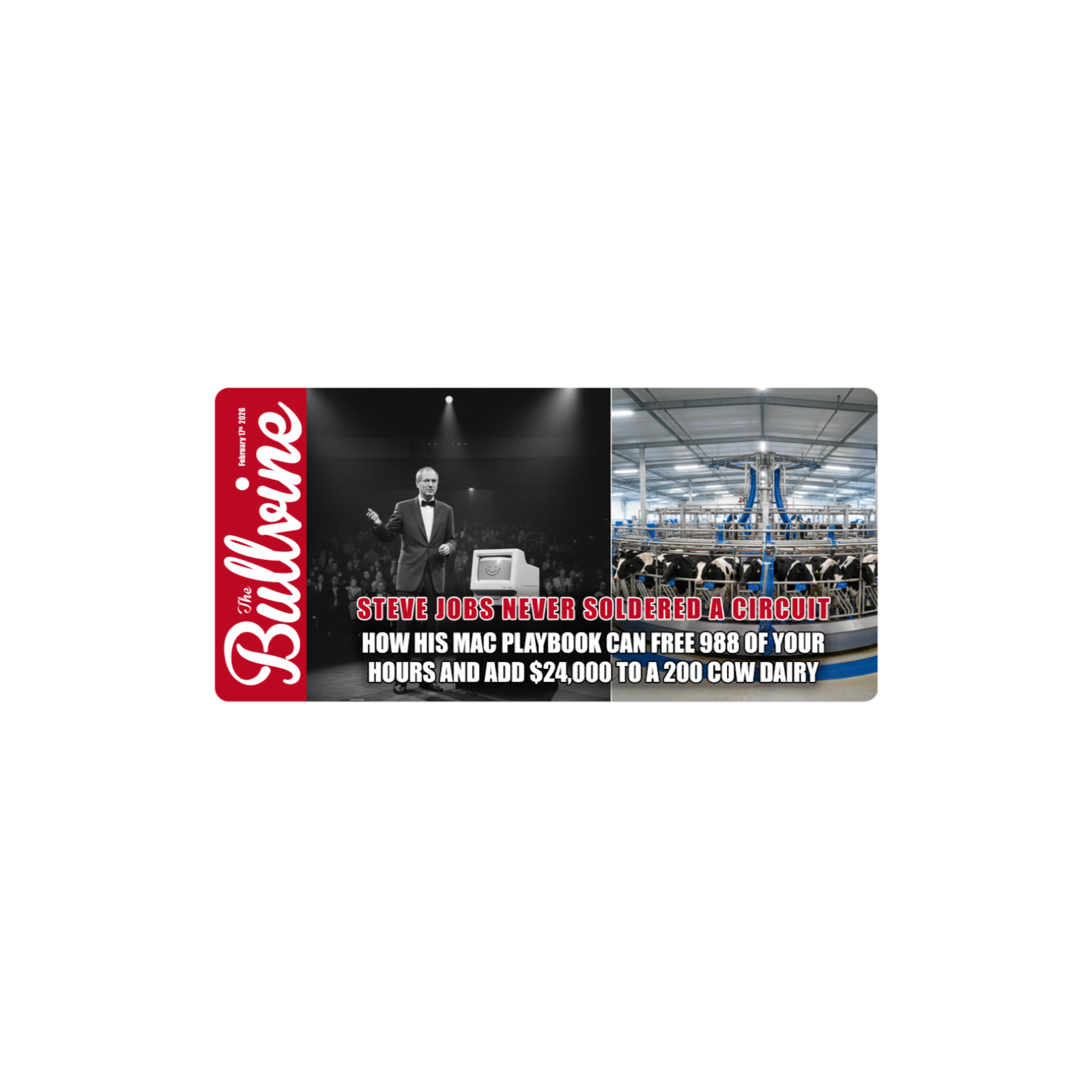
E492 Steve Jobs Never Soldered a Circuit: How His Mac Playbook Can Free 988 of Your Hours and Add $24,000 to a 200‑Cow Dairy
The most profitable dairy farms don't have cheaper labor. They have better systems. Cornell's 2024 Dairy Farm Business Summary revealed something that should stop every herd owner mid-stride: top-quartile and bottom-quartile farms pay their workers roughly the same — about $60,000 per year. The difference? Top farms extract 1.7 million pounds of milk per worker. Bottom farms: 1.2 million. Same cost. Forty percent more output. This episode breaks down exactly why — and what Steve Jobs has to do with your pregnancy rate.
In this episode, you'll learn:
- Why the owner who milks every shift is the single biggest bottleneck on most dairies under 500 cows — and the math that proves it
- How Teagasc data shows 19 hours per week separating top and bottom quartile dairies on nearly identical herd sizes (112 vs. 113 cows)
- The "Milker Trap" — and Dr. John Fetrow's reproductive economics showing a 6-point pregnancy rate gap costs $24,000/year on a 200-cow herd
- What a 606-cow operation in North Devon, England did to hit a 25% pregnancy rate — top 5% nationally — with just two people running the rotary
- Why buying a robot without building protocols first means you've purchased a guilt machine, not technology
- The Steve Jobs principle applied to dairy: why designing the system always beats being the hardest worker inside it
- A 4-step framework to transition from grinding to designing — starting with a 30-day test any herd can run this month
Most dairy management advice tells you to work smarter. This episode tells you to work on a fundamentally different job. The data is clear: Cornell, Teagasc Moorepark, and the University of Minnesota all point to the same conclusion — the gap between top and bottom performers isn't genetics, facilities, or labor cost. It's how the owner spends their hours.
We walk through the real-world case of Wayside Dairy in Wisconsin, where 17 years of protocol building and team development took pregnancy rates from 18% to 33% before a single sensor was ever installed. CowManager ear tags caught the last five points to 38%. The foundation came first. The tech amplified it.
Ten years from now, the herds still standing will be owned by designers — not the "hired milker in chief." This episode helps you figure out which one you're training to be.
Visit https://www.thebullvine.com/management/steve-jobs-never-soldered-a-circuit-how-his-mac-playbook-can-free-988-of-your-hours-and-add-24000-to-a-200%e2%80%91cow-dairy/ for the complete article with all the Cornell data, the Wayside Dairy case study, and the 4-step playbook. Subscribe to The Bullvine Podcast wherever you listen so you never miss an episode. And if this one made you rethink how you spend your hours — share it with a fellow producer who needs to hear it.
Join the conversation on Facebook and tell us: what's the one task you know you should hand off but can't bring yourself to let go of?
That clocks in at just under 3,900 characters, leaving a small buffer for any link formatting Apple Podcasts might require. The structure follows a hook → bullet takeaways → deeper context → CTA flow that Apple Podcasts listeners expect, while keeping every claim grounded in the specific data from the article — Cornell DFBS, Teagasc, and Fetrow's reproductive economics.
You May Also Like

SignalsAZ.com Prescott News Podcast
Talking Glass Media, LLC
The Bulwark Podcast
The Bulwark

RDN Radio – Roma Daily News
Radio RDN - RomaDailyNews
Unholy: Two Jews on the News
Unholy Media
The Adam Mockler Show
The Adam Mockler Show
Jeffrey Epstein: The Coverup Chronicles
Bobby Capucci

The Richie Allen Show
The Richie Allen Show
The Megyn Kelly Show
SiriusXM
The Alex Marlow Show
The Alex Marlow Show

Real America’s Voice
Real America's Voice
SignalsAZ.com Prescott News Podcast
Talking Glass Media, LLC
The Bulwark Podcast
The Bulwark
RDN Radio – Roma Daily News
Radio RDN - RomaDailyNews
Unholy: Two Jews on the News
Unholy Media
The Adam Mockler Show
The Adam Mockler Show
Jeffrey Epstein: The Coverup Chronicles
Bobby Capucci
The Richie Allen Show
The Richie Allen Show
The Megyn Kelly Show
SiriusXM
The Alex Marlow Show
The Alex Marlow Show
Real America’s Voice
Real America's Voice
Community discussion