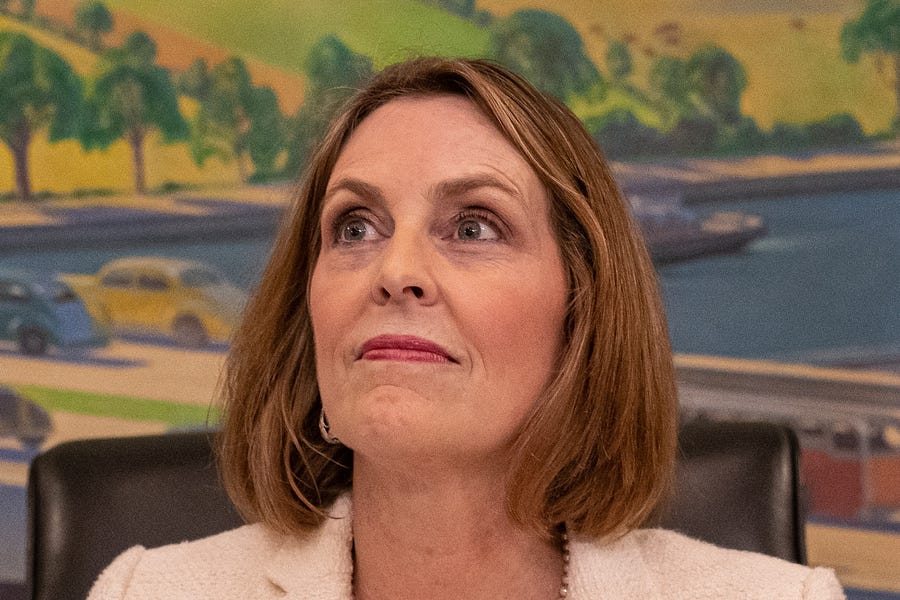
Reflecting on the work of the soon-to-retire House climate committee
In this episode, Florida Rep. Kathy Castor, chair of the House Select Committee on the Climate Crisis, describes the committee’s ambitious goals and notable achievements over the past three years.
Text transcript:
David Roberts
In 2019, in the wake of Democrats’ congressional victories, House Speaker Nancy Pelosi announced that she would be re-forming the Select Committee on the Climate Crisis, which had been disbanded by Republicans in the previous session. She appointed Florida Representative Kathy Castor as chair.
At the time, the decision caused considerable controversy in the climate community. Climate activists were pushing for a more ambitious committee, with the power to write a full Green New Deal legislative package. Instead, the committee was to be an advisory body only, meant to do research and develop policy suggestions.
History is littered with congressional committees that busily produce reports and whitepapers that no one reads. But the climate committee proved much more potent than that.
Castor set about gathering testimony from hundreds of witnesses — scientists, policy wonks, and average citizens alike — and putting her expert staff to work translating their testimony into policy recommendations. But the recommendations did not simply decorate reports. The Democrats on the committee, and the Democrats educated by the committee's work, took those recommendations back to their own committees, where they found their way into a wide variety of bills. The bipartisan infrastructure bill, the CHIPS Act, and the Inflation Reduction Act contained numerous policies that originated in the climate committee.
Altogether, hundreds of the recommendations made by the committee found their way into law — a crazy-high success rate for a committee with no real power. As the committee prepares to sunset — of course Republicans are disbanding it again — it has put out a final report, summarizing all its achievements and pointing to the work that remains to be done.
I called Rep. Castor to get her thoughts on the committee's work, the achievements she is most proud of, and what progress she thinks can be made in the next two years.
Alright, then. With no further ado, Representative Kathy Castor. Welcome to Volts. Thank you so much for coming.
Rep. Kathy Castor
Oh, I'm delighted to be here, David. Thank you.
David Roberts
So just to start off, I'm assuming that the coming Republican majority is going to shut down the committee. Has this been explicitly stated yet, or is this just ... are we all assuming? Is that a valid assumption?
Rep. Kathy Castor
Yeah, the ranking member, Garret Graves of Louisiana, did kind of spill the beans. The problem is, on the Republican side, the Speaker-to-be, Kevin McCarthy, does not quite have the votes yet. So that leaves everything in limbo getting organized for the new year. But, they've made it plain that the climate crisis is not a priority for them, and therefore the Select Committee on the Climate Crisis will not exist in the next Congress.
David Roberts
So then it's been wrapped up. It's been a whirlwind three years, I guess, since you were placed in charge of this committee. Have you had a chance to kind of pause and step back and think about it all, or are you still kind of in a sprint til' the end of the term?
Rep. Kathy Castor
It has been a sprint right til' the end, especially since the large appropriations package and the defense bill were not completed due to really foot-dragging of the US Senate. We have so much more left to do. I mean, we are thrilled that this was the most important Congress when it comes to clean energy and climate action and building more resilient, safer communities across the country. I mean, this was the Congress, the one that people inside and outside have been pressing for decades, frankly. But there's still so much more left to do. We're living in a climate emergency, and the world's top scientists tell us it is just urgent that we reduce climate pollution across the board. And now we have the tool. We passed a number of the tools, but implementation will be key, and that's what we're looking ahead towards.
David Roberts
I wanted to ask you, looking back on it, if you can cast your mind back to 2019, when you became chair and you had a majority in the House, but very narrow-split Senate, looking back, were you surprised by the productivity of this Congress? How did it perform, relative to your expectations from back in 2019?
Rep. Kathy Castor
Gosh, it was yes, I think the the fact that we were able to accomplish so much when the United States Senate was divided 50-50 truly exceeded our expectations, but we really didn't have a choice. Policy could not wait any longer, while so many private actors, private sector, clean energy entrepreneurs, some utilities, some states and local communities are going gangbusters. The federal government and the Congress had not responded. So the stars finally aligned when we kind of knitted together pieces of the climate movement across the country, across the economy, and had the plan ready when President Biden was elected. But a 50-50 Senate, that was a roadblock. But looking back now, it's pretty impressive. The bipartisan bills that we were able to pass into law.
David Roberts
Yeah, my expectations are so low, naturally, that I was quite pleasantly surprised. So let's talk about a little bit about what I think is one of the most striking features of this last few years, which has been a crazy time. But I wrote a piece back in, I think it was 2019 or 2020, about the climate movement kind of splintered apart after Waxman-Markey back in 2008, 2009, and was kind of just fractured and drifting up through, I would say probably like 2018. And then, of course, I've been writing about these processes, whereby groups are talking to one another, and there's been just this intensive policy discussion and activity.
And the left seem to sort of pull together around a policy vision, which I sort of characterized as standards, investments, and justice: SIJ. I tried to get SIJ to catch on, but it never quite did. But then your committee comes along, you consult with hundreds of people. You get testimony from hundreds of people. And that's kind of that shared vision is more or less what you came around to. And for all the chaos of the ensuing years and all the sort of ups and downs and roller coaster of it, there was remarkably little, I thought, conflict within the Democratic Party or within the left about policy specifics.
There seemed to be a weird sort of policy consensus that kind of held firm. Did that strike you too, especially relative to like, 2008, 2009, when, you know, whether you supported cap and trade or not was this, you know, this absolute marker of your purity or your intentions and all this, you know, all the very vicious policy fights back then? I thought there was a strange amount of consensus around policy this time around. Did you find that as well?
Rep. Kathy Castor
I'm glad that we made it look easy, because it wasn't. And it really started with Speaker Pelosi's vision coming back in tackling the climate crisis, there's nothing like having a professional committee, staff of ex
You May Also Like
The Dominic Carter Show
Podcast WABCRadio

Die Nachrichten
Deutschlandfunk

Čteme vám Seznam Zprávy
Seznam Zprávy

O Antagonista
O Antagonista

NPR News Now
NPR

The Diddy Diaries
Bobby Capucci
Newshour
BBC World Service

Real America’s Voice
Real America's Voice

CNN 5 Cosas
CNN en Español

True Crime Today | Daily True Crime News & Interviews
Real Story Media
The Dominic Carter Show
Podcast WABCRadio
Die Nachrichten
Deutschlandfunk
Čteme vám Seznam Zprávy
Seznam Zprávy
O Antagonista
O Antagonista
NPR News Now
NPR
The Diddy Diaries
Bobby Capucci
Newshour
BBC World Service
Real America’s Voice
Real America's Voice
CNN 5 Cosas
CNN en Español
True Crime Today | Daily True Crime News & Interviews
Real Story Media
Community discussion