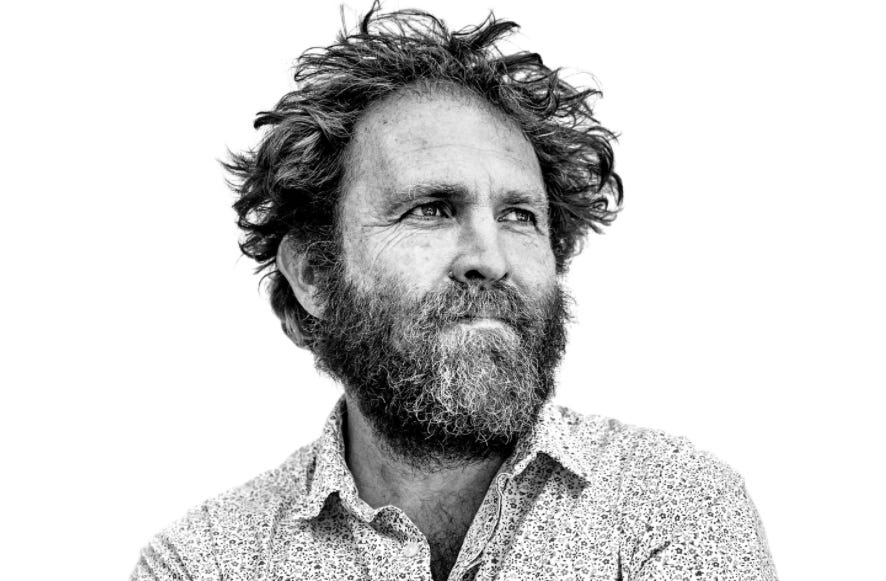
A conversation with Saul Griffith
In this episode, Saul Griffith — co-founder of Rewiring America and, more recently, Rewiring Australia — chats about all the things that energy nerds love to chat about.
Text transcript:
David Roberts
If you are a Volts subscriber, you are almost certainly familiar with Saul Griffith. I've been following him and his work for years, and I think I can say without hyperbole that he is the smartest person I have ever met.
An Australian by birth and an MIT PhD by training, he got his start as a tinkerer, inventor, and entrepreneur, responsible for, among other things, the kite-based wind power company Makani and the innovation incubator Otherlab.
A few years ago, alarmed by the lack of progress on climate change, he turned his attention to public advocacy, authoring the book Electrify and co-founding Rewiring America. That organization has, in relatively little time, become incredibly influential among US thought leaders and policy makers. It played a key role in the passage of the Inflation Reduction Act.
In 2021, Griffith and his family moved back to Australia, where he helped found Rewiring Australia, and sure enough, it has already become as or more influential than its American counterpart. As Volties know, I am currently down in Australia. I was scheduled to do a public event with Griffith, so I thought it would be fun to meet up a little beforehand to record a pod.
Neither of us had particularly prepared for said pod, but it will not surprise you to hear that Griffith was nonetheless as fascinating and articulate as always, on subjects ranging from IRA to Australian rooftop solar to green steel. Enjoy.
I won't belabor any further introductions. Saul, thanks for coming.
Saul Griffith
Thanks for joining me in a strange little kissing booth in Sydney's central business district.
David Roberts
Yes, we are. This is the second ever Volts recorded in person. And just so the audience knows, this came together at the last minute and neither of us have prepared at all. So we're all just freestyling here and we're just going to have a conversation. So, Saul, let's start with you were intimately involved in the sausage making of IRA. Why don't you just start with telling us a little bit about how on earth someone like you ended up in the halls of DC with the ear of lawmakers. What's the origin story of this?
Saul Griffith
The romantic origin story is just before I married my wife and I think it was 2007, I said, if the world hasn't made sufficient progress on climate change by 2020, can I become an ecoterrorist? To which, it was so far in the future, she said yes.
David Roberts
Surely, well, by then, surely.
Saul Griffith
And then 2019 came around and I said, remember that you made that promise to me. And she said, yes, but we didn't have two children, so you're not allowed to do that. And she sort of actually first planted the idea in my head. You're always complaining that the hardest thing to do in energy technology is the regulatory stack. So why don't you focus on regulatory and policy for a while? I give you leave. We can afford it. See what you can do. Right about then, I was having another conversation with a guy called Alex Laskey. He was a founder of Opower.
He wanted to talk to me about heat pumps. We were working on some new heat pump technologies and the conversation spiraled out of control and we said, well, working on heat pumps is good, but these Democrats keep saying climate change. So this is in the primaries. Every time any of them say climate change, they wince a little bit and try to shy away from what you would do. So we started Rewiring America. We booked a few tickets to DC, we took a few trips to DC and we thought that we were going to be an advocacy organization, trying to help Democrats talk positively about what the energy transition could be, how we could save money, how our health outcomes could improve, how we could change local community economics.
So we were trundling along with that effort, working with all of the presidential candidates at the time, and I can retroactively say I loved them all exactly equally.
David Roberts
Didn't you love Jay Inslee just a slight bit more, though?
Saul Griffith
Understanding where you're from, I know why you say that. And I did love Jay Inslee just a little bit more and just a little bit more than Jay Inslee I also loved Elizabeth Warren.
David Roberts
Yes, RIP, I know she's still alive.
Saul Griffith
I'm sure she's, well, maybe not politically.
David Roberts
But RIP to her.
Saul Griffith
I have a habit of judging people by their staff and it was so obvious to me that her staff loved her and believed in the mission and it was extraordinary to behold. So we were doing that and then the election was won and it became — we'd hired, Alex and I are probably both ADHD to an extreme, so we hired a competent adult to run the organization Rewiring America, a guy called Ari Matusiak. He'd actually worked in the White House under Biden, worked on similarly complex legislation, the American Healthcare Act. So we knew a bunch of people on the climate team going in and we were worried, so we went to talk because really what we wanted to prosecute was the case for — electrification of everything is really the only pathway to eliminate the majority emissions and secondly, that any spending should equally or even maybe bias more a focus on the demand side.
And what I mean by the demand side, the places where we use energy. So households, small businesses. Part of that was because there was still the idea that you just decarbonize the grid and they were thinking about clean electrification standards. But if you just do that, you don't also electrify the cars and electrify the homes and eliminate all their stuff. So I was worried that we were going to have insufficient climate policy because of that. So we did a lot of work working on the demand side. The early days, we didn't know whether the Democrats were going to take on the filibuster and whether they were going to go big, so they're — sigh yes.
So there was three or four or five months where we thought there was going to be regulation and legislation and I think people were thinking about regulating and legislating the grid and electrification grid. When that fell through, let's say that ears were a lot more receptive to what we were trying to propose, which was this demand side electrification. We got extremely lucky a few times he's told this story himself, so hopefully I'm not speaking out of school, but Senator Martin Heinrich of New Mexico, his dad was a lineman, so familiar with electricity, the only senator with an engineering training. He had heard not to belittle your podcast, but he had heard another fabulous podcast with me and Ezra Klein when he was driving across the country with COVID and he cold emailed us at Rewiring America, and we actual
You May Also Like
The Dominic Carter Show
Podcast WABCRadio

Die Nachrichten
Deutschlandfunk

Čteme vám Seznam Zprávy
Seznam Zprávy

O Antagonista
O Antagonista

NPR News Now
NPR

The Diddy Diaries
Bobby Capucci
Newshour
BBC World Service

Real America’s Voice
Real America's Voice

CNN 5 Cosas
CNN en Español

The Fox News Rundown
FOX News Radio
The Dominic Carter Show
Podcast WABCRadio
Die Nachrichten
Deutschlandfunk
Čteme vám Seznam Zprávy
Seznam Zprávy
O Antagonista
O Antagonista
NPR News Now
NPR
The Diddy Diaries
Bobby Capucci
Newshour
BBC World Service
Real America’s Voice
Real America's Voice
CNN 5 Cosas
CNN en Español
The Fox News Rundown
FOX News Radio
Community discussion