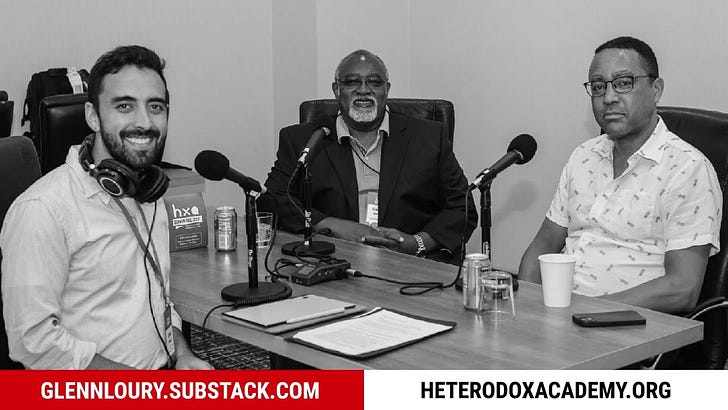
Bonus Episode: Glenn and John at Heterodox Academy
Last month, John McWhorter and I participated in Heterodox Academy’s 2022 conference in Denver, Colorado. We spoke in front of an audience and discussed how to model constructive disagreement. But before that, we had a bit of a warm-up session with Zach Rausch, host of the Heterodox Out Loud podcast. Zach had us in to talk about our long relationship as conversation partners, civil discourse, and the purpose of the university. Newer listeners may be interested to hear about my “origin story” with John. While we’re good friends now, that wasn’t always the case. We’ve had our ups and downs, and we’ve switched sides on some issues. (Here’s our first recorded conversation, from November 2007.) But we keep coming back because we enjoy talking to each other too much to quit, and because we believe if we don’t have the kind of conversations we have, they might not happen at all.
This post is free and available to the public. To receive early access to TGS episodes, an ad-free podcast feed, Q&As, and other exclusive content and benefits, click below.
JOHN MCWHORTER: There's another thing actually, which is, you should distrust if you can look into yourself, a feeling that you're arguing for a point because doing so is what makes you a good person. You should strive to get away from the belly and stick with the head.
GLENN LOURY: We come to the university as black or white or Latino or gay or trans. That's not who we are. Our essence is much broader and finer and deeper and richer and human than that.
ZACH RAUSCH: Glenn Loury and John McWhorter on Heterodox Out Loud. I'm Zach Rausch. Today, a special conversation with both of them. This was recorded at Heterodox Academy's 2022 Conference in Denver. For those who could not be at the conference, we got your back. We recorded a few exclusive conversations with our featured speakers to give you a taste of the extraordinary conversations that were had.
Our guests today are Glenn Loury, professor of the Social Sciences and Economics at Brown University, and John McWhorter, professor of Linguistics at Columbia University. John has authored over 20 books on issues of race and language and writes a widely read biweekly newsletter for the New York Times. Glenn has published numerous influential books on race, inequality, and economics. He's also the well-known host of the podcast The Glenn Show on BloggingheadsTV, where John is a regular guest.
In our interview, we discuss the future of higher education and how we can improve our collective discourse. It was recorded on the morning of their talk at the conference. I asked Glenn what they'd be discussing.
GLENN LOURY: I haven't got any idea. All I know is that the subject matter is how do you have productive conversations? I take it that John and I, in our podcast practice, model productive conversation. And so we're going to be reviewing the nuts and bolts and the foundation of how it is that we're able to discuss contentious matters with one another productively. In 2007, a guy called Josh Cohen, a philosopher at Stanford, invited me onto Robert Wright's platform Bloggingheads to discuss some lectures that I had given on mass incarceration at Stanford that year. That was my first exposure to any kind of podcasting. I came on. I had a couple of conversations with Josh. They were well received.
Bob Wright invited me to be a regular contributor to his platform, hosting a variety of people of my choosing, and John was one of those people. This is 2007, at the height of the Democratic Party primary contest, which Barack Obama ultimately won. So John and I started having conversations prompted by the events of the day around questions of race. And my association with Bloggingheads developed such that I was doing a post once a week or so at Bloggingheads, and John would be a guest once a month or so on the platform that I was developing with Robert Wright at Bloggingheads. And that went on from 2007 continuously until the present day. We've expanded our reach, moved from the Bloggingheads platform to Patreon to Substack, and talk now every other week on a regularly scheduled basis, John and I, the black guys.
JOHN MCWHORTER: Glenn and I were not exactly chummy for a lot of the aughts, and, not enemies, but we were not warm and fuzzy. And when we had our first conversation, it was amidst that context, and I think both of us knew it. And in terms of the fact that apparently Glenn and I have conversations that somebody might want to model their own after, which is something that I don't think either one of us ever thought about consciously, but that's what people seem to see, I think part of the way that probably we may have something to offer in that is that for our first session, it's not like it was two friends talking. We were coming from different places, and yet neither one of us were angry. It didn't get ugly.
And so, for example, to take an instructive contrast—and this has nothing to do with settling scores—during that same era, I had a Bloggingheads exchange with Ta-Nehisi Coates, and this is before he was as famous as he would become. But Ta-Nehisi Coates and I have very different views on things, and the way it ended was a little bit unpleasant. And I would have to say that I was the person who initiated that, not him. But that was the way that you don't do it. You don't let the feelings get into the discussion. Glenn and I have never had that. There is an equipoise that many people could master where you could learn to converse about things that touch you in your gut.
ZACH RAUSCH: And do you consider yourselves friends?
JOHN and GLENN: Yeah.
ZACH RAUSCH: Where do you think your strongest disagreements are between the both of you?
JOHN MCWHORTER: Moralism, the morality of these issues. We seem to really hit a wall on that in that there's a part of you, Glenn, who is appalled at the way certain people behave, both rioters and, say, Nikole Hannah-Jones. Whereas there's a part of me that is annoyed but is always trying to think, are they capable of thinking out of their box? How angry can we be at them? We have an issue there.
GLENN LOURY: Yeah. The way John once put it was, Omar makes me mad, but Omar makes him sad. Now, Omar is one of these characters that John has invented. This is part of his modus operandi. He creates these names for people, these types, these stereotypes or prototypes, and we kind of know who he's talking about. And Omar is a ruffian and ghetto bound, miscreant, messes up, commits crimes, doesn't take care of his kids, is standing on top of a car saying, “Burn this town,” and things of this kind. This is Omar. And I'm mad as hell at Omar. He pisses me off, and he makes John sad. And John wants to understand the Omar's of the world.
JOHN MCWHORTER: I do, because I think Omar is a very parochial figure. I think Omar, just, it’s the only language he ever knew. I have a recoil in terms of Omar, if I was standing there watching him climbing up on the car. Omar is not my friend, but I look at him and I think, how could he know otherwise? And maybe in that I'm being too forgiving, maybe change doesn't happen when you think that way. Because what I'm doing is basically falling for the whole root causes bit, which has created so much harm. But I honestly think that a little bit of it is a way of avoiding the anger, which I'm afraid could also get in the way of constructive policy. I feel sorry for
You May Also Like

Les Nuits de France Culture
France Culture
Thomas Paine Podcast
mike moore
Thrilling Threads - Conspiracy Theories, Strange Phenomena, Unsolved Mysteries, etc!
Byte & Pieces

Tilos Rádió heti podcast
Tilos Rádió
Money Making Conversations Master Class
Rushion McDonald

Rogue Energy
iHeartPodcasts

Talk of Iowa
Iowa Public Radio

FnA Van Life
Frankie and Alex Van Life

アラサー女子の人間観察
望未とひかる

Knicks Fan TV: The Podcast
Blue Wire
Les Nuits de France Culture
France Culture
Thomas Paine Podcast
mike moore
Thrilling Threads - Conspiracy Theories, Strange Phenomena, Unsolved Mysteries, etc!
Byte & Pieces
Tilos Rádió heti podcast
Tilos Rádió
Money Making Conversations Master Class
Rushion McDonald
Rogue Energy
iHeartPodcasts
Talk of Iowa
Iowa Public Radio
FnA Van Life
Frankie and Alex Van Life
アラサー女子の人間観察
望未とひかる
Knicks Fan TV: The Podcast
Blue Wire
Community discussion