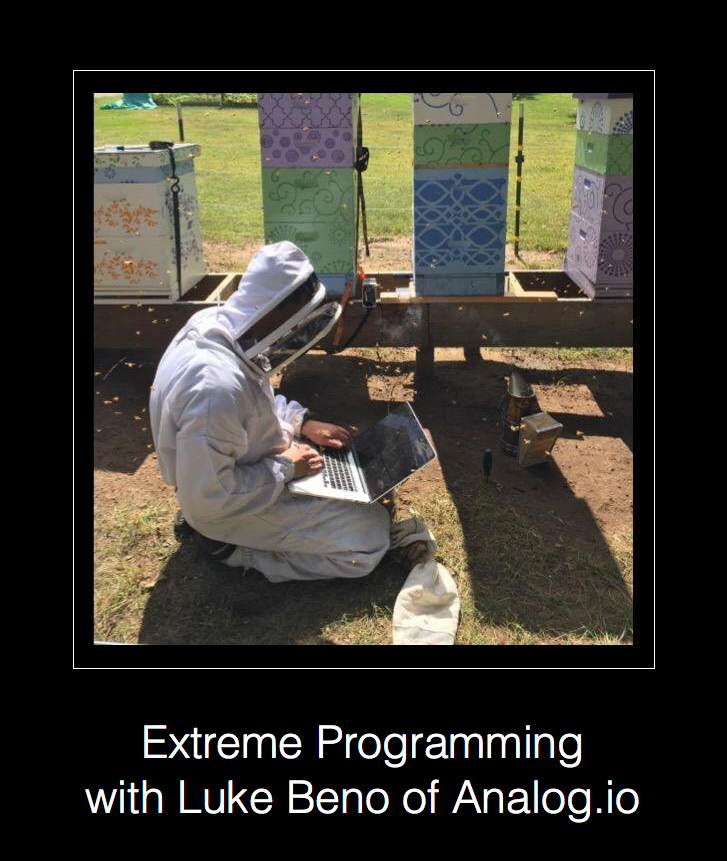
An Interview With Luke Beno of Analog.io
Welcome, Luke Beno of Analog.io!
- Analog.io is a data collection and charting website where you can view and share datastreams with others.
- Luke entered Analog.io (including a hardware component) into The Hackaday Prize.
- This is used for keeping track of lots of data over time, but Luke uses it for tracking beekeeping.
- The site does not directly collect data, currently Analog.io pulls mainly from data.sparkfun.com. That server runs the open source phant.io.
- Luke says it's easiest to get started using an Electric Imp or a Particle board.
- The boards make http requests which get recorded by phant.io. Notification based upon trigger levels is not currently supported.
- As platforms get larger, holes in server reliability become more apparent.
- Dave and Chris have been reading Free by former guest Chris Anderson.
- One example of a likely purchaser of services would be monitoring temp/humidity of vacation home (making sure the heat isn't broken).
- There was a kickstarter about a bee hive with a direct tap.
- Other similar platforms include xively and thingspeak.
- Luke has a tutorial for getting up and running using a tiny temp/humidity board and an electric imp.
- The service used to be called imp.guru, but changed names.
- The electric imp uses a server/agent scheme.
- You don't always need to use an Electric Imp, it just makes compiling and downloading (or updating) code easier.
- Instead, Luke targeted a lower power solution using a sensor node built with an MSP430 and an NRF24 radio. The base had another NRF24 radio and an ESP8266 to talk to the wifi network.
- Google is making a new router called OnHub.
- Chris sees parallels to Distributed Control Systems.
- The day of recording is BTTF day (Oct 21st, 2015).
- Dave was very concerned about power consumption.
- MQTT has a "broker" that acts like a satellite. Anyone subscribed to the broadcast message will get the data packet that is submitted by a device.
- SmartThings was bought by Samsung and acts as a connected home router.
- LoRA has 7 mile low power RF coverage. There is a kickstarter for this with the Things Network.
- APRS is a ham radio version of multi node system.
- Luke utilized the 43oh.com forums to build his system.
- Software for his stack
- He programmed using Energia for the MSP430 (arduino style).
- He used arduino for esp8266
- The Sparkfun server running phant.io is NodeJS
- Analog.io is Ruby on Rails.
- In browser processing and mapping is javascript/angular.js
- In his day job, Luke is an ASIC architect for Triad Semiconductor.
- He attempted to answer why aren't there low pin FPGAs with tons of resources like Dave wants (some are starting to hit the market).
You May Also Like

That UFO Podcast
That UFO Podcast
Radiolab
WNYC Studios
Radiowissen
Bayerischer Rundfunk

Breaking Down: Collapse
Kory & Kellan

Tom Nelson
Thomas Nelson

The 365 Days of Astronomy
365DaysOfAstronomy.org

The Grave Talks | Haunted, Paranormal & Supernatural
Ghost Stores, Haunted, Paranormal & Supernatural Stories

Trent Loos Podcast
Trent Loos

Eye On The Sky
Vermont Public

TheThinkingAtheist
The Thinking Atheist
That UFO Podcast
That UFO Podcast
Radiolab
WNYC Studios
Radiowissen
Bayerischer Rundfunk
Breaking Down: Collapse
Kory & Kellan
Tom Nelson
Thomas Nelson
The 365 Days of Astronomy
365DaysOfAstronomy.org
The Grave Talks | Haunted, Paranormal & Supernatural
Ghost Stores, Haunted, Paranormal & Supernatural Stories
Trent Loos Podcast
Trent Loos
Eye On The Sky
Vermont Public
TheThinkingAtheist
The Thinking Atheist
Community discussion