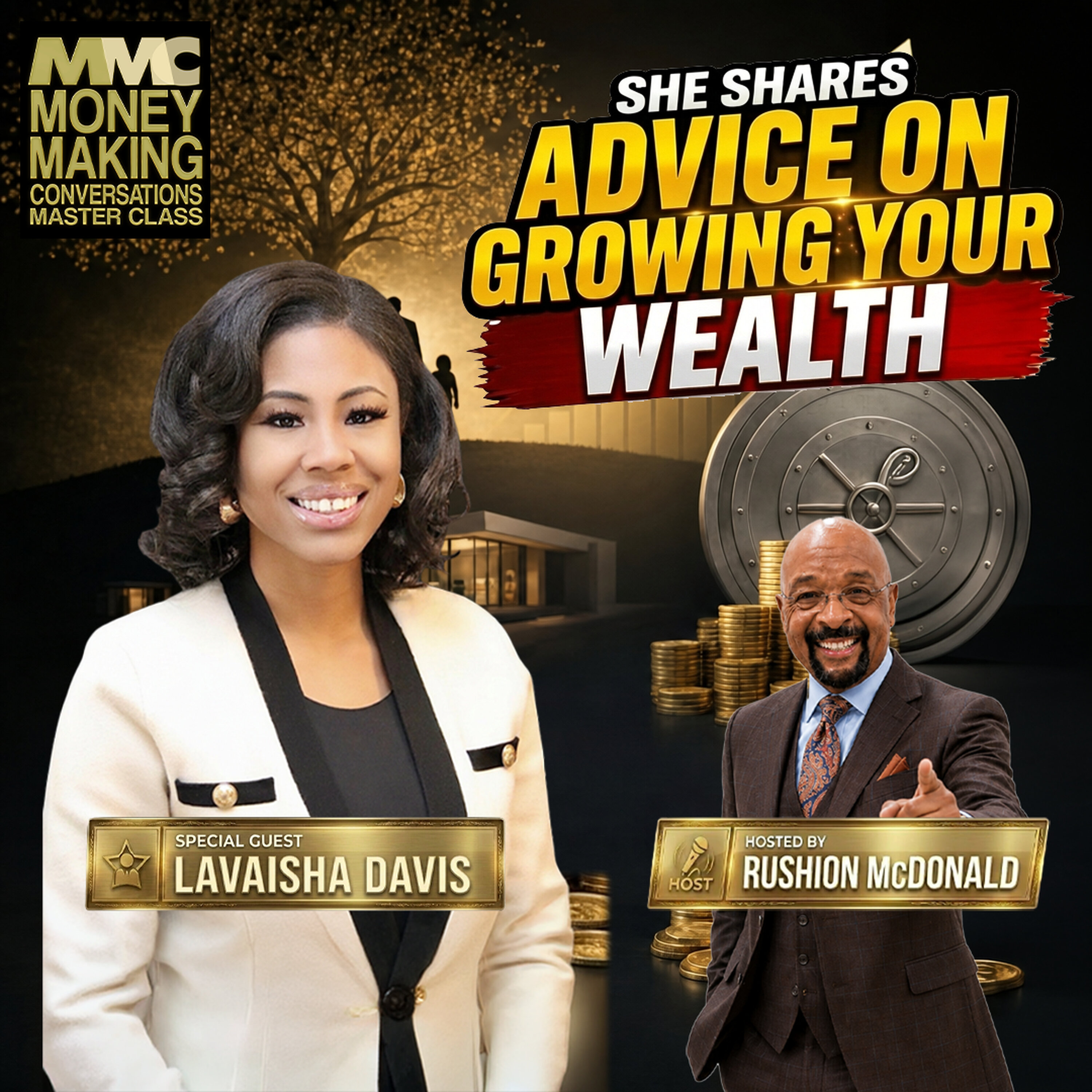
Money Talk: LaVashia explains how families can organize, protect, grow, and transfer wealth across generations.
Listen and subscribe to Money Making Conversations on iHeartRadio, Apple Podcasts, Spotify, www.moneymakingconversations.com/subscribe/ or wherever you listen to podcasts. New Money Making Conversations episodes drop daily. I want to alert you, so you don’t miss out on expert analysis and insider perspectives from my guests who provide tips that can help you uplift the community, improve your financial planning, motivation, or advice on how to be a successful entrepreneur. Keep winning!
Two-time Emmy and Three-time NAACP Image Award-winning, television Executive Producer Rushion McDonald interviewed LaVaisha Davis.
Guest: LaVashia Davis, Founder of Ell Wess Advisors (boutique family office and wealth management firm)
Host: Rushion McDonald
Topic: Building multigenerational wealth, family wealth planning, asset protection, and creating lasting legacies.
Purpose of the Interview
The interview focuses on helping first-generation wealth builders and entrepreneurs understand that wealth creation is about more than investments. Davis explains how families can organize, protect, grow, and transfer wealth across generations by treating their family finances as a structured enterprise rather than simply accumulating money.
A central theme is that many successful individuals earn substantial incomes but lack a blueprint for preserving and transferring wealth. Davis advocates for intentional planning, legal structures, family involvement, and asset protection to create lasting legacies.
Key Takeaways 1. Wealth Requires a Blueprint
Davis explains that creating a legacy does not happen automatically. Families need a deliberate plan, legal structures, and defined roles if they want wealth to survive beyond one generation. [Lavashia D...(Podcast) | Txt]
Takeaway: Making money and building wealth are not the same. Wealth requires systems and succession planning.
2. Family Should Be Treated as an Asset
One of Davis's strongest messages is that family members can play meaningful roles in wealth-building efforts.
She argues that when people think about legacy, they often overlook the importance of human relationships and family participation. Wealth-transfer strategies frequently require successors, trustees, managers, and beneficiaries. Many of those roles can be filled by family members. [Lavashia D...(Podcast) | Txt]
Takeaway: Family can be a strategic asset when properly organized and aligned.
3. Not Every Family Member Contributes Equally
Davis acknowledges that some family members may behave more like liabilities than assets.
Using a balance-sheet analogy, she explains that every family includes both contributors and individuals who may create financial burdens. The key is identifying those dynamics without allowing them to derail long-term wealth planning. [Lavashia D...(Podcast) | Txt]
Takeaway: Successful family wealth planning requires honest assessment of family dynamics.
4. Wealth Management Is More Than Investments
Davis differentiates her firm's approach from traditional investment-focused advisory services.
Her firm begins with:
- Family and wealth governance
- Legal structures
- Estate planning
- Tax planning
- Business succession planning
- Preparing future generations to inherit wealth
Investments are addressed after these foundational elements are in place. [Lavashia D...(Podcast) | Txt]
Takeaway: Investments should support a broader wealth strategy, not drive it.
5. "Your Family Is a Business"
One of Davis's most memorable concepts is that families should think of themselves as enterprises.
She advises clients to separate their “wealth business” from their personal household and to create structures that can survive beyond their lifetime. [Lavashia D...(Podcast) | Txt]
Takeaway: Families should operate with the same intentionality that successful businesses use.
6. First-Generation Wealth Creates Unique Challenges
Davis specializes in serving people who are the first high earners or successful entrepreneurs within their families.
She notes that these individuals often face challenges that previous generations never had to navigate, including:
- Sudden financial complexity
- Family expectations
- Tax planning
- Asset protection
- Wealth transfer decisions [Lavashia D...(Podcast) | Txt]
Takeaway: New wealth requires new skills and specialized guidance.
7. There Are Four Forms of Capital
Davis identifies four sources of capital:
- Human Capital – people, family, relationships
- Intellectual Capital – knowledge and expertise
- Social Capital – networks and connections
- Financial Capital – money and assets
She argues that most families focus only on financial capital while neglecting the others. [Lavashia D...(Podcast) | Txt]
Takeaway: Wealth is broader than money.
8. Asset Protection Is Essential
Davis warns that unprotected assets can disappear quickly due to lawsuits, business failures, creditor claims, or debt obligations.
She emphasizes the importance of proper ownership structures, legal entities, and asset protection strategies. [Lavashia D...(Podcast) | Txt]
Takeaway: Wealth must be protected as carefully as it is created.
9. Different Advisors Serve Different Stages of Wealth
When McDonald asks how people should evaluate their
You May Also Like

Les Nuits de France Culture
France Culture

Tilos Rádió heti podcast
Tilos Rádió

Ma perché?
OnePodcast
Great Company with Jamie Laing
Jampot Productions

Sherry's Notes 雪力的心理學筆記
雪力 ‧ 夏瑄澧
Thomas Paine Podcast
mike moore
Thrilling Threads - Conspiracy Theories, Strange Phenomena, Unsolved Mysteries, etc!
Byte & Pieces

Documentales TV -Historia y Ficción
JuAnRa

Palestras Filosóficas Nova Acrópole
Palestras Filosóficas Nova Acrópole

True Cheating Wives and Girlfriends Stories 2025 - True Cheating Stories Podcast
True Cheat Stories Official 2026
Les Nuits de France Culture
France Culture
Tilos Rádió heti podcast
Tilos Rádió
Ma perché?
OnePodcast
Great Company with Jamie Laing
Jampot Productions
Sherry's Notes 雪力的心理學筆記
雪力 ‧ 夏瑄澧
Thomas Paine Podcast
mike moore
Thrilling Threads - Conspiracy Theories, Strange Phenomena, Unsolved Mysteries, etc!
Byte & Pieces
Documentales TV -Historia y Ficción
JuAnRa
Palestras Filosóficas Nova Acrópole
Palestras Filosóficas Nova Acrópole
True Cheating Wives and Girlfriends Stories 2025 - True Cheating Stories Podcast
True Cheat Stories Official 2026
Community discussion