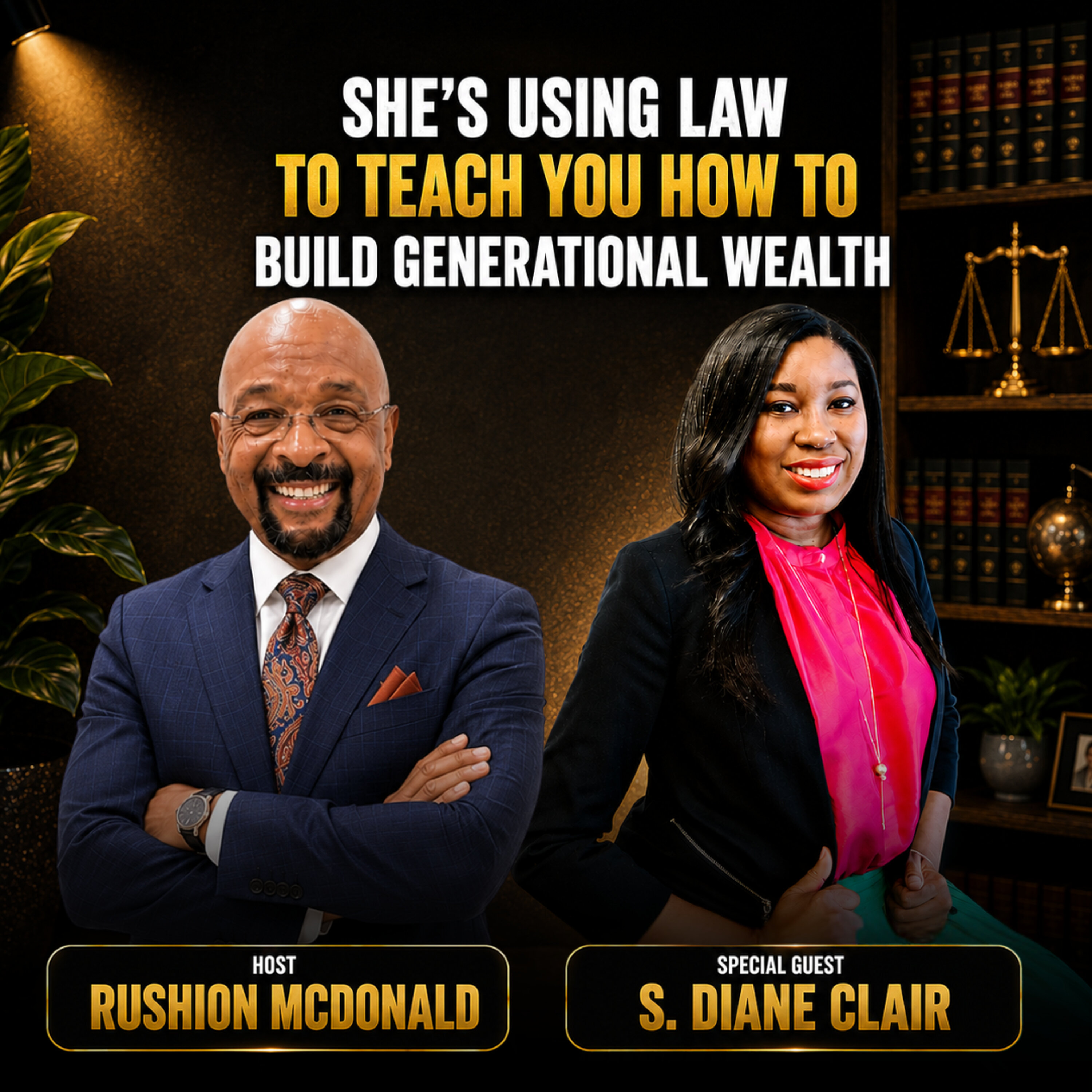
Info You Can Use: A Masterclass on Real Estate Investing, filing wills and estate planning.
Listen and subscribe to Money Making Conversations on iHeartRadio, Apple Podcasts, Spotify, www.moneymakingconversations.com/subscribe/ or wherever you listen to podcasts. New Money Making Conversations episodes drop daily. I want to alert you, so you don’t miss out on expert analysis and insider perspectives from my guests who provide tips that can help you uplift the community, improve your financial planning, motivation, or advice on how to be a successful entrepreneur. Keep winning!
Two-time Emmy and Three-time NAACP Image Award-winning, television Executive Producer Rushion McDonald interviewed Attorney S. Diane Clair.
A Georgia-based attorney, real estate law professor at Kennesaw State University, and founder of a law practice specializing in real estate, estate planning, probate, business, and contract law. The discussion focuses on wealth building through real estate investing, asset protection, and estate planning strategies for generational wealth.
Purpose of the Interview
The primary purpose of the interview was to:
- Educate listeners about real estate investing opportunities, including lesser-known strategies such as tax liens and tax deeds. [
- Stress the importance of working with qualified legal professionals instead of relying on Google, social media, AI tools, or generic legal templates. [
- Promote wealth preservation through estate planning, particularly trusts and business structures. [
- Encourage minority communities to create estate plans and pass wealth to future generations. [
Key Takeaways 1. Don't Rely Solely on Google, Social Media, or AI for Legal Advice
Clair warns that many individuals attempt to create wills, trusts, and legal documents online without professional guidance. She emphasizes that legal matters require experienced attorneys because AI and internet sources may provide incomplete or incorrect information.
Why it Matters
- Legal mistakes can create costly problems later.
- AI-generated content can be inaccurate.
- Estate planning and real estate transactions require professional review.
2. Real Estate Is a Powerful Wealth-Building Tool
Clair argues that real estate remains one of the strongest ways to build and transfer wealth between generations. She highlights its relative stability compared to stock market fluctuations.
Benefits Mentioned
- Builds long-term wealth
- Generates passive income
- Creates assets that can be inherited
- Helps achieve financial freedom [
3. Start Real Estate Investing Through a Business Entity
One of Clair's first recommendations is to establish a legal business structure before purchasing investment properties.
Recommended Structures
- LLC
- Corporation
- Other formal business entities [
She repeatedly stresses that investment assets ideally should not be owned in an individual's personal name.
4. You Don't Need Large Amounts of Money to Invest
A major myth she debunks is that real estate investing requires significant capital.
Entry-Level Strategies
- Tax liens
- Tax deeds
- Foreclosure purchases
- Fix-and-flip projects
- Rental properties [
According to Clair, investors can begin with relatively small amounts by purchasing tax liens and earning interest when property owners redeem them. [
5. Estate Planning Is Largely Ignored
Clair shares a startling statistic:
- Approximately 64% of Americans do not have an estate plan.
- Among minorities, that number rises to about 70%. [
She believes the problem is educational rather than financial, noting that even wealthy celebrities frequently fail to plan their estates.
6. Trusts Are Better Than Wills for Many Situations
Clair strongly favors trusts, especially irrevocable trusts, as vehicles for preserving wealth.
Advantages of Trusts
- Avoid probate
- Potential tax benefits
- Asset protection
- Easier transfer of wealth
- Can operate while the creator is still alive
Difference Between a Will and a Trust
Will
- Takes effect after death
- Goes through probate court
- Directs distribution of assets
Trust
- Can function during the owner's lifetime
- Avoids probate
- Can provide stronger protection and tax advantages [
7. Asset Protection Is Essential
Clair explains that trusts can own:
- Real estate
- Bank accounts
- Businesses
- Investments
- Other valuable assets
Because the trust, rather than the individual, owns the property, there can be additional protection from lawsuits and claims.
Notable Quotes On Legal Services Beyond Personal Injury Law
"You can hire lawyers for way more, and we can assist you in way more." [
On Using AI for Legal Matters
"AI is not really something you want to trust... It creates and makes up stuff."
You May Also Like

Les Nuits de France Culture
France Culture
Thomas Paine Podcast
mike moore

The Vince Everett Ellison Show
Media Squatch

Rogue Energy
iHeartPodcasts

Tilos Rádió heti podcast
Tilos Rádió

True Cheating Wives and Girlfriends Stories 2025 - True Cheating Stories Podcast
True Cheat Stories Official 2026

Promo Estereo Podcast
PROMO ESTEREO PODCAST
Thrilling Threads - Conspiracy Theories, Strange Phenomena, Unsolved Mysteries, etc!
Byte & Pieces

Border Nights
Border Nights

Daily Reddit Stories
RedditKing
Les Nuits de France Culture
France Culture
Thomas Paine Podcast
mike moore
The Vince Everett Ellison Show
Media Squatch
Rogue Energy
iHeartPodcasts
Tilos Rádió heti podcast
Tilos Rádió
True Cheating Wives and Girlfriends Stories 2025 - True Cheating Stories Podcast
True Cheat Stories Official 2026
Promo Estereo Podcast
PROMO ESTEREO PODCAST
Thrilling Threads - Conspiracy Theories, Strange Phenomena, Unsolved Mysteries, etc!
Byte & Pieces
Border Nights
Border Nights
Daily Reddit Stories
RedditKing
Community discussion