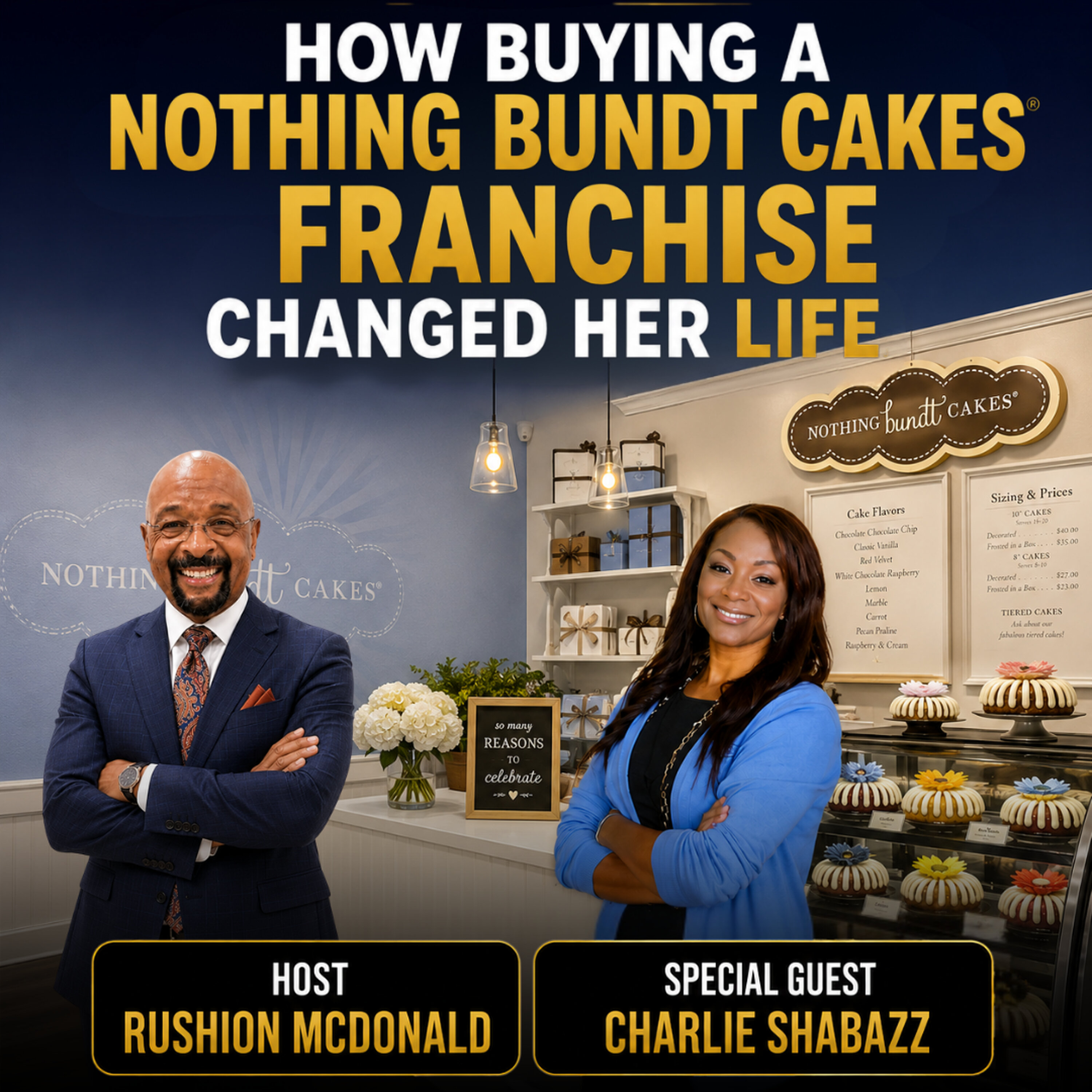
E426: Entrepreneur: Former CPA Charlie Shabazz tells us how she pivoted her career to Nothing Bundt Cake Franchisee.
Listen and subscribe to Money Making Conversations on iHeartRadio, Apple Podcasts, Spotify, www.moneymakingconversations.com/subscribe/ or wherever you listen to podcasts. New Money Making Conversations episodes drop daily. I want to alert you, so you don’t miss out on expert analysis and insider perspectives from my guests who provide tips that can help you uplift the community, improve your financial planning, motivation, or advice on how to be a successful entrepreneur. Keep winning!
Two-time Emmy and Three-NAACP Image Award-winning television producer Rushion McDonald interviewed Charlie Shabazz.
owner of a Nothing Bundt Cakes franchise in Tucker, Georgia. Charlie's entrepreneurial journey is particularly inspiring because she did not come from a baking background. Instead, she built her career as a CPA and tax professional before transitioning into franchise ownership.
The conversation explores entrepreneurship, overcoming fear, franchising, financial discipline, mentorship, career pivots, and the importance of pursuing opportunities even when they fall outside your comfort zone.
Purpose of the Interview
The purpose of the interview was to:
- Share Charlie Shabazz's entrepreneurial journey.
- Explain the realities of franchise ownership.
- Encourage aspiring entrepreneurs to overcome fear.
- Demonstrate the value of mentorship and preparation.
- Discuss financial discipline and debt management.
- Inspire listeners to pursue opportunities outside their original career path.
- Highlight successful Black women entrepreneurs.
About Charlie Shabazz
Before becoming a franchise owner, Charlie:
- Grew up in Philadelphia.
- Graduated from Temple University.
- Earned a degree in Accounting.
- Obtained a Master's degree in Taxation.
- Became a CPA.
- Built a successful career in tax accounting.
For years, she expected accounting to be her lifelong profession.
As she explained:
"I thought I would do taxes for the rest of my life."
Life ultimately had different plans.
Key Takeaways
1. Fear Should Not Dictate Your Future
One of the strongest themes throughout the interview was overcoming fear.
Charlie left Philadelphia to pursue an opportunity in Atlanta despite uncertainty.
She faced concerns such as:
- Leaving family behind
- Starting over in a new city
- Taking professional risks
- Building a new support system
Yet she moved forward anyway.
Key Point: Courage is not the absence of fear. It is acting despite fear.
2. Mentorship Accelerated Her Growth
When Charlie wanted to learn business taxation, she realized she lacked experience.
Instead of avoiding the challenge, she proactively sought a mentor.
Her approach was simple:
- Contact an experienced CPA.
- Offer to work for free.
- Learn as much as possible.
The mentor accepted.
Charlie credits this experience with helping her gain expertise in business tax preparation.
Key Point: Great mentors can dramatically shorten the learning curve.
3. Success Requires Sacrifice
During the interview, a caller asked how Charlie managed finances while building her career.
Charlie openly discussed financial struggles.
At one point:
- She carried credit card debt.
- Faced financial stress.
- Needed a structured repayment plan.
She created a spreadsheet tracking:
- Every credit card balance
- Monthly payments
- Payoff goals
She followed the plan consistently.
Key Point: Financial success often starts with discipline rather than income.
4. Every Dream Needs a Plan
Charlie emphasized the importance of having a plan.
She explained that dreams alone are not enough.
Success requires:
- Clear goals
- Strategy
- Consistent execution
- Accountability
Her own progress came from deliberate planning rather than luck.
5. Opportunities Often Arrive Unexpectedly
One surprising fact from the interview:
Charlie was not originally planning to own a Nothing Bundt Cakes franchise.
Her original goal was simply:
Bring a bakery to Tucker, Georgia.
She initially explored another bakery franchise opportunity.
When that deal fell apart, she started looking for alternatives.
That search eventually led her to Nothing Bundt Cakes.
Key Point: Sometimes disappointment redirects us toward better opportunities.
6. She Wasn't a Baker
Perhaps the most inspiring part of the conversation was Charlie's admission that she did not come from a baking background.
In fact:
- She was a CPA.
- She never envisioned owning a bakery.
- Baking was not her profession.
Her success came from:
- Business skills
- Leadership
- Determination
- Willingness to learn
Key Point: You do not always have to be the technical expert to own a successful business.
7. Franchising Provides a Proven Blueprint
Charlie explained franchising in simple terms.
A franchise system gives owners access to:
- Established products
- Proven processes
- Operational systems
- Marketing support
- Brand recognition
When franchise founders have already worked through the challenges, new owners can follow an established roadmap.
Key Point: Franchising reduces some startup risk by providing a proven business model.
8. Pivoting Is Part of Entrepreneurship
A recurring lesson throughout the interview was adaptability.
Charlie started with one idea.
That idea evolved.
The franchise she initially considered changed.
New opportunities emerged.
Instead of fighting change, she embraced it.
As she explained, entrepreneurs must sometimes:
- Adjust
- Pivot
- Adapt
- Reevaluate
without losing sight of the larger goal.
9. Black Women Continue to Lead in Entrepreneurship
Rushion asked Charlie why Black women have become one of the fastest-growing groups in entrepreneurship.
She credited:
- Strong mothers
- Community support
- Determination
- High expectations
Charlie noted that many Black women are taught early:
- To pursue education
- To strive for excellence
- To create opportunities
These influences frequently become entrepreneurial strengths.
10. Relationships Matter
One reason Charlie personally delivered products and inter
You May Also Like

Les Nuits de France Culture
France Culture
Thomas Paine Podcast
mike moore

The Audio Long Read
The Guardian

呱吉
呱吉
The Atlas Obscura Podcast
SiriusXM and Atlas Obscura

The Rush Hour With Dave Neal
Dave Neal
The Documentary Podcast
BBC World Service

Uchom po mape s BUBO
BUBO

Tilos Rádió heti podcast
Tilos Rádió

Ma perché?
OnePodcast
Les Nuits de France Culture
France Culture
Thomas Paine Podcast
mike moore
The Audio Long Read
The Guardian
呱吉
呱吉
The Atlas Obscura Podcast
SiriusXM and Atlas Obscura
The Rush Hour With Dave Neal
Dave Neal
The Documentary Podcast
BBC World Service
Uchom po mape s BUBO
BUBO
Tilos Rádió heti podcast
Tilos Rádió
Ma perché?
OnePodcast
Community discussion