Powering your Copilot for Data – with Artem Keydunov of Cube.dev
The first workshops and talks from the AI Engineer Summit are now up! Join the >20k viewers on YouTube, find clips on Twitter (we’re also clipping @latentspacepod), and chat with us on Discord!
Text-to-SQL was one of the first applications of NLP. Thoughtspot offered “Ask your data questions” as their core differentiation compared to traditional dashboarding tools. In a way, they provide a much friendlier interface with your own structured (aka “tabular”, as in “SQL tables”) data, the same way that RLHF and Instruction Tuning helped turn the GPT-3 of 2020 into the ChatGPT of 2022.
Today, natural language queries on your databases are a commodity. There are 4 different ChatGPT plugins that offer this, as well as a bunch of startups like one of our previous guests, Seek.ai. Perplexity originally started with a similar product in 2022:
In March 2023 LangChain wrote a blog post on LLMs and SQL highlighting why they don’t consistently work:
* “LLMs can write SQL, but they are often prone to making up tables, making up field”
* “LLMs have some context window which limits the amount of text they can operate over”
* “The SQL it writes may be incorrect for whatever reason, or it could be correct but just return an unexpected result.”
For example, if you ask a model to “return all active users in the last 7 days” it might hallucinate a `is_active` column, join to an `activity` table that doesn’t exist, or potentially get the wrong date (especially in leap years!).
We previously talked to Shreya Rajpal at Guardrails AI, which also supports Text2SQL enforcement. Their approach was to run the actual SQL against your database and then use the error messages to improve the query:
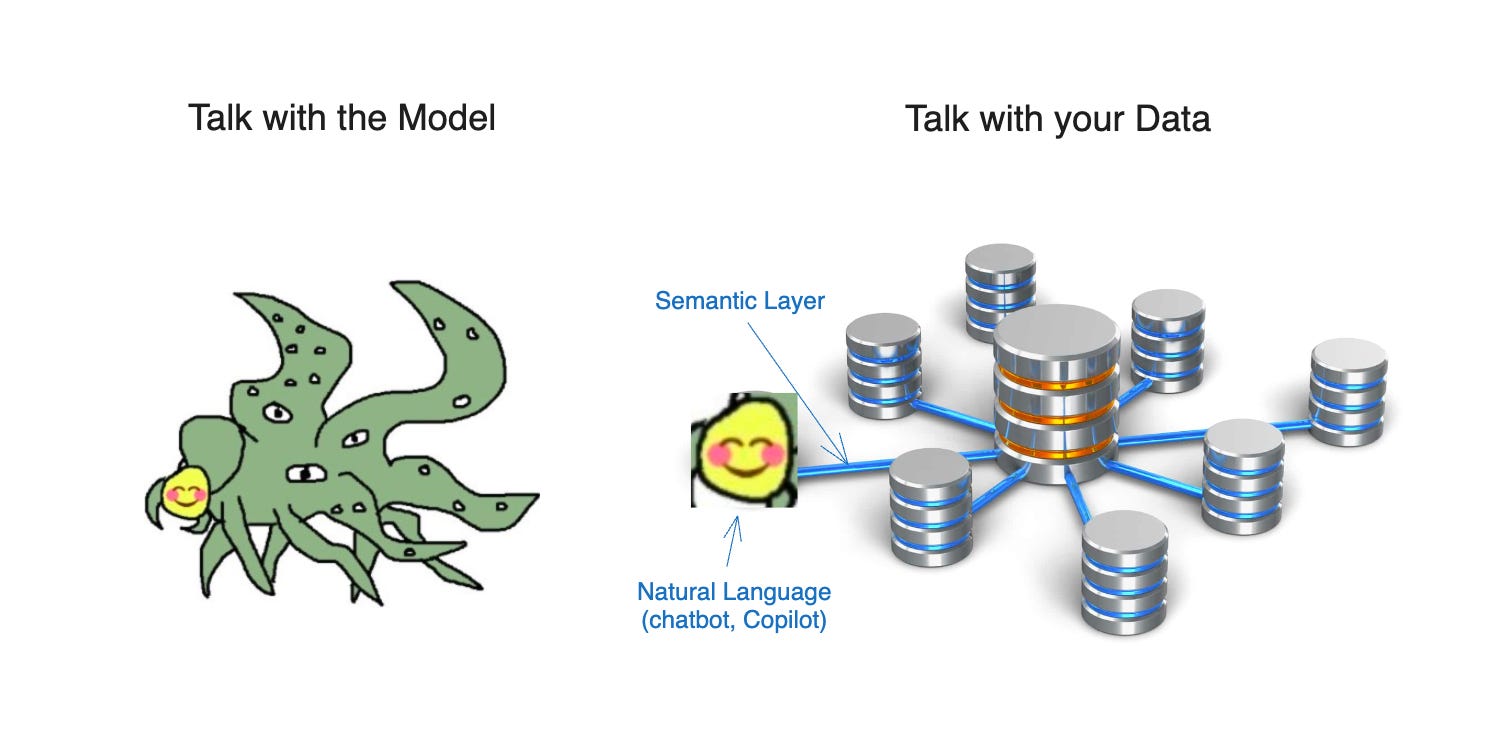
Semantic Layers to the rescue
Cube is an open source semantic layer which recently integrated with LangChain to solve these issues in a different way. You can use YAML, Javascript, or Python to create definitions of different metrics, measures and dimensions for your data:
Creating these metrics and passing them in the model context limits the possibility for errors as the model just needs to query the `active_users` view, and Cube will then expand that into the full SQL in a reliable way. The downside of this approach compared to the Guardrails one for example is that it requires more upfront work to define metrics, but on the other hand it leads to more reliable and predictable outputs.
The promise of adding a great semantic layer to your LLM app is irresistible - you greatly minimize hallucinations, make much more token efficient prompts, and your data stays up to date without any retraining or re-indexing. However, there are also difficulties with implementing semantic layers well, so we were glad to go deep on the topic with Artem as one of the leading players in this space!
Timestamps
* [00:00:00] Introductions
* [00:01:28] Statsbot and limitations of natural language processing in 2017
* [00:04:27] Building Cube as the infrastructure for Statsbot
* [00:08:01] Open sourcing Cube in 2019
* [00:09:09] Explaining the concept of a semantic layer/Cube
* [00:11:01] Using semantic layers to provide context for AI models working with tabular data
* [00:14:47] Workflow of generating queries from natural language via semantic layer
* [00:21:07] Using Cube to power customer-facing analytics and natural language interfaces
* [00:22:38] Building data-driven AI applications and agents
* [00:25:59] The future of the modern data stack
* [00:29:43] Example use cases of Slack bots powered by Cube
* [00:30:59] Using GPT models and limitations around math
* [00:32:44] Tips for building data-driven AI apps
* [00:35:20] Challenges around monetizing embedded analytics
* [00:36:27] Lightning Round
Transcript
Swyx: Hey everyone, welcome to the Latent Space podcast. This is Swyx, writer, editor of Latent Space and founder of Smol.ai and Alessio, partner and CTO in residence at Decibel Partners. [00:00:15]
Alessio: Hey everyone, and today we have Artem Keydunov on the podcast, co-founder of Cube. Hey Artem. [00:00:21]
Artem: Hey Alessio, hi Swyx. Good to be here today, thank you for inviting me. [00:00:25]
Alessio: Yeah, thanks for joining. For people that don't know, I've known Artem for a long time, ever since he started Cube. And Cube is actually a spin-out of his previous company, which is Statsbot. And this kind of feels like going both backward and forward in time. So the premise of Statsbot was having a Slack bot that you can ask, basically like text to SQL in Slack, and this was six, seven years ago, something like that. A lot ahead of its time, and you see startups trying to do that today. And then Cube came out of that as a part of the infrastructure that was powering Statsbot. And Cube then evolved from an embedded analytics product to the semantic layer and just an awesome open source evolution. I think you have over 16,000 stars on GitHub today, you have a very active open source community. But maybe for people at home, just give a quick like lay of the land of the original Statsbot product. You know, what got you interested in like text to SQL and what were some of the limitations that you saw then, the limitations that you're also seeing today in the new landscape? [00:01:28]
Artem: I started Statsbot in 2016. The original idea was to just make sort of a side project based off my initial project that I did at a company that I was working for back then. And I was working for a company that was building software for schools, and we were using Slack a lot. And Slack was growing really fast, a lot of people were talking about Slack, you know, like Slack apps, chatbots in general. So I think it was, you know, like another wave of, you know, bots and all that. We have one more wave right now, but it always comes in waves. So we were like living through one of those waves. And I wanted to build a bot that would give me information from different places where like a data lives to Slack. So it was like developer data, like New Relic, maybe some marketing data, Google Analytics, and then some just regular data, like a production database, so it sells for sometimes. And I wanted to bring it all into Slack, because we were always chatting, you know, like in Slack, and I wanted to see some stats in Slack. So that was the idea of Statsbot, right, like bring stats to Slack. I built that as a, you know, like a first sort of a side project, and I published it on Reddit. And people started to use it even before Slack came up with that Slack application directory. So it was a little, you know, like a hackish way to install it, but people are still installing it
You May Also Like

Tech Brew Ride Home
Morning Brew

Jak Piggott
Jak Piggott

ITSPmagazine
ITSPmagazine, Sean Martin, Marco Ciappelli

Artificial Intelligence Masterclass
AI Masterclass

Mark Tilbury
Mark Tilbury Fan

The Good Tech Companies
HackerNoon

AI and the Future of Work: Artificial Intelligence in the Workplace, Business, Ethics, HR, and IT for AI Enthusiasts, Leaders and Academics
Dan Turchin

Jack Hopkins
Jack Hopkins

How I AI
Brooke Gramer

Engadget News + Next
Engadget
Tech Brew Ride Home
Morning Brew
Jak Piggott
Jak Piggott
ITSPmagazine
ITSPmagazine, Sean Martin, Marco Ciappelli
Artificial Intelligence Masterclass
AI Masterclass
Mark Tilbury
Mark Tilbury Fan
The Good Tech Companies
HackerNoon
AI and the Future of Work: Artificial Intelligence in the Workplace, Business, Ethics, HR, and IT for AI Enthusiasts, Leaders and Academics
Dan Turchin
Jack Hopkins
Jack Hopkins
How I AI
Brooke Gramer
Engadget News + Next
Engadget
Community discussion