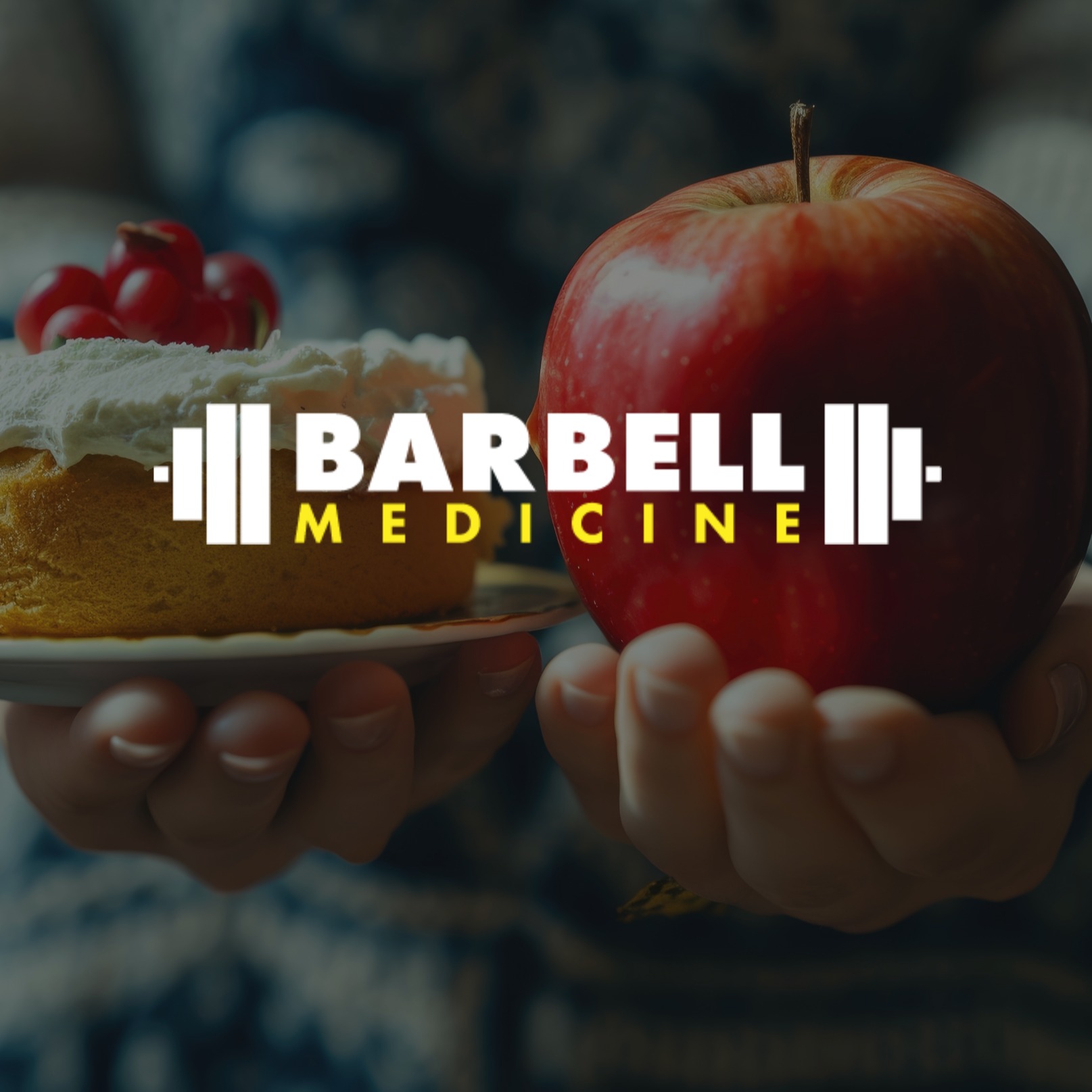
Is Obesity a Willpower Problem? The Biology of Weight, Diets, and GLP-1s
Obesity roughly tripled in about 60 years, and the genes didn't change in that time. So if body weight isn't a willpower problem, what is it? Dr. Jordan Feigenbaum and Dr. Austin Baraki walk through what actually sets your weight: the adoption and twin studies behind the genetics, the "defended range" your biology fights to hold, the food environment that does most of the eating for you, and where GLP-1 medications actually work. Along the way — why diets regain after you white-knuckle them, what The Biggest Loser six-year data show about resting metabolism, and four willpower myths worth retiring.
Hosted by Dr. Jordan Feigenbaum and Dr. Austin Baraki, co-founders of Barbell Medicine.
Timestamps
- 00:00 Cold open: Danny Cahill and The Biggest Loser
- 01:03 What we mean by "willpower"
- 05:48 Obesity tripled in ~60 years: the one number
- 06:31 Adoption and twin studies: genes vs. household
- 09:37 Set point vs. the defended range
- 10:37 Gene–environment mismatch
- 14:03 In the clinic: a lifelong weight history
- 19:18 Losing weight vs. keeping it off
- 20:26 Appetite doesn't reset (Sumithran)
- 25:52 Metabolic adaptation and the Biggest Loser data
- 34:07 Part 2: eating on autopilot
- 35:10 Portion size runs the meal
- 39:12 What changed in the food supply
- 40:42 Same genes, new environment: Pima and immigrants
- 43:20 Why ultra-processed food is easy to overeat
- 50:28 Processing vs. calories: the Hall ward study
- 52:36 When the brain changes eating: gourmand syndrome
- 1:00:01 Why the willpower story stuck
- 1:01:08 Taft, Churchill, and the intelligence myth
- 1:02:43 Does intelligence predict weight? (sibling study)
- 1:11:16 Are GLP-1s cheating? What they actually do
- 1:15:10 Beyond the scale: muscle, health, nutrition
- 1:24:21 Myth-busting: lightning round
- 1:39:04 Three takeaways: what to actually do
- 1:41:00 Danny Cahill, revisited
Resources
Barbell Medicine coaching and templates: https://www.barbellmedicine.com
https://www.barbellmedicine.com/shop/subscriptions/plus-podcast-subscription/
https://www.barbellmedicine.com/shop/subscriptions/barbell-medicine-premium/
Signal book pre-order: https://www.barbellmedicine.com/shop/learning/signal/
Coaching, programs & templates: https://www.barbellmedicine.com/
Prevalence of Overweight, Obesity, and Severe Obesity Among Adults Age 20 and Older: United States, 1960-1962 Through August 2021-August 2023. NCHS Health E-Stats. 2024. https://www.cdc.gov/nchs/data/hestat/hestat111.htm
Obesity and Severe Obesity Prevalence in Adults: United States, August 2021-August 2023. NCHS Data Brief No. 508. Hyattsville, MD: National Center for Health Statistics; 2024. https://www.cdc.gov/nchs/products/databriefs/db508.htm
Hill JO, Peters JC. Environmental contributions to the obesity epidemic. Science. 1998;280(5368):1371-1374. https://doi.org/10.1126/science.280.5368.1371
Morton RW, Murphy KT, McKellar SR, et al. A systematic review, meta-analysis and meta-regression of the effect of protein supplementation on resistance training-induced gains in muscle mass and strength in healthy adults. Br J Sports Med. 2018;52(6):376-384. https://doi.org/10.1136/bjsports-2017-097608
Stunkard AJ, Sorensen TIA, Hanis C, et al. An adoption study of human obesity. N Engl J Med. 1986;314(4):193-198. https://doi.org/10.1056/NEJM198601233140401
Stunkard AJ, Harris JR, Pedersen NL, McClearn GE. The body-mass index of twins who have been reared apart. N Engl J Med. 1990;322(21):1483-1487. https://doi.org/10.1056/NEJM199005243222102
Speakman JR, Levitsky DA, Allison DB, et al. Set points, settling points and some alternative models: theoretical options to understand how genes and environments combine to regulate body adiposity. Dis Model Mech. 2011;4(6):733-745. https://doi.org/10.1242/dmm.008698
Kalm LM, Semba RD. They starved so that others be better fed: remembering Ancel Keys and the Minnesota Experiment. J Nutr. 2005;135(6):1347-1352. https://doi.org/10.1093/jn/135.6.1347
Sumithran P, Prendergast LA, Delbridge E, et al. Long-term persistence of hormonal adaptations to weight loss. N Engl J Med. 2011;365(17):1597-1604. https://doi.org/10.1056/NEJMoa1105816
Fothergill E, Guo J, Howard L, et al. Persistent metabolic adaptation 6 years after 'The Biggest Loser' competition. Obesity (Silver Spring). 2016;24(8):1612-1619. https://doi.org/10.1002/oby.21538
Hall KD. Energy compensation and metabolic adaptation: 'The Biggest Loser' study reinterpreted. Obesity (Silver Spring). 2022;30(1):11-13. https://doi.org/10.1002/oby.23308
Cohen DA, Farley TA. Eating as an automatic behavior. Prev Chronic Dis. 2008;5(1):A23. https://www.cdc.gov/pcd/issues/2008/jan/07_0046.htm
Rolls BJ, Morris EL, Roe LS. Portion size of food affects energy intake in normal-weight and overweight men and women. Am J Clin Nutr. 2002;76(6):1207-1213. https://doi.org/10.1093/ajcn/76.6.1207
Diliberti N, Bordi PL, Conklin MT, Roe LS, Rolls BJ. Increased portion size leads to increased energy intake in a restaurant meal. Obes Res. 2004;12(3):562-568. https://doi.org/10.1038/oby.2004.64
Hollands GJ, Shemilt I, Marteau TM, et al. Portion, package or tableware size for changing selection and consumption of food, alcohol and tobacco. Cochrane Database Syst Rev. 2015;(9):CD011045. https://doi.org/10.1002/14651858.CD011045.pub2
Hall KD, Ayuketah A, Brychta R, et al. Ultra-processed diets cause excess calorie intake and weight gain: an inpatient randomized controlled trial of ad libitum food intake. Cell Metab. 2019;30(1):67-77.e3. https://doi.org/10.1016/j.cmet.2019.05.008
Pontzer H, Raichlen DA, Wood BM, et al. Hunter-gatherer energetics and human obesity. PLoS One. 2012;7(7):e40503. https://doi.org/10.1371/journal.pone.0040503
Careau V, Halsey LG, Pontzer H, et al. Energy compensation and adiposity in humans. Curr Biol. 2021;31(20):4659-4666.e2. https://doi.org/10.1016/j.cub.2021.08.016
Miller WC, Koceja DM, Hamilton EJ. A meta-analysis of the past 25 years of weight loss research using diet, exercise or diet plus exercise intervention. Int J Ob
You May Also Like
The Body Pod
Hailey Happens Fitness + Love By Laura

Calming Anxiety | Guided Meditation, Sleep Hypnosis & Panic Attack Relief
Martin Hewlett - Calming Anxiety
Thunderstorm Ambience
Sol Good Media

Nature ASMR Sounds
Sol Good Media
Boundless Life
Ben Greenfield

Chasing Life
CNN Podcasts

Life Kit: Health
NPR
Everyday Wellness: Midlife Hormones, Menopause, and Science for Women 35+
Everyday Wellness™

Optimal Health Daily - Fitness and Nutrition
Optimal Living Daily | Dr. Neal Malik

New Mindset, Who Dis?
Case Kenny
The Body Pod
Hailey Happens Fitness + Love By Laura
Calming Anxiety | Guided Meditation, Sleep Hypnosis & Panic Attack Relief
Martin Hewlett - Calming Anxiety
Thunderstorm Ambience
Sol Good Media
Nature ASMR Sounds
Sol Good Media
Boundless Life
Ben Greenfield
Chasing Life
CNN Podcasts
Life Kit: Health
NPR
Everyday Wellness: Midlife Hormones, Menopause, and Science for Women 35+
Everyday Wellness™
Optimal Health Daily - Fitness and Nutrition
Optimal Living Daily | Dr. Neal Malik
New Mindset, Who Dis?
Case Kenny
Community discussion