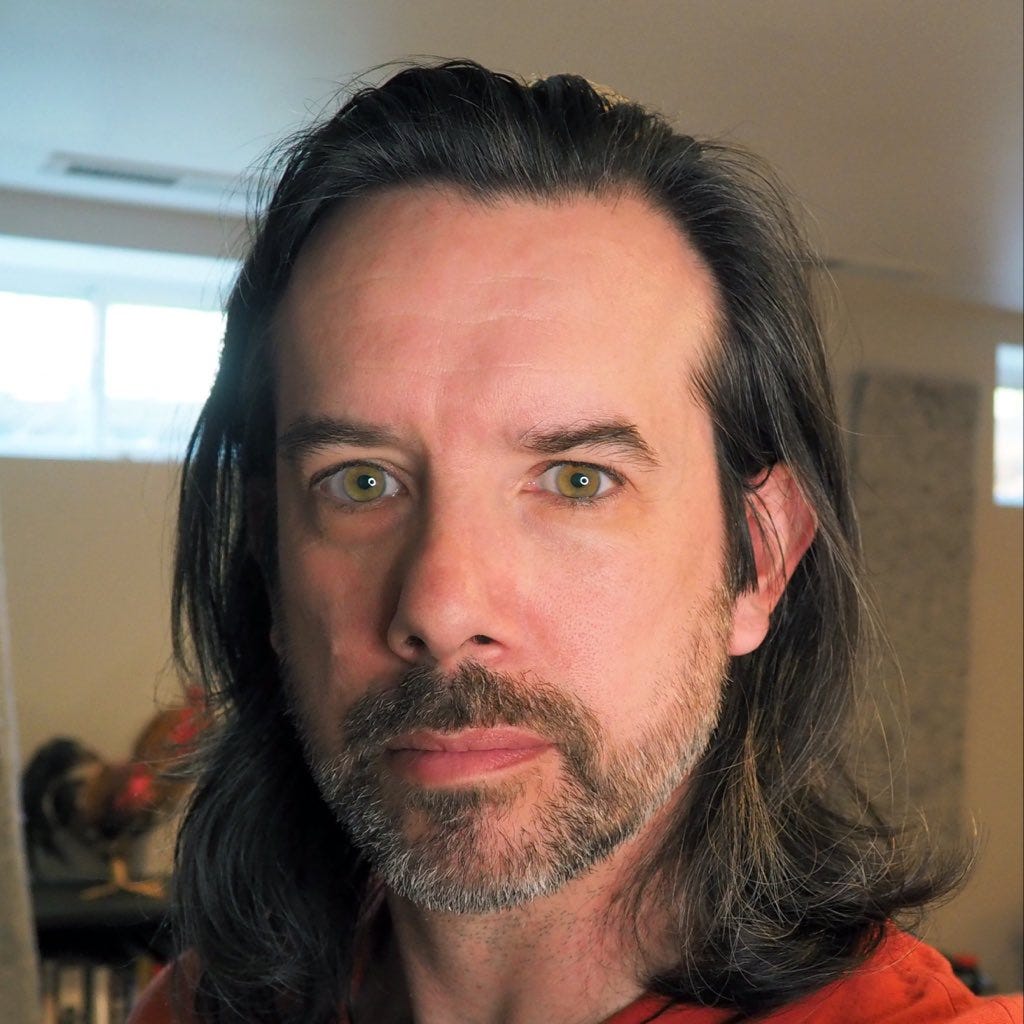
Volts podcast: Will Wilkinson on libertarianism, pluralism, and America's political crisis
I have been reading Will Wilkinson’s writing since I was a baby blogger, way back in the early 2000s. By then, I had already left behind the libertarianism that gripped me in college, but Will was still a professional libertarian at the Cato Institute. I disagreed with him about many things, but I always found him rigorous and engaging.
Over the years, I’ve followed as he’s moved from Cato to the center-right Niskanen Center (where he got canceled) to, now, the Progressive Policy Institute, where he is a senior fellow. In the process he left behind libertarianism for “liberaltarianism” and now some some kind of synthesis that doesn’t quite have a name but lands in the vicinity of social democrat, with an emphasis on small-d democracy.
And of course, like everyone who’s anyone, he has his own newsletter: Model Citizen.
There’s something nice about following a mind you admire as it tries to work its way toward higher and better understanding — it is so rare these days to witness anyone change their minds about anything — and there’s something especially nice when it ends up converging with your own thinking. I feel much more confident about things I believe when Will articulates them.
Both Will and I have come to spend less time thinking about what might be the correct or optimal political philosophy and more time thinking about the workaday challenges of pluralism and democracy: how people of different cultures, ethnicities, genders, beliefs, and personalities, whose disagreements and conflicts are unlikely ever to be entirely resolved, can live together in relative peace.
All of which is to say, I’ve wanted to talk politics with Will forever. We got around to it a few weeks ago and now I’ve finally got the thing produced. If you're in the mood for almost two hours of nerdy talk about Ayn Rand, rationalism, freedom, social insurance, the relationship between markets and government, and the perils of pluralism, strap on those headphones and travel along.
(Note: several times in the pod I say “non-zero” when I mean “non–zero sum,” which bugs me now, but what can you do.)
VOLTS
D: Hello, welcome to volts. I am your host, David Roberts. Today I'm excited, as I have as a guest Will Wilkinson who is currently a senior scholar at the Progressive Policy Institute, which is sure to be of some amusement to those who have followed Will's career which began at the extremely different Cato Institute. So rather than try to explain Will’s whole history, which we're going to get into, I'll just say that I've been reading Will’s work for years now, and have been following his intellectual and political journey that he's been on, which has paralleled my own in a lot of ways. And so I thought I would talk with him about that journey, and about where he's ended up, and how we move forward in American politics from now. So we're taking on all the big questions today. So thanks for coming, Will, we appreciate you being on.
WW: Thanks, Dave. I'm ready.
DR: So before getting into the meat of things, just start by telling us a little bit about where you're from and how the story of Will Wilkinson that ended with you being a young, teenage Ayn Rand enthusiast, what's the what's the origin story?
WW: Well, I was born the child of a poor sharecropper. Just kidding. That's, yeah, that's The Jerk. which describes me pretty well.
I grew up in a little town in the middle of Iowa - Marshall town - it’s a small city of about 27,000 people. It's the county seat. So that makes it locally important. And it's exactly the same size as it was when I grew up there, which is interesting, because the composition of the population is very different today, but I moved there when I was five, because my dad had taken a job as the chief of police. So my entire childhood my dad was the chief of police in my hometown. My mother was a nurse for a large part of my childhood, she stayed at home, but she also worked as an obstetrics nurse and a home health nurse when I was a little bit older. I’ve got two older sisters. You know, go Bobcats. I don't know, what do you want to know about?
DR: It's so American. Well, it's a small town, the chief police dad, the nurse Mom, it's, you know,
WW: It's like, I really liked encyclopedia brown books because his dad was a police chief and his mom was a nurse. I grew up in a John Cougar Mellencamp song, I even would suck down chili dogs outside the Tasty Freeze, for real. So, one of the things that I find interesting, and I've been working for a long time on a book proposal of a version of this density divide paper that I wrote a couple of years ago. And I've been using my hometown as a model of things that have changed in the economy and how that's affected where people settle. And I didn't know when I was a kid that I was enjoying peak Marshalltown, Iowa; it was as good as it ever was in its existence. And it was as good as it was ever going to be. You know, it was a really healthy, vital little town with small manufacturers. The schools were great, you know, just like an incredibly active civic life - great little league, flag football, all of that stuff. And, you know, most of it's gone now.
DR: All things that seem to be sort of dying out.
WW: Not the Little League Baseball, that's not gone. But I mean most of the manufacturing is gone, and the average level of education in the town has gone down. One of the main employers was a place called Fisher Controls, which makes governors and valves. They employed a lot of engineers and a lot of lawyers, people like that. And they really downscaled their presence in Marshalltown. We also used to have a big Maytag air conditioning plant, a bunch of different stuff, which employed executives and hired lawyers and employed accountants and people with college degrees. Most of that stuff has gone, along with the good manufacturing jobs for, for people without college degrees. And so we've got mostly shitty manufacturing jobs in food processing.
drvolts 5:11
It's gone from a 90s John Cougar Mellencamp song to like a 2010s John Cougar Mellencamp song.
Will Wilkinson 5:18
Yeah, it's gotten a little, it's getting a little darker. But it was, it was a lovely place to grow up. Really. And, it was a conservative place. You know, my dad is a cop, which is a conservative-ish profession. My mother was actually a more political person and she was very conservative. For some time, she subscribed to the Phyllis Schlafly Eagle Forum newsletter, and that was just kind of background in my childhood. It's not like our family was very political. My dad was one of those old fashioned public servants who thought it was extremely untoward to ever express a political opinion. Because his job was to look after the safety and security of the whole town, and everybody needs to believe that you're working for them. And you can't take sides, right, so he wouldn't even tell us what his political opinions were at the kitchen table.
DR: Funny.
WW: Yeah, yeah. And I think that kind of ethos really has changed in law enforcement.
drvolts 6:23
To say the least. Well, let's start with both of us. You have told this story of before you were sort of an enthusiastic libertarian as a teen and ended up entering the professional, libertarian world. I also had a brief period of enthusiastic Ayn Rand enthusiasm, and libertarianism. And we're going to talk about how you move past that, but I want to just take a moment to take seriously what it is about libertarianism that attracts a certain type of young man, like we were. Mos
You May Also Like
5/7 Le Morning RMC
RMC
The Derek Hunter Podcast
Derek Hunter

SBS Vietnamese - SBS Việt ngữ
SBS
Forklart
Aftenposten

Las noticias de la SER
SER Podcast

Asmongold TV
Asmongold TV

Bloomberg Daybreak: Asia Edition
Bloomberg

Ox news daily
Ox News

The Stone Zone with Roger Stone
Podcast WABCRadio
The Moscow Murders and More
Bobby Capucci
5/7 Le Morning RMC
RMC
The Derek Hunter Podcast
Derek Hunter
SBS Vietnamese - SBS Việt ngữ
SBS
Forklart
Aftenposten
Las noticias de la SER
SER Podcast
Asmongold TV
Asmongold TV
Bloomberg Daybreak: Asia Edition
Bloomberg
Ox news daily
Ox News
The Stone Zone with Roger Stone
Podcast WABCRadio
The Moscow Murders and More
Bobby Capucci
Community discussion