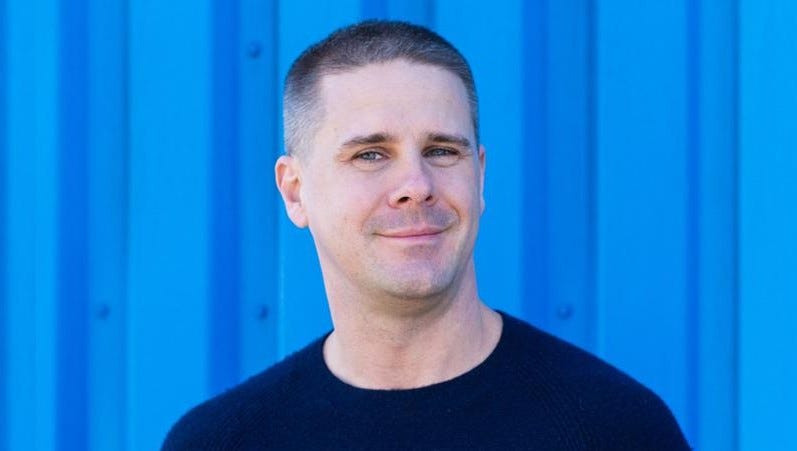
Volts podcast: Dan Pfeiffer on the Democratic Party's megaphone problem
In this episode, political communications expert Dan Pfeiffer speaks to the wide influence of right-wing media, why Democrats keep losing messaging battles, and what they need to do about it.
Text transcript:
David Roberts
You probably know Dan Pfeiffer best as one of the hosts of the wildly successful Pod Save America podcast, part of the growing Crooked Media empire of which he is a co-founder. Or perhaps you know him as the author of the Message Box newsletter, where he dispenses communications advice to left-leaning subscribers.
But before he was a new media mogul, Pfeiffer was in the thick of politics as a top aide on Obama’s campaign and then in Obama’s White House, where he ran communications and strategy.
Pfeiffer has seen the media war between the parties play out, and he has seen Democrats lose messaging battles again and again. He has first-hand experience of the growing power of the right-wing media machine to spread disinformation, set the agenda for the rest of the media, and deflect accountability.
Now he has written a book on the subject: Battling the Big Lie is an extended examination of the growing imbalance between the conservative movement’s massive media megaphone … and the left’s lack of one.
Listeners know that I have been obsessed with this imbalance for as long as I’ve been following politics, so I was super geeked to talk with Pfeiffer about how right-wing media grew, how it successfully intimidated both mainstream media and social media companies, and how Democrats can begin building a comparable megaphone of their own, before it’s too late.
Dan Pfeiffer. Welcome to Volts. Thanks for coming.
Dan Pfeiffer
Thanks for having me.
David Roberts
Congratulations on writing a book under extreme time pressure. An extremely stressful time to be alive. I hope the psychological damage has been minimal.
Dan Pfeiffer
I think we'll only know how much damage there was many years from now, so the full cost of this endeavor will not be known.
David Roberts
Well, I want to talk about the current situation, but just briefly at the beginning, let's look a little bit at history. So I wonder what you think are sort of the kind of the landmarks on the road to the current situation. So for instance, tell us a little bit about when the press, the mainstream press as the enemy, became a popular thing on the right. That's sort of the first and then the second is like, what are the sort of markers of the growth of their own media apparatus? How did we get here?
Dan Pfeiffer
Sure, there had been a bubbling sentiment of conservative anti-press sentiment dating back to the New Deal and FDR and Democrats sort of dominating the conversation. But it became a political strategy, primarily in Barry Goldwater's 1964 campaign. He hammered the press, he hammered Eastern elites. He handed out pins to the press on the press planes, calling them members of the Eastern establishment. The press as enemy became an explanation to the right, themselves and their voters why they kept losing elections. It wasn't that their policies were bad. It wasn't that they were unpopular. It wasn't that their rhetoric wasn't good.
It was that the press hated them. Nixon took that into hyperdrive because of his own set of insecurities and grievances. And even before Watergate, like in the course of the Nixon administration, there was real thoughts on how you go about destroying the press. Richard Nixon had his enemies list, which included members of the press. He also explored with Roger Ailes and some of his other aides very specific forerunners, the Fox News. In terms of state sponsored propaganda, there was an effort where they explored creating local news pieces created by the White House that would then be under a sort of undercover that would be sent to local news stations.
There was an effort to fund a pro-Vietnam War documentary to push back against the Pentagon Papers and other efforts out there. And then when the press, in the common "tell all the President's men" telling of what happened, took down Nixon, that became sort of the cause celeb in the right. "The press is out to get us. The press is out to get us." Reagan took that in the 80s. Getting rid of the Fairness Doctrine as a part of it was part of his campaign.
David Roberts
One question about that, about the Fairness Doctrine thing, I'm curious what sort of the public versus private justifications for that were, like, did Reagan and his people consciously do that in order to bolster right wing voices or was there some sincere ideological motivation back there somewhere?
Dan Pfeiffer
I think there was probably some sincere ideological motivation, but the primary driving factor, as I understand the history, was the fact that the Fairness Doctrine was putting downward pressure on efforts to have an emerging right wing radio ecosystem. And that in order to have that, every time they kept trying to move towards local stations, kept trying to move towards sort of the forerunners to Rush Limbaugh, there would be pressure from the FCC for equal time, et cetera. And so ending the Fairness Doctrine basically created the environment by which right-wing radio could thrive. Which created the environment by which Fox News could thrive.
The idea that the FCC and the Fairness actor and the big government were preventing conservative media was one of the motivating factors among grassroots activists that pushed Reagan to do it. And then there are a couple of moments in time where the idea of aggressive Republican Party adjacent media comes from. And I use that to distinguish between ideological media like Human Events and the Weekly Standard and sort of National Review, of which we have examples in the pre-Trump era on the right and the left, right sort of real magazines. It's pushing the party agenda, left or right, depending.
And that's obviously Roger Ailes recognizing that the power was in the press and so get partnering with Rupert Murdoch to start Fox News. Fox News becomes very, very powerful over the course of time finds a real market. And then there are two other moments that I think are incredibly significant. One is right after the 2012 election, there was a view pushed primarily by Steve Bannon that the right is losing the messaging wars and they need to double and triple down in the ability to push the political conversation in their direction. Their direction. And his view was cultural wars, immigration, et cetera.
And that leads to Breitbart, The Daily Caller, Free Beacon with real investment from a new set of, quote unquote, "Rupert Murdochs," like the Mercers who help start Breitbart, or take Breitbart from its previous version to the Steve Bannon pro-Trump version. You have Foster Freeze, who gives money to Tucker Carlson to start The Daily Caller. And then the moment that really sort of takes that, which would be in Supercharges, is Facebook really hits a tipping point in around 2014 where its reach, the news feed and the algorithm all sort of combine with these new right wing digital outlets to move the political conversation powerfully towards right wing extremist messagi
You May Also Like
700 WLW On-Demand
WLW-AM (WLWAM)

La Estrategia del Día México
Bloomberg Línea
The Dominic Carter Show
Podcast WABCRadio
The Adam Mockler Show
The Adam Mockler Show

Die Nachrichten
Deutschlandfunk

Bloomberg Law
Bloomberg

Čteme vám Seznam Zprávy
Seznam Zprávy

聽天下:天下雜誌Podcast
天下雜誌

O Antagonista
O Antagonista

NPR News Now
NPR
700 WLW On-Demand
WLW-AM (WLWAM)
La Estrategia del Día México
Bloomberg Línea
The Dominic Carter Show
Podcast WABCRadio
The Adam Mockler Show
The Adam Mockler Show
Die Nachrichten
Deutschlandfunk
Bloomberg Law
Bloomberg
Čteme vám Seznam Zprávy
Seznam Zprávy
聽天下:天下雜誌Podcast
天下雜誌
O Antagonista
O Antagonista
NPR News Now
NPR
Community discussion