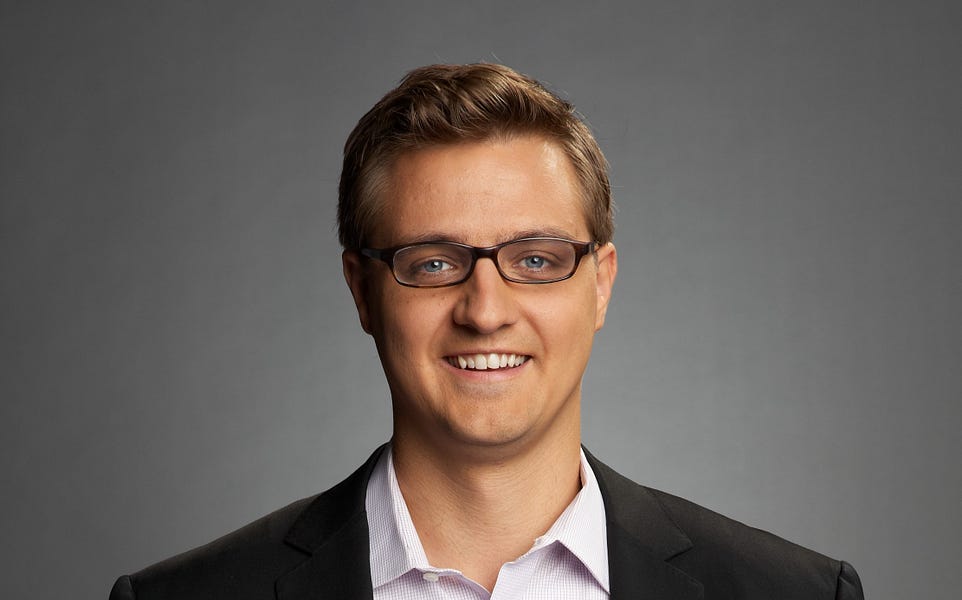
Volts podcast: Chris Hayes on how his politics have changed since 2015
In this episode, Chris Hayes of MSNBC discusses how American politics and society changed after the Obama years, where things might head in the future, and how his own views have shifted along the way.
Text transcript:
David Roberts
I often reflect on a particular moment in the summer of 2015. It was not long after the Supreme Court made gay marriage legal across the nation in Obergefell v. Hodges. And America was in the middle of one of its regular fights over Confederate monuments and flags, which were being pulled down by progressives across the country.
One afternoon I ran across a cartoon — I think it was on Facebook? — showing a Confederate flag being lowered and the LGBTQ flag being raised in its stead.
Hot damn, I thought. Maybe we really do get it right eventually.
I now think back on that moment as the peak of my belief in what you might call the Obama creed, which the nation's first black president repeated in one way or another in virtually every speech: that the essence of America is its continuous struggle toward the egalitarian ideals of its founding. Again and again it delays and falls short and takes two steps back, but it never stops striving, improving, bit by hard-fought bit. The arc of history is long, but it bends toward justice.
To a first approximation, everything that has happened since then has sucked. We fell into the ugly 2016 Democratic nomination fight, followed by the ugly presidential election, then four years of daily insults to dignity and compassion by Trump, then a plague that we bungled in countless ways and that has killed more than a million of us, and now, the Supreme Court is systematically dismantling the pillars of the modern administrative state while Biden and the Democrats fumble their way through a slow-motion catastrophe, setting up an openly seditious Republican Party to seize near-total power in the coming two elections.
To put it mildly, these developments have been rough on the Obama creed, at least for me and many people I know. Much of what Obama himself did was crushed or reversed by Trump, and Biden has barely begun rebuilding from the wreckage. More than that, America's reactionary minority seems ascendent. And its intentions are clear: to follow Viktor Orban's lead in Hungary. To whittle democracy down until it's entirely hollow, one-party rule in all but name. It finds echoes in similar reactionary backlashes currently rising in nations across the globe.
Is America redeemable? Is white Christian patriarchy ready and willing to destroy the country before it gives up power? Is the arc of history bending, or is it merely flailing back and forth, with no larger purpose or pattern? Is modern multi-racial, multi-cultural democracy still a viable long-term project?
To help ponder these weighty questions, I've turned to the inimitable Chris Hayes, who, as they say, needs no introduction. You've seen his shows on MSNBC, you've listened to his podcast, you've read his essays and books, you know that he is one of the leading liberal voices of our time. He’s also a friend. We are part of the same generation of journalists, living through the same dumpster fires, seeing the same patterns, and our paths have crossed regularly over the years. I’ve also been on several of his shows! We go way back.
I’ve always felt that Chris and I share similar political and intellectual instincts — one of the few people at the commanding heights of US journalism and punditry about whom I can say that — so I’m curious to hear how his political outlook has changed since 2015, whether he still believes in the Obama creed, and what he thinks is coming in America’s near future.
So with that portentous wind-up, let's bring him into the conversation.
Chris Hayes
That was great. I love that. I found that very moving.
David Roberts
Oh, great. Alright, well, thanks for coming on Volts.
Chris Hayes
I should say I'm a Volts reader, too.
David Roberts
Thank you. Thank you. I appreciate it. We're talking during a very dark time. Dark. I mean, it's all shades of dark these days. It's particularly dark in the wake of the latest ...
Chris Hayes
Child murder?
David Roberts
Child murder. Yes, child mass murder. That we're all going through the motions as we always do, until that fades and something else horrible comes up in the news. But let's pull the lens back. I want to do some big picture talking, and then a little bit more close in, like proximate, what's our proximate future talk? But let's start with the big picture. So I just want to start by asking you in the most general possible terms, if you think back to 2015, which I mark as sort of the last normal year, how has your political outlook changed?
I think of you as basically sort of a Left liberal, Scandinavian, welfare-state kind of guy. Has any of that fundamentally changed? Or if not, have you changed your mind about any big things? How have you evolved since then?
Chris Hayes
Yeah, I think my basic orientation, which is like, a Social Democrat, a Rawlsian liberal, a mixed economy, freedom plus groceries, adherent — freedom plus groceries, a great quote from a New Deal congressman describing the New Deal, which has never been improved upon for basically Social Democratic, mixed economy, rule of law. Broadly, I'm a liberal, and I'll talk about that in a second because I actually think that I'm more that in a specific philosophical sense than I ever was before, actually. But, yeah, that hasn't really changed. But things have changed. So one, I do think I'm a little less, I don't know what I feel about progress.
What I do feel with age, and with now going through having been a sort of professional working journalist for 20 years now, just like that, there are reformist moments and reactionary moments, and they kind of alternate and being able to recognize when you're in one almost the way that an athlete can recognize a defense. It's like, "Oh, yeah, no, right now we're in a reactionary moment." I just know what a reactionary moment feels like because I've been through a bunch of them. And in some ways there's a little bit of some comfort, I find, in that, because there's a little of "this too shall pass" about the nature of reactionary moments.
First sort of reformist moments, radical moments, even. I mean, I think there were moments in the Trump administration where we're almost sort of revolutionary in some ways, a level of sort of radical thirst for and exuberant enthusiasm for taking on Patriarchy and White Supremacy that I'd never seen before in my life. I mean, the the sort of both "Me Too" and the Women's March and then the George Floyd protests. So I think I've gotten more, just like a little, again, I think a little wisened or sanguine about the fact that you go through different periods in the life of a society, in a democracy.
I also think things are more tangibly perilous than they've ever been. I think that's informed by actual hard facts. And it really is the case that January 6th hadn't ever happened before. It really is the case that one of the two parties is openly seditious, or contains a faction that's openly seditious. It really is the case that we've pissed away 20 years that we could have been doing stuff on carbon, and no
You May Also Like

World News Tonight with David Muir
ABC News

NPR News Now
NPR
700 WLW On-Demand
WLW-AM (WLWAM)

The Indo Daily
Irish Independent

Start
Il Sole 24 Ore

Erin Burnett OutFront
CNN Podcasts

Matices
Central de Radios

O Antagonista
O Antagonista

La Estrategia del Día México
Bloomberg Línea
Jeffrey Epstein: The Coverup Chronicles
Bobby Capucci
World News Tonight with David Muir
ABC News
NPR News Now
NPR
700 WLW On-Demand
WLW-AM (WLWAM)
The Indo Daily
Irish Independent
Start
Il Sole 24 Ore
Erin Burnett OutFront
CNN Podcasts
Matices
Central de Radios
O Antagonista
O Antagonista
La Estrategia del Día México
Bloomberg Línea
Jeffrey Epstein: The Coverup Chronicles
Bobby Capucci
Community discussion