Volts podcast: Charles Marohn on unsustainable suburbs
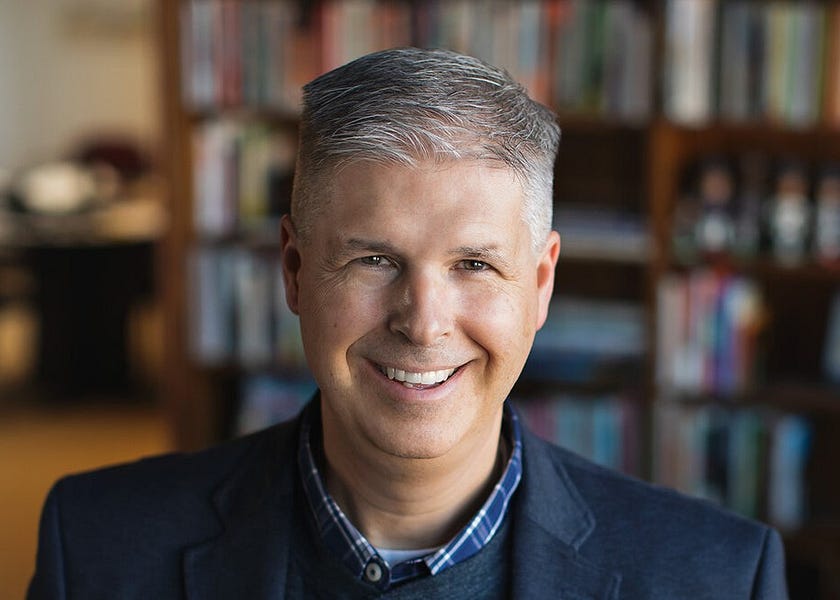
In this episode, Charles Marohn of Strong Towns discusses why urban planning too often creates money-sucking suburbs, what it might look like to build healthy communities, and why there are so many barriers to doing so.
Text transcript:
David Roberts
Charles Marohn — “Chuck” to his friends — grew up in a small town in Minnesota and later became an urban planner and traffic engineer in the state. After a few years, he began noticing that the projects he was building were hurting the towns he was putting them in — subtracting more tax value than they added, forcing everyone into cars, breaking apart communities and saddling them with unsustainable long-term liabilities.
He began recording his observations on a blog called Strong Towns. It quickly caught on, and over the years, Strong Towns has grown into a full-fledged nonprofit with an educational curriculum, an awards program, and a rich network of local chapters working to improve the towns where they are located.
Marohn has since written several books, most recently 2021’s Confessions of a Recovering Engineer and 2019’s Strong Towns. Intellectually, he sits somewhat orthogonally to most of the contemporary urbanist community. He’s an avowed conservative and opposes many of the state and federal solutions to the housing crisis favored by today’s YIMBYs.
But there is arguably no one alive in America who has done more to get people thinking about what makes for a healthy community and how the US can begin to repair its abysmal late-20th-century land-use choices. I was excited to talk to Marohn about why suburbs are money-losers, the right way to think about NIMBYs and local control, and why the city planning profession is so resistant to reform.
Okey-doke, without any further ado, Chuck Marohn of Strong Towns. Welcome to Volts. Thanks for coming.
Charles Marohn
Hey, thanks for having me.
David Roberts
This is really cool. I've been sort of a follower of Strong Towns for many, many years. It's great to finally get you on here. I wish we could be talking under more pleasant circumstances.
Charles Marohn
Oh yeah. You got to always have some joy and optimism to things.
David Roberts
I'm trying. Before we get into any of that stuff, I am sure this is something you've talked about a million times, but I still don't know that it's sunk into the general public. So let's just summarize real quick right off the bat, the core of the Strong Town's critique of suburbs, the sort of Ponzi scheme critique. Because I think still to this day, it probably comes as a surprise to most average Americans, just the idea that suburbs don't pay for themselves, but I just don't think most people know it. So let's just review that real quick.
Charles Marohn
It's astounding though because we've come a long way, because now I see when people bring up what is kind of like an ignorant statement of like, "I pay my taxes, this stuff is paying ..." people are like, "Whoa, hang on, let me show you something." So when I was a young engineer and planner, I have a civil engineering degree, I have a planning degree, I was building all this stuff to make cities really successful. I was putting in roads and streets and pipes and building Walmart parking lots and Arby's drive throughs and ...
David Roberts
Every architect's dream as a child.
Charles Marohn
Oh, yeah, no, this was great stuff. And I believed in my heart that I was making the city that I live in, the city that I grew up in, wealthier and more prosperous. But over and over and over again, I would be exposed to these insane projects. These projects that if you're an engineer, you kind of work in a silo of design. If you're a planner, you kind of work in a silo of regulation. But when you do both, you wind up with this left brain, right brain conflict that makes you ask like weird questions. And that's what I was doing.
I was asking questions like, "Okay, this is going to cost us a million dollars. How long will it take us to recoup that with the tax base that we get?" And I would run these numbers and it would be insane things like 120 years. It's like, okay, either I'm calculating this wrong, or something's really messed up. And I started just doing this over and over and over again with all these different developments that I had worked on. And in 2008, I started to publish this stuff. I started to write a blog and I share this stuff.
And quite frankly, I was open to the idea that maybe I was crazy, right? There's got to be something I'm not seeing because there's a lot of smart people doing this work. I can't be the only one asking this question. But turns out, I was the only one really asking this question. Or there were others, but they were disparate voices, either from the past or silent. And we started to build at Strong Towns. Myself and some of my colleagues and friends started to build this body of insight, this body of evidence that at a certain point just became undeniable.
And the undeniable nature of it is that when you build in the suburban pattern, we call the auto-oriented pattern development because we certainly find this style of development within urban areas too. Right, we tear down stuff and rebuild it in a suburban style. When you see this style of development, what we find is that it generates from a cash flow standpoint, a lot of immediate cash. The quintessential example is we get a developer to come in and put in the pipe and put in the road and put in the sidewalks and build all the infrastructure and then gift it to the city.
And the city then gets all the tax base, all the revenue, all the money coming in from this without having to spend anything upfront. So from a cash flow standpoint, the city is way ahead, way ahead in year one, way ahead in year two, way ahead in year three. But the problem with this transaction is that the city then agrees to take on the long-term liability. We will go out and maintain that road. We will go out and maintain that pipe. And of course, they do this on behalf of the public, right? So we all collectively together get cash today in exchange for a long-term promise that we have to make good on in the future.
If you compare those two things, if you add up all the cash, and you compare it to the ultimate amount we have to expend, in this style of the development, the post-war style of development, the style of the first ring, second ring, third ring, exurbs, the style that we've re-developed the internal core of many of our cities around. It's not just functionally insolvent. It's bizarrely insolvent. It creates a dime or two of revenue for every dollar of expense it generates. It literally is a wealth-destroying, kind of, growth machine. And, yeah, I think the difficulty in perception is that we can all see that cities that are growing fast are shiny and new and look better and are doing better than the cities that are stagnant or declining.
David Roberts
Right.
Charles Marohn
We can all see that. We can all see that those cities have bigger budgets and fancier stuff. And while all of
You May Also Like

NPR News Now
NPR
Newshour
BBC World Service

The Fox News Rundown
FOX News Radio

24/7 News: The Latest
iHeartPodcasts and TTWN
Dialogue Works
Nima Rostami Alkhorshid

Asmongold TV
Asmongold TV

共同通信Podcastーニュースの裏側も、多言語学習も、経済もー
共同通信社 KyodoNews(Japan News Agency)

Jeffrey Epstein: The Coverup Chronicles
Bobby Capucci

Así las cosas con Carlos Loret de Mola
WRadio

The Political Scene | The New Yorker
The New Yorker
NPR News Now
NPR
Newshour
BBC World Service
The Fox News Rundown
FOX News Radio
24/7 News: The Latest
iHeartPodcasts and TTWN
Dialogue Works
Nima Rostami Alkhorshid
Asmongold TV
Asmongold TV
共同通信Podcastーニュースの裏側も、多言語学習も、経済もー
共同通信社 KyodoNews(Japan News Agency)
Jeffrey Epstein: The Coverup Chronicles
Bobby Capucci
Así las cosas con Carlos Loret de Mola
WRadio
The Political Scene | The New Yorker
The New Yorker
Community discussion