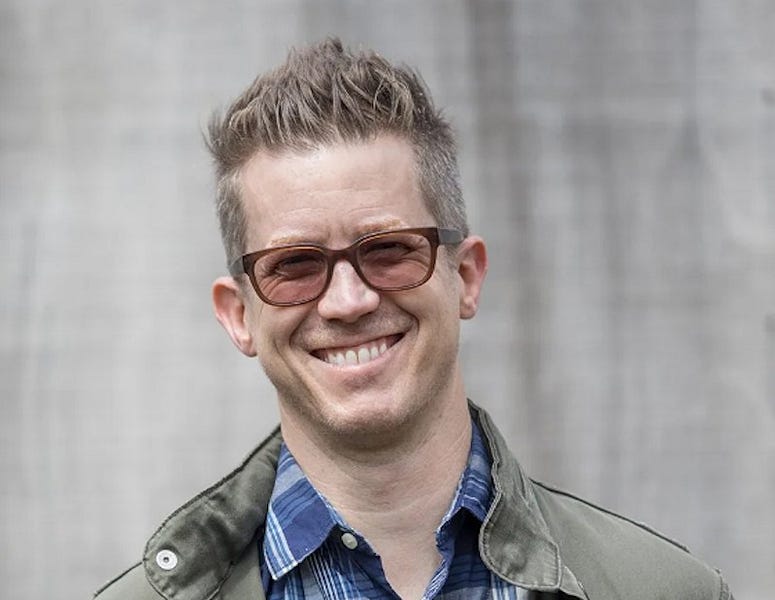
Volts podcast: a music festival that treads lightly on the earth
In this episode, Zale Schoenborn shares about emphasizing sustainability at Pickathon, the Northwest music festival he founded.
Text transcript:
David Roberts
Listeners, today at Volts we've got something a little different, a little off our beaten path. It’s an episode about one of my favorite music festivals. It might not seem obvious to you why you should care about a small music festival in the far northwest of the country, but I think if you are patient and listen for a little bit, you'll get a sense of why I’m spending time on it (beyond self-indulgence).
By the time 2011 rolled around, I was more or less done with music festivals. I love live music and have been to many great concerts, but most festival experiences were so hectic, stressful, crowded, dirty, and exploitative that it just no longer seemed worth the effort. (That has only gotten more true in intervening years.) So I was a little skeptical when a friend told me about the Pickathon festival, held every year about 20 miles outside of Portland, Oregon.
For one thing … “Pickathon”? Sounds like one of those twangy festivals with crunchy hippies playing mandolins and banjos. That is not my bag. But he assured me that the lineup is diverse, from all genres, focused on acts that are about to break bigger.
He talked me into going. And listener, it blew my mind.
For one thing, the land itself is gorgeous — it is held at Pendarvis Farm, a sprawling area of pastureland and wooded hills that is used only once a year for gatherings, only for Pickathon.
Every attendee camps (the festival lasts three days), but not in some crowded parking lot. Rather, there is a whole network of trails running through the woods, with established camping spots that have been used and reused since 1999 when the festival started.
Then there’s the crowd. It wasn't jam-packed. You could always get food or drink with very little line. You could always see the band, no matter which band you wanted to see. There were tons and tons of families and children and almost no backward-baseball-cap bros. It felt oddly wholesome.
But perhaps the strongest impression I took away that first weekend was how weirdly, anomalously clean the festival was. One staple of festival life is giant, overflowing trash cans, with food wrappings and disposable cups strewn everywhere. At Pickathon there was none of that. There was virtually no visible trash. Water was free, available at spigots across the grounds.
It all struck me as so intensely human, so humane, that I fell in love and attended almost every year thereafter. (Here’s a 2013 story I did for Grist and a 2017 story I did for Vox, in which I interviewed 20 artists in three days.)
Pickathon is back this year after a two-year hiatus, so I couldn’t pass up the opportunity to talk with festival founder Zale Schoenborn about how the festival has evolved since 1999, what's next on the sustainability front, and what's new at the festival this year. Even if you don't happen to live in the Pacific Northwest and can't attend, I think you'll enjoy hearing from someone who has put so much thought into into bringing humans together to commune and celebrate in a socially and environmentally sustainable way.
Alright. Zale Schoenborn of Pickathon, thank you for coming to Volts.
Zale Schoenborn
Thanks for having me.
David Roberts
I'm sure this must be an insanely busy week for you, so thanks for taking the time.
Zale Schoenborn
No problem. It is definitely exciting.
David Roberts
Yeah. So there's a ton to talk about with your music festival, but first, I guess I'd like to just go back and hear a story that I'm sure you have told hundreds of times by now. But Pickathon is remarkably long-running, in the context of the music festival world. It started in 1999, which is just wild. So stretch your mind back, if you can, that far, and tell our listeners the story of just why did you start a music festival? And initially, when you started it, what was kind of the vision? And to what extent is that vision changed or sort of held steady in the, doing math, 24 years? 3? 23 years since?
Zale Schoenborn
24? I don't know. It's all ... you got to count one extra year in there, I think. Great question. Well, going all the way back, something that lasts 24 years, if anyone has the honor of kind of a hobby that grows out of control, that can turn into something, that's the only way you get to what Pickathon is. It's years of making horrible mistakes, and fixing them, and surviving them. So, like, all of the above. But if you rewind all the way back to 1999, it really was pretty humble beginnings. We just thought of, why don't we have kind of a better music party with our friends? And we always had this idea of "genre-based music festivals are really annoying." Like, how come we have to be so isolated in a Bluegrass festival or a Rock festival?
David Roberts
Yes, thank you for saying that. I don't know why that's not a more widespread opinion. "We're having an ice cream festival. Come and eat all ice cream for three days." I mean, I like ice cream.
Zale Schoenborn
Exactly. You really get sick of music you love, if that's all you hear. So it was interesting because the response from the pre-program crowds was very negative to that. They did not endorse it. There's like a hardcore following in these kind of genre circuits, and if you were there, they're going to come see the genre that they kind of support. But if you mixed it up, you are off in Never Never Land. And it wasn't until the really big festivals like Bonnaroo and other folks started mixing it up some, that that became a thing. So now it's pretty common, but we stretch it a little farther. And that's kind of like the early days. We were just kind of having a party. Let's potluck party. And we said, "jeez, what can we do with all this energy? Well, let's support our community radio station." So we were just like raising money for KBOO, a local radio station here. And that kind of happened for like six, seven years in that mode.
David Roberts
This was in Portland, though.
Zale Schoenborn
It did start ... we were out in Portland. We've been in three different sites. So the first site we were out at is Horning's Hideout. So in this KBOO phase, we were out in a place a little bit out in the west side of Portland, and beautiful little kind of reserved acreage in the coastal mountains. We didn't survive there because there was just a lot of neighbor turmoil, and we were the little festival. We were having awesome acts. I think we had one of the last Holy Modal Rounders, true performances by them. Kelly Joe Phelps.
It was awesome, but it was just not ... it takes a while. Pickathon is one of those things that we could tell everyone it was going to be awesome. And we, basically, had to have people come and grow by like 10% a year because that's the only way folks would get it. We just didn't do a lot of what we
You May Also Like

24/7 News: The Latest
iHeartPodcasts and TTWN
Dialogue Works
Nima Rostami Alkhorshid

The Political Scene | The New Yorker
The New Yorker

Meet the Press
NBC News

The Epstein Chronicles
Bobby Capucci

IHIP News
Jennifer Welch & Angie Sullivan

The MeidasTouch Podcast
MeidasTouch Network

Durango Local News
LNN Durango, Colorado

Bloomberg Intelligence
Bloomberg

The Sean Spicer Show
The Sean Spicer Show
24/7 News: The Latest
iHeartPodcasts and TTWN
Dialogue Works
Nima Rostami Alkhorshid
The Political Scene | The New Yorker
The New Yorker
Meet the Press
NBC News
The Epstein Chronicles
Bobby Capucci
IHIP News
Jennifer Welch & Angie Sullivan
The MeidasTouch Podcast
MeidasTouch Network
Durango Local News
LNN Durango, Colorado
Bloomberg Intelligence
Bloomberg
The Sean Spicer Show
The Sean Spicer Show
Community discussion