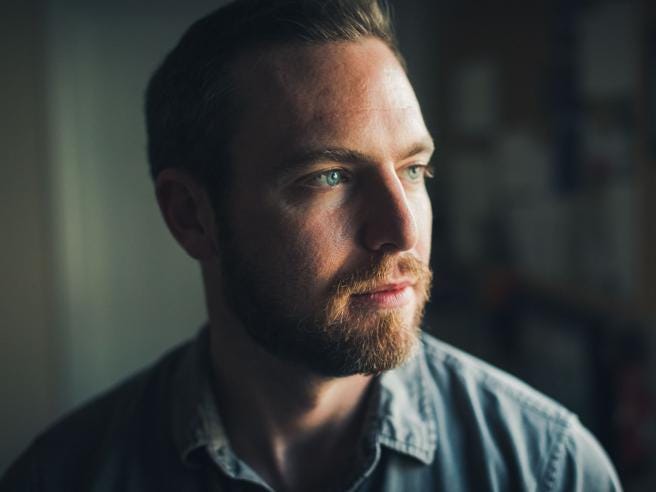
On writing an ambitious and terrifyingly realistic novel about climate change
In this episode, author Stephen Markley discusses his new novel, The Deluge, which describes a future affected by climate change that hits uncomfortably close to home.
Text transcript:
David Roberts
In 2018, author Stephen Markley won near-universal critical praise with his debut novel Ohio, a tight set piece that takes place over the course of a single night, as four high school classmates reunite at a diner in their northeastern Ohio hometown.
“Four characters, one night” is pretty much the opposite of Markley’s sprawling new novel The Deluge, which tracks dozens of characters over the course of decades, from the 2010s out past 2040, everyone from climate activists to scientists to political operatives, as they suffer the effects of climate change (there are some quasi-biblical disasters) and struggle to marshal the political will to address it.
The novel crucially involves climate policy, reactionary backlashes, and direct activism, among other topics of great interest to the Volts audience.
On Thursday January 12th at Seattle’s Third Place Books, I was lucky enough to talk to Markley about the genesis of the novel, some of its major themes, and the difficulties he faced in writing it.
The crew at Third Place was kind enough to record the event (thanks Spencer!), so I'm happy to bring it to you as an episode of Volts. Please enjoy, and while you're at it, do the smart thing and buy copies of The Deluge for all the readers in your life.
Third Place Books Staff
Please join me in welcoming Stephen Markley and David Roberts to Third Place Books.
David Roberts
Where to begin? I'm just going to jump right in asking Stephen questions because I have nothing interesting to say. So, I've been writing nonfiction my whole life and have thought periodically about writing fiction—like every nonfiction author does—and even took a while one summer or one time when I had some time off to sort of sit and stare at the screen for a while and think about doing it. I had kind of a plot for a near future quasi-scifi thing, and there are tons and tons of reasons why I very quickly concluded that I was not suited to writing fiction.
But one of them was the one I still think about, which is just: "What does the near future look like?" And the more I thought about that, the more I thought, "Boy, I have no idea at all what the near future looks like." I mean, I guess you could say that at any time in history, but it seems like particularly now, there's just so much crazy s**t going on. It's really like, how is it all going to interact and play out? And I found myself completely daunted and shut down by that problem.
So here you are. You have decided to start a novel basically two years in the past, and then literally just detail what happens—not in some fictional world or some far off world—what happens in this world among these people in this country over the next two, four, six, ten years in detail. And that just strikes me as just, like, fictionally speaking, the highest conceivable level of difficulty that you could set yourself. Why do that? In the book that we talked a little bit beforehand, you were thinking about even before Ohio, it just seems like the hardest thing you could do. Why not write a couple of easy books to start with?
Stephen Markley
Yeah, it all breezed by. It all went super easy and nothing surprised me. Yeah, it just came pouring out with no...nothing got in the way, historically or politically, that made... Yeah, no, it was an incredibly high degree of difficulty for the reasons you said. And all the problems of writing a 1,000-page novel, combined with the problems of it has to feel absolutely realistic at the moment of its publication. It has to feel as if it's our world sliding into this next world, right. At dinner, we were talking, I started the book in 2010, at roughly the same time as "Ohio," had to set it aside when "Ohio" was published, and then came back to it in 2017. So in that time, I don't know if you guys heard, a game show host actually got elected president. And so, the terrifying presidential character I was returning to was suddenly really unrealistic in his bombasticness. Because, like the real thing was much...
David Roberts
There's a relatively muted fascist president in your book, looking at it from our present vantage point.
Stephen Markley
I mean, look, it was a mind-blowing project for me because I had to keep paying attention to every little detail of what was happening in climate, technology, politics, our society. And unfortunately, I had found the right veins, clearly, just in terms of how our politics were developing. And that just felt like it accelerated so quickly. And then with climate policy, I think that was another, sort of, murky issue. You've talked about on your podcast before, where there was this dead period after Waxman-Markey failed in the Obama administration, where it felt like everybody was throwing up their hands. And I think that was a tough place to be to...like thinking about the future of where policy would head or how it might develop.
David Roberts
Yeah. And speaking of difficulty, sort of as you're writing and finishing, finally, Democrats are back in control and coming back to climate policy and debating the Build Back Better bill and then, specifically, the climate bill and, specifically, during that exact time period you were finishing, Joe Manchin was noodling around...
Stephen Markley
Prevaricating, let's say.
David Roberts
...prevaricating and noodling around and making everybody wait and wonder. And it was just wildly uncertain right up until the day he woke up on the right side of the yacht, I guess, or whatever happened. But right up until that day, it was just wildly unclear what was going to happen. It was a very big, sort of, historical pivot that was on the line. And it literally...that historical pivot took place during the years covered by your book. So, did this keep you awake at night, the course of actual events?
Stephen Markley
Yeah, and I mean, in a way, when it passed, I was like both sobbing with relief and pissed at the Democrats. Like, "You should have let this fail so my novel would make more sense." Actually, what happened was I had fourth pass, like the last pass in my hands at the moment Joe Manchin was like, "I'm out on this bill. It's not happening." Right. So I send the book off to the publisher. I'm listening to people, like, cry on podcasts about our dark future, and then the bill passes. So what is going to be the case in the next edition?
There are some key sentences that will be changed to reflect the reality of the Inflation Reduction Act passing. So this is just a way of me selling more books. You got to get the first edition and then come back to the next edition and buy that one too.
David Roberts
You May Also Like

NPR News Now
NPR

700 WLW On-Demand
WLW-AM (WLWAM)

Start
Il Sole 24 Ore

Erin Burnett OutFront
CNN Podcasts

Matices
Central de Radios
O Antagonista
O Antagonista

La Estrategia del Día México
Bloomberg Línea
Jeffrey Epstein: The Coverup Chronicles
Bobby Capucci
The Dominic Carter Show
Podcast WABCRadio
The Adam Mockler Show
The Adam Mockler Show
NPR News Now
NPR
700 WLW On-Demand
WLW-AM (WLWAM)
Start
Il Sole 24 Ore
Erin Burnett OutFront
CNN Podcasts
Matices
Central de Radios
O Antagonista
O Antagonista
La Estrategia del Día México
Bloomberg Línea
Jeffrey Epstein: The Coverup Chronicles
Bobby Capucci
The Dominic Carter Show
Podcast WABCRadio
The Adam Mockler Show
The Adam Mockler Show
Community discussion