On the abuse (and proper use) of climate models
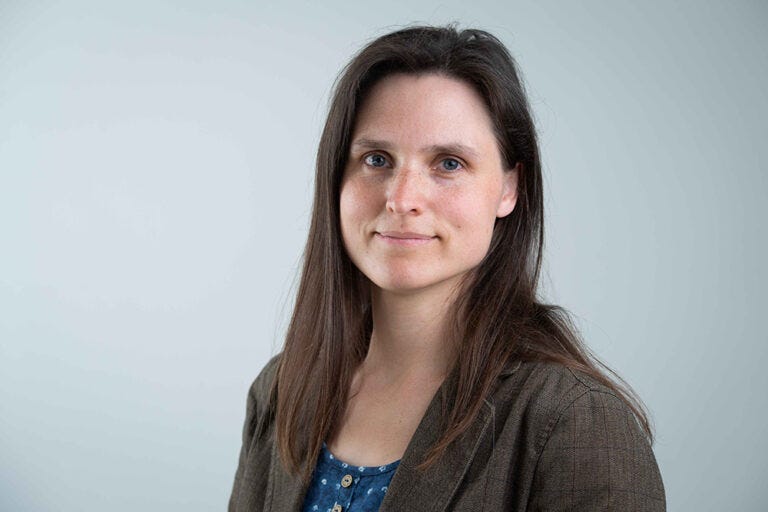
British researcher Erica Thompson’s recently published book is a thorough critique of the world of mathematical modeling. In this episode, she discusses the limitations of models, the role of human judgment, and how climate modeling could be improved.
Text transcript:
David Roberts
Everyone who's followed climate change for any length of time is familiar with the central role that complex mathematical models play in climate science and politics. Models give us predictions about how much the Earth's atmosphere will warm and how much it will cost to prevent or adapt to that warming.
British researcher Erica Thompson has been thinking about the uses and misuse of mathematical modeling for years, and she has just come out with an absorbing and thought-provoking new book on the subject called Escape from Model Land: How Mathematical Models Can Lead Us Astray and What We Can Do About It.
More than anything, it is an extended plea for epistemological humility — a proper appreciation of the intrinsic limitations of modeling, the deep uncertainties that can never be eliminated, and the ineradicable role of human judgment in interpreting model results and applying them to the real world.
As Volts listeners know, my favorite kind of book takes a set of my vague intuitions and theories and lays them out in a cogent, well-researched argument. One does love having one's priors confirmed! I wrote critiques of climate modeling at Vox and even way back at Grist — it's been a persistent interest of mine — but Thompson's book lays out a full, rich account of what models can and can't help us do, and how we can put them to better use.
I was thrilled to talk with her about some of her critiques of models and how they apply to climate modeling, among many other things. This is a long one! But a good one, I think. Settle in.
Alright, then, with no further ado, Erica Thompson, welcome to Volts. Thank you so much for coming.
Erica Thompson
Hi. Great to be here.
David Roberts
I loved your book, and I'm so glad you wrote it. I just want to start there.
Erica Thompson
That's great. Thank you. Good to hear.
David Roberts
Way, way back in the Mesozoic era, when I was a young writer at a tiny little publication called Grist—this would have been like 2005, I think—one of the first things I wrote that really kind of blew up and became popular was, bizarrely, a long piece about discount rates and their role in climate models. And the whole point of that post was, this is clearly a dispute over values. This is an ethical dispute that is happening under cover of science. And if we're going to have these ethical judgments so influential in our world, we should drag them out into the light and have those disputes in public with some democratic input.
And for whatever reason, people love that post. I still hear about that post to this day. So, all of which is just to say, I have a long-standing interest in this and models and how we use them, and I think there's more public interest in this than you might think. So, that's all preface. I'm not here to do a soliloquy about how much I loved your book. Let's start with just briefly about your background. Were you in another field and kept running across models and then started thinking about how they work? Or were you always intending to study models directly? How did you end up here?
Erica Thompson
Yeah, okay. So, I mean, my background is maths and physics. And after studying that at university, I went to do a PhD, and that was in climate change physics. So climate science about North Atlantic storms. And the first thing I did—as you do—was a literature review about what would happen to North Atlantic storms given climate change, more CO2 in the atmosphere. And so you look at models for that. And so, I started looking at the models, and I looked at them, and this was sort of 10-15 years ago now—and certainly there's more consensus now—but at that time, it was really the case that you could find models doing almost anything with North American storms.
You could find one saying... the storm tracks would move north, they'd move south, they'd get stronger, they'd get weaker, they'd be more intense storms, less intense storms. And they didn't even agree within their own aerobars. And that was what really stuck out to me, was that, actually, because these distributions weren't even overlapping, it wasn't telling me very much at all about North Atlantic storms, but it was telling me a great deal about models and the way that we use models. And so I got really interested in how we make inferences from models. How do we construct ranges and uncertainty ranges from model output? What should we do with it? What does it even mean? And then I've kind of gone from there into looking at models in a series of other contexts. And the book sort of brings together those thoughts into what I hope is a more cohesive argument about the use of models.
David Roberts
Yeah, it's a real rabbit hole. It goes deep. The book is focusing specifically on mathematical models, these sort of complex models that you see today in the financial system and the climate system. But the term "model" itself, let's just start with that because I'm not sure everybody's clear on just what that means. And you have a very sort of capacious definition.
Erica Thompson
I do, yeah.
David Roberts
...of what a model is. So just maybe let's start there.
Erica Thompson
Yeah. So, I mean, I suppose the models that I'm talking about mostly, when I'm talking in the book, is about complex models where we're trying to predict something that's going to happen in the future. So whether that's climate models, weather models—the weather forecast is a good example—economic forecasts, business forecasting, pandemic and public health forecasting are ones that we've all been gruesomely familiar with over the last few years. So those are kind of the one end of a spectrum of models, and they are the sort of big, complex, beast-end of the spectrum. But I also include, in my idea of models, I would include much simpler ones, kind of an Excel spreadsheet or even just a few equations written down on a piece of paper where you say, "I'm trying to sort of describe the universe in some way by making this model and writing this down."
But also I would go further than that, and I would say that any representation is a model insofar as it goes. And so that could include a map or a photograph or a piece of fiction—even if we go a bit more speculative—fiction or descriptions. These are models as metaphors. We're making a metaphor in order to understand a situation. And so while the sort of mathematical end of my argument is directed more at the big, complex models, the conceptual side of the argument, I think, applies all the way along.
David Roberts
Right, and you could say—in regard to mathematical models—some of the points you make are y
You May Also Like

The Stone Zone with Roger Stone
Podcast WABCRadio

The Diddy Diaries
Bobby Capucci

World News Tonight with David Muir
ABC News

NPR News Now
NPR

700 WLW On-Demand
WLW-AM (WLWAM)

The Indo Daily
Irish Independent

Start
Il Sole 24 Ore

Erin Burnett OutFront
CNN Podcasts

Dialogue Works
Nima Rostami Alkhorshid

JIJI English News-時事通信英語ニュース-
時事通信社
The Stone Zone with Roger Stone
Podcast WABCRadio
The Diddy Diaries
Bobby Capucci
World News Tonight with David Muir
ABC News
NPR News Now
NPR
700 WLW On-Demand
WLW-AM (WLWAM)
The Indo Daily
Irish Independent
Start
Il Sole 24 Ore
Erin Burnett OutFront
CNN Podcasts
Dialogue Works
Nima Rostami Alkhorshid
JIJI English News-時事通信英語ニュース-
時事通信社
Community discussion