How big business sold America the myth of the free market
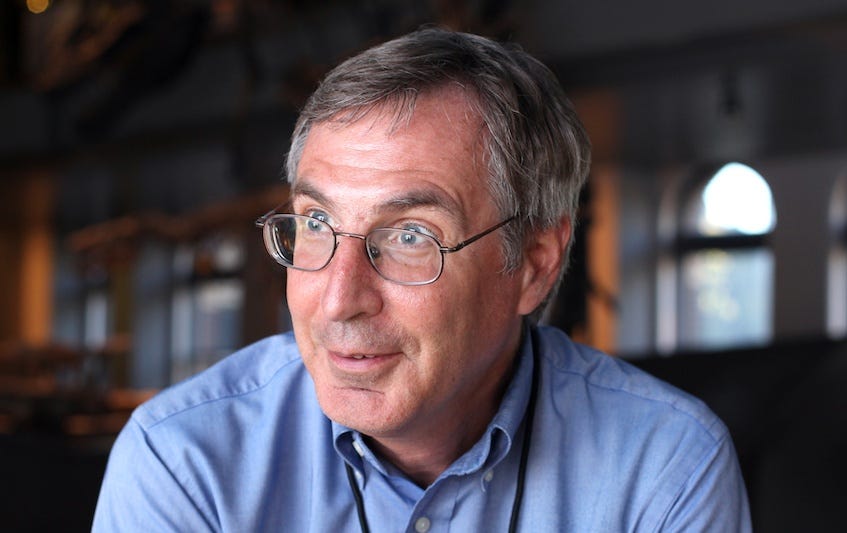
In this episode, Erik M. Conway discusses his new book The Big Myth: How American Business Taught Us to Loathe Government and Love the Free Market, coauthored with Naomi Oreskes.
Text transcript:
David Roberts
In 2010, historians of technology Erik M. Conway and Naomi Oreskes released Merchants of Doubt: How a Handful of Scientists Obscured the Truth on Issues from Tobacco Smoke to Global Warming, a book about weaponized misinformation that proved to be extraordinarily prescient and influential.
Now Oreskes and Conway are back with a new book: The Big Myth: How American Business Taught Us to Loathe Government and Love the Free Market. It's about the laissez-faire ideology of unfettered, unrestrained markets, which was invented and sold to the American people in the 20th century through waves of well-funded propaganda campaigns. The success of that propaganda has left the US ill-equipped to address its modern challenges.
On March 8, I interviewed Conway at an event for Seattle's Town Hall, where we discussed the themes of the book, the hold free-market ideology still has over us, and the prospects for new thinking. The organizers were kind enough to allow me to share the recording with you as an episode of Volts. Enjoy!
Megan Castillo
Good evening, everybody. My name is Megan Castillo. I'm Town Hall's program manager. On behalf of the staff here at Town Hall Seattle and our friends at Finney books, it's my pleasure to welcome you to our presentation with Eric Conway and David Roberts. Conway's new book, "The Big Myth," is the subject of tonight's talk. Please join me in welcoming Eric Conway and David Roberts.
David Roberts
Hey, everybody. Thanks. I'm just going to jump right in. Several things I'd like to get into, but just to start, one of the things that really the book really gets across well, I thought, which I don't know that I fully appreciated, is the extent to which this idea of unfettered, unregulated free capitalism is an invention of the 20th century. It's not what capitalism ... the founders and architects of capitalism, it very much goes against their larger philosophy and their larger kind of moral sentiments. And the way it does this is by elevating property rights, basically trying to they call it the "indivisibility thesis" that property rights and political freedom are one and the same.
And any limitation on property rights is de facto a limitation on political freedom. That's new, that was not original to capitalism. So maybe talk a little bit about property rights and how they sort of what the pivot these groups did with that concept in the 20th century, in the early 20th century.
Erik Conway
Okay, so that's a jump forward from a book that starts with child labor laws in the 19th century. What I think you're bringing up is the tripod of freedom that the National Association of Manufacturers concocts in the late 1930s as part of their effort to undo the New Deal of the Roosevelt administration. And the idea of the tripod of freedom was, if you think about a three-legged stool there's what they would call industrial freedom or business freedom, religious freedom, and political freedom are the three legs of the stool. So if you remove industrial freedom, businesses freedom to do what they want, then the stool falls.
This is a slippery slope argument that equates business freedom with the other two first amendment freedoms. That's what they spent a decade and millions of dollars, 1930s dollars, promoting through billboard campaigns and materials made for schools and movies and so forth in order to try to convince the public that that's the American way, even though it is a pure invention. In the 19th century, of course, lots of business was regulated and the corporate form itself was primarily a tool used by states. States would create a corporation to accomplish a thing like the Erie Canal Corporation to build and run that canal system for the state.
And roads were done this way and so forth. And through a whole complicated process, the corporation sort of slowly gets disentangled from the state in the 19th century so that by 1935, we can imagine corporations that are no longer state functions.
David Roberts
Yeah, one of the wild things is learning that early corporations had to go to states and say, "Can we be a corporation?" And the states would be like justify why? Like tell us why. What public good are you serving? It's just a wild inversion of things. And also another piece of this is, and maybe this doesn't come into it as much until the Austrian economists that get brought over, and I guess this would be in the 60s, kind of 50s and 60s, Hayek and the other one whose name is not coming to my mind. Yeah, but this idea that not only is business freedom core to American freedom but the role of the business person, businessman, I guess they always said back then, is explicitly not to be decent, not to be good, solely to make money.
So the idea is that if you have these like purely self-interested actors, the magic of aggregating them produces social good, but the individual not only has no obligation to do public good with their business or their corporation, in a sense they're sort of like violating the spirit of capitalism if they do it. Which again is like would send Adam Smith rolling in his grave. Only if you could just say a little bit about how they conceive of the morality of the business person or the morality of business and how that changed from what Adam Smith laid out.
Erik Conway
So that invention of what we now call shareholder value we can trace really back to Chicago school economist. It's mostly popularized by Milton Friedman, though he didn't concoct the term. The idea is, in his 1962 book Capitalism and Freedom he takes a more extreme view of that than the Austrian economist did. Hayek, for example, actually thought there was grounds for workmen's rights of some kind and that there were some justifiable kinds of social mitigations of industrial freedom, as did Adam Smith. Yet Friedman's ideals are what take over in the course of the early eighties. I think it's in the 1980s that the idea really takes off around General Electric Corporation.
For example, those of us of a certain age remember Neutron Jack just dismantling General Electric and removing the basic ideas that the company had served in the 30s and 40s, for example, of investing in its community in order to have healthy communities around its plants and so forth. And all that goes away in that era of the 80s. So you can see, for example, in the movie "Wall Street," if anybody remembers that from the 80s, there's a great speech about Teldar paper by Michael Douglas and how it exists only to serve its shareholders. And that's where all the profits should go, and its only social good should be ensuring the continued flow of finance to the shareholders.
And all other good things are supposed to fall out of that, except what else actually fell out of that is workers livelihoods and so forth. It's a fascinating reinvention. In fact, as we begin to br
You May Also Like

World News Tonight with David Muir
ABC News

NPR News Now
NPR

700 WLW On-Demand
WLW-AM (WLWAM)

The Indo Daily
Irish Independent

Start
Il Sole 24 Ore

Erin Burnett OutFront
CNN Podcasts
Dialogue Works
Nima Rostami Alkhorshid

JIJI English News-時事通信英語ニュース-
時事通信社

Matices
Central de Radios
O Antagonista
O Antagonista
World News Tonight with David Muir
ABC News
NPR News Now
NPR
700 WLW On-Demand
WLW-AM (WLWAM)
The Indo Daily
Irish Independent
Start
Il Sole 24 Ore
Erin Burnett OutFront
CNN Podcasts
Dialogue Works
Nima Rostami Alkhorshid
JIJI English News-時事通信英語ニュース-
時事通信社
Matices
Central de Radios
O Antagonista
O Antagonista
Community discussion