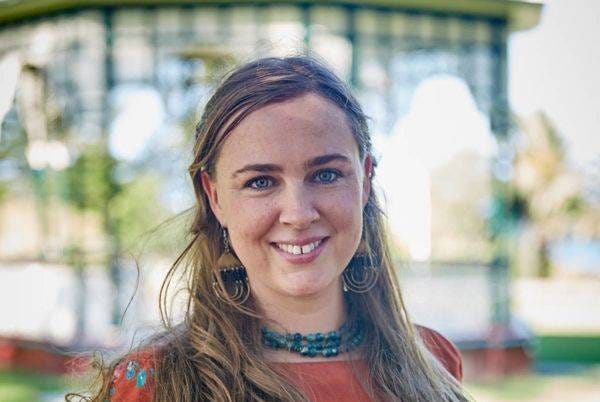
Getting local communities on board with renewable energy, Australia edition
In this episode, Jarra Hicks of the Australian nonprofit Community Power Agency talks about addressing rural resistance to clean energy infrastructure through effective community engagement.
Text transcript:
David Roberts
To hit its climate targets, the US must build an enormous amount of new clean energy infrastructure. Much of that infrastructure is going to be built in rural communities, and the resistance of those communities to that infrastructure is one of the greatest threats to the clean energy transition.
I've done a couple of pods on this subject and will probably do more. Today, we're going to get something of an international perspective.
When I was in Australia, I interacted with a broad network of scholars and activists who are thinking seriously about the social mechanics of community buy-in. One of those scholars and activists is Jarra Hicks, who got her PhD at the University of New South Wales with a dissertation on community-owned wind farms in rural (or as they call them in Australia, “regional”) communities. She now runs the Community Power Agency, a nonprofit organization that is working to ensure a “faster and fairer transition to clean energy.”
Among other things, Hicks has co-authored a benefit-sharing guide and runs an online benefit-sharing course, both meant to help renewable energy developers better navigate this tricky territory.
I've been meaning catch up with Hicks ever since I returned from Australia. Last week I finally got the chance — we talked about the problem of rural resistance, the balance between community engagement and speed, and the many varieties of benefit sharing. I think it will be clear to everyone how this knowledge transfers into the US context. I enjoyed it immensely and hope you do too.
All right then. Jarra Hicks, welcome to Volts. Thank you so much for coming.
Jarra Hicks
Yeah, thanks for having me.
David Roberts
This is a topic of great, great interest in the U.S. right now, but I thought it would be interesting to get a perspective from another country as well, especially since you seem to have devoted your life to learning about this. So I think there are going to be some lessons that are transferable, but let's just start maybe with how you came to this subject of your PhD and of your professional work.
Jarra Hicks
Yeah, sure. So I was really lucky. I got the chance to visit a lot of communities that were doing renewable energy projects, and these were communities that were really embracing renewables. They loved renewables and they were getting great outcomes for their communities and for the planet. And I wanted to see more of that. I wanted to see more communities who were really passionate about renewables and able to get a lot of great benefits from being involved in the energy transition. And I wanted to see more communities who felt positive about this change. And if we go back, I first got involved in this in the early two thousands.
And at that time, there were a lot of communities who were pushing for more renewable energy uptake. And in Australia at that time, there really wasn't a ton of renewable energy, and probably similar in the states, communities were really wanting to get behind renewable energy as a means of taking action on climate change. And at that time, there was an absence of national policy supporting renewables. So it was about a grassroots movement to get renewables up and running. So we saw programs like communities coming together to organize a bulk purchase and install of solar panels at a community scale.
So helping reduce the barriers for people, helping them understand the technology, helping them install it in their homes. But we also saw communities coming together to establish commercial-scale projects like little two-turbine wind farms. And this was really motivated by communities wanting to take positive action on climate change.
David Roberts
Did that switch at some point to resistance? Because that's the opposite of the problem we have now.
Right, well, I guess, yeah. So what we're seeing now is there is emerging resistance to large scale renewable energy projects. And so it is, it's a really different landscape. But what I've learned through my years of being involved is that it's really possible for communities to not only accept renewable energy projects but to really love them and to welcome them in their communities. And it's about the way we go about these projects, and it's about the way we make opportunities for people to really be involved and to genuinely participate in that process.
What was the PhD work, what was the specific focus of your PhD?
Jarra Hicks
So, my PhD looked at small community-owned wind farms. So using commercial-scale turbines, 900-megawatt turbines, 1 MW turbines, but just one or two or three of them at a time. So these are small wind farms that are owned by the community. And those projects, they've emerged from a community desire to have their own energy or to have clean energy to take action on climate change. And these communities went through different processes to set up these enterprises so that they could have community-owned wind farms. And my PhD was really looking at what are the social outcomes that can occur in a community when they go through this process together.
And ultimately, what I was looking at is how can we do renewable energy development in a way that brings people along and that helps people to feel positive and confident and comfortable about renewable energy, and that creates a business model that delivers benefit back into communities as well. And through my career now, I've been able to learn about what is it that helps to create a positive relationship between communities and large scale renewable energy projects and to translate some of those learnings into the commercial large scale renewable energy practice of development.
David Roberts
Social license, as they call it. Talk a little bit about how you think about social license, just sort of in the abstract. What is social license and why is it particularly so important for renewables?
Jarra Hicks
Yeah, so it's a term that's used to describe the ongoing relationship between a project, the project proponent, and the local community or the society hosting that project. It's a dynamic relationship. It's not a once-off license that you might get for other aspects of project approval. It's not a once-off stamp, and there it is. It's dynamic and ongoing. It's constant. It's through the development process, it's through the operation phase of the project. It's lifelong. And it's about creating and maintaining a level of acceptance and approval for a project in the community that is hosting that project.
And at its strongest, it's about actually embedding tha
You May Also Like

The Stone Zone with Roger Stone
Podcast WABCRadio

The Diddy Diaries
Bobby Capucci

World News Tonight with David Muir
ABC News

NPR News Now
NPR
700 WLW On-Demand
WLW-AM (WLWAM)

The Indo Daily
Irish Independent

Start
Il Sole 24 Ore

Erin Burnett OutFront
CNN Podcasts
Dialogue Works
Nima Rostami Alkhorshid

JIJI English News-時事通信英語ニュース-
時事通信社
The Stone Zone with Roger Stone
Podcast WABCRadio
The Diddy Diaries
Bobby Capucci
World News Tonight with David Muir
ABC News
NPR News Now
NPR
700 WLW On-Demand
WLW-AM (WLWAM)
The Indo Daily
Irish Independent
Start
Il Sole 24 Ore
Erin Burnett OutFront
CNN Podcasts
Dialogue Works
Nima Rostami Alkhorshid
JIJI English News-時事通信英語ニュース-
時事通信社
Community discussion