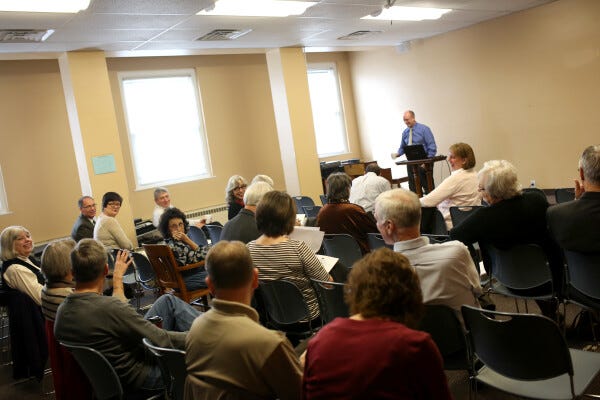
The other kind of teaching
In last week’s follow-up post about community (‘Can we just hang out?’), I mentioned the advantages of doing the obvious—that is, actually teaching our people about the nature of membership and community. But how well do we do this kind of thing? I said this:
I am often struck by how meagrely and haphazardly we teach about such subjects in our churches. We do the essential work of expounding the Scriptures week by week, and we also study Bible passages in our small groups (often the same ones). But the integrative work of applied theology—that is, the task of drawing the Bible’s teaching on a subject together, and showing what it means for our lives … this is something we do much less often, and less effectively.
I promised some further thoughts, and here they are.
Has it ever occurred to you (as it occurred to me recently) that when we preach an expository sermon on, say, 1 Corinthians 1:18-31, we are doing something different from what the passage itself is doing?
What I mean is that our process starts with the biblical text—with understanding it, expounding it, and then applying its truths to our lives. The content of our preaching is initiated by the authoritative Scriptural text and flows from there to the minds, hearts and lives of our listeners.
This is exactly how it should be, you say, and I entirely agree.
But it is interesting that this is not how 1 Corinthians 1 itself proceeds. Its point of departure is not a text being expounded but a subject being addressed. In whatever way we describe the issue or problem Paul is tackling at Corinth—factionalism, divisiveness, arrogance, worldly wisdom—Paul crafts this chapter as a response to this. He draws on a theology of the cross in order to teach the Corinthians that their arrogance and factionalism is ridiculously wrong and out of place.
I guess you could say that Paul is practising applied systematic theology. When we preach the passage, though, we are practising applied biblical theology—that is, we take the text as it is given to us in Scripture, expound and explain it in its own terms and according to its literary and biblical context, and apply its message to our hearers. The same is true for the small Bible study group that opens this passage, seeks to understand it together and apply it to one another’s lives. We start with the Bible, and let its message shape our discussion and mutual encouragement.
Again (in case you’re worried) let me re-assert that this is just as it should be.
In fact, as I look back on nearly four decades of Christian thinking and ministry, one of the features of the evangelical movement for which I am most thankful has been the consistent and vigorous effort to restore expository preaching and Bible study to the centre of our churches and ministries. God’s word is the lamp to our feet. We should humbly and contritely tremble before his speech in Scripture, and listen. This is what the ‘expository movement’ (if I can call it that) has sought to recover. And praise God that in many places it has succeeded.
This is especially so when we consider the alternative that we’ve been working to overcome—the kind of topical preaching that starts with a biblical text and then springboards off into the topic that the preacher wants to speak about; or the therapeutic preaching that starts with the felt need in our lives and tries to solve it; or the moralistic or political preaching that is always taking its subject from the latest social issue or moral outrage; or even the systematic theology kind of preaching that preaches an important (or favourite) doctrine but never actually pauses to listen to and expound the text.
Topicality is certainly dangerous. It not only runs the risk of replacing God’s agenda with ours, but frequently leads us to lift Bible verses and passages out of their context and apply them in ways that the authors (and Author) never intended.
But topicality is also unavoidable and necessary. This is because the worthy Christian walk takes place in human time and space. To state the obvious, daily discipleship constantly confronts us with circumstances and situations in which we are called to be godly and faithful. But as soon as we ask, “What does the Bible say about how I should be godly in this situation?” we are asking the topical question. We’re starting with an issue and going back to the Bible, to draw together, integrate and apply what it says.
So you might say that there are two ways in which God shapes and directs our thinking and our lives through the Scriptures. We start with the Bible, humbly reading and preaching and meditating upon it as it is given to us, having our minds and hearts transformed by the Spirit as we do so. And we also turn to it, and seek its truth and wisdom regarding the particular issue or challenge that we are facing today.
Both are important, and they are complementary. The more we start with the Bible and have our minds shaped by it, the better we will understand our circumstances and situations, and know where to turn in the Scriptures for guidance on particular topics. Conversely, the better we understand the key topics and subjects that the Bible addresses, and its entire teaching about these subjects, the better we’ll be equipped to read each individual part of the Scripture with an awareness of the theological truths that undergird it.
Just as in theology we need both biblical and systematic theology, so in church life we need both to teach and apply the Bible expositorily on its own terms and teach and apply the theology of the Bible to the issues and challenges of our lives.
Which brings me back to the question with which we started: where in our church life today do we teach about topics?
I am referring not just to the classical topics of theology—the person and work of Christ, the content of the gospel, the doctrine of Scripture, the Holy Spirit, and so on. I’m also talking about the various topics of Christian living and ministry—the nature of faith and love and hope and thanksgiving and generosity and assurance and holiness and so much more. Where do we teach our people what membership and community mean, or what the Bible itself is and how to read it, or what evangelism is and how we can personally be involved in it, and so on?
Historically, evangelical churches have done this in various ways and at different levels. We preach the occasional topical sermon series. We run conferences or weekends that address topics. We might run a one-off seminar at church. However, most churches in my part of the world have few or no intentional ministry structures within which to do applied theology with our people.
I was struck (once again) during my recent trip to the US by their culture of adult Sunday schools. It’s common in many American evangelical churches for Sunday morning to consist of an hour of Sunday school (both for adults and children), followed by Sunday service. The adult Sunday school is essentially the vehicle for topical teaching in the church—whether on doctrinal subjects (‘Understanding Death and the Afterlife’) or on subjects of Christian living and ministry (‘Biblical parenting’; ‘One-to-one ministry’; ‘Sharing your faith’).
I know that adult Sunday schools have their issues, and I don’t remotely know how we could introduce that kind of structure into the churches in my part of the world. But I remain a little jealous of what the structure (or trellis) allows many US churches to do in an uncomplicated way—to regularly teach applied theology to their people on a range of important subjects.
As I think about my own history in all of this, I realise that what I’m talking about ove
You May Also Like

Let the Bible Speak Radio
Dr. Alan Cairns

Daf Yomi: The 35 minute Daf
Daf Yomi

Renewing Your Mind
Ligonier Ministries

Café Com Deus Pai | Podcast oficial
Junior Rostirola
Rabbi Yaakov Wolbe Podcast Collection
TORCH

Your Daily Prayer
Your Daily Prayer

The Protestant Libertarian Podcast
Alex Bernardo

Moriel Ministries
MorielTV

Onwankelbare vreugde - een dagboek van John Piper
Geloofstoerusting

WGKM
KGOR Radio
Let the Bible Speak Radio
Dr. Alan Cairns
Daf Yomi: The 35 minute Daf
Daf Yomi
Renewing Your Mind
Ligonier Ministries
Café Com Deus Pai | Podcast oficial
Junior Rostirola
Rabbi Yaakov Wolbe Podcast Collection
TORCH
Your Daily Prayer
Your Daily Prayer
The Protestant Libertarian Podcast
Alex Bernardo
Moriel Ministries
MorielTV
Onwankelbare vreugde - een dagboek van John Piper
Geloofstoerusting
WGKM
KGOR Radio
Community discussion