Essential Services Pt 3: Back to church
So far we’ve talked about the big why of Christ’s heavenly church, and the local purposes that this generates for us as members of that cosmic gathering (i.e. to ‘build’ that gathering by joining together in apostolic ministry).
But what about the actual physical church meetings that many of us are keen to get back to? What have we learned that can guide us in that task?
That’s the focus of the third installment in this mini-series on ‘Essential Services’.
I’m also glad to introduce a guest co-author into this post. As I was in the middle of writing this series, my friend and colleague at Reach Australia, Andrew Heard, sent me a draft of something that he had been writing along a similar line. It had so much good stuff in it, and was so similar to the direction I was heading, that we decided to collaborate on this final post in the series. (The bits in plain text are mine; the sections in italics are Andrew’s.)
So—given all that we have said so far (particularly from Ephesians), what is the rationale or purpose of actually gathering together in physical, local assemblies?
Interestingly, when we look in Ephesians (or elsewhere) for a link between the heavenly gathering and its earthly counterpart, we don’t find the kind of explicit connection we might expect—something useful for pastors to exhort their people with like: “Because you belong to the heavenly church, make sure that you join a good earthly, local church and go every week!”
In fact, in Ephesians, as in much of the New Testament, the importance of actually meeting getting in local gatherings is not so much an application or conclusion as a baseline presupposition. Of course we gather together, because what else would we do—as members of the new household of God, the body of Christ, the new humanity? The heavenly church of Christ is like a homing beacon that calls its earthly members together in local assemblies—all of us belonging to that cosmic body of Christ, delighted to be unified together in him, and seeking together to grow and fortify his body through the apostolic ministry of word and prayer.
The physical gathering of believers around Christ and his word in a particular place at a particular time is the visible expression of an invisible reality that is at the very heart of God’s purposes. He brings peace to us by reconciling us to himself, but at the same time he brings peace to the various groups that have been hostile to one another, that by his grace we might together be ‘one new man’. In Christ, we are all one—all sinners saved by grace to share the same standing before him, and with each other.
This is true spiritually in the heavenly assembly, and is understood to be true by faith. But it is given visible expression here on earth when sinners actually get up out of their houses, go to a common place, and stand shoulder to shoulder with other people they used to be alienated from—the Gentile actually standing together with the Jew—and both declaring and rejoicing that Jesus Christ is Lord.
Without physically gathering we simply can’t give expression to this. We might hold this thought in our heads as we watch a centralized stream or video clip, knowing that others who are different from me are watching the same stream. But it is a pale thing in comparison to actually standing with those same people in a common space.
It is this reality, of being gathered physically with one another, that brings glory to God in the heavenly realms as the forces of evil look on and see the victory of God in gathering people from all nations, tribes and tongues. This was God’s purpose from all eternity, though it was kept hidden for generations past. But now, through the church (the physically gathered assembly) the universe is made to see that God has won the victory.
Why do we go to church? It’s not actually about us. It is about the glory of Christ that we gather—that we might show the universe that he is Lord and that he has won.
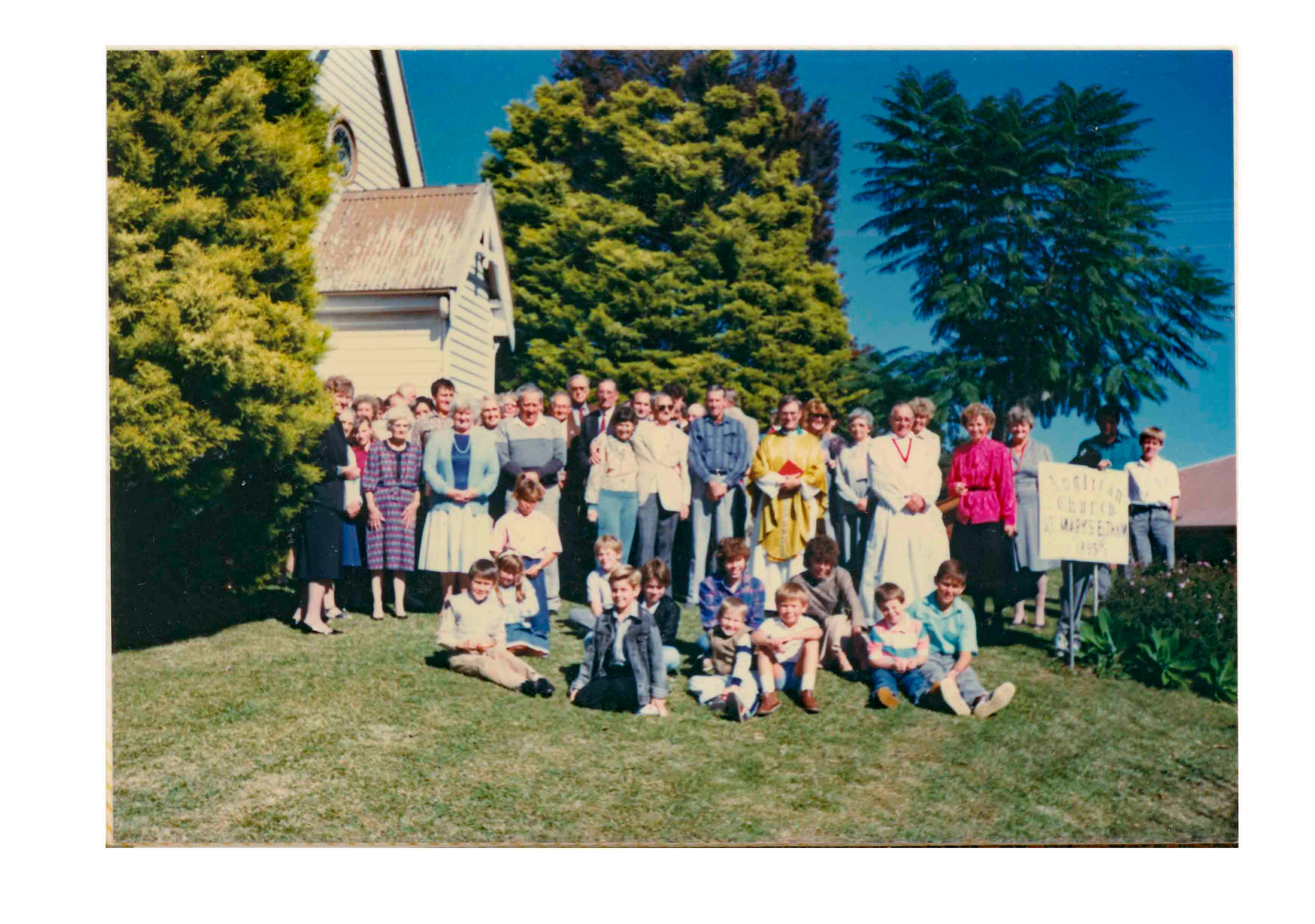
We haven’t been doing this while streaming content to our lounge-rooms on Sundays. We haven’t been churching. But we are now moving into a phase when we can church again, and it is imperative that Christians seize this opportunity to come back together, even though it may be lame and limited in various ways for some time.
Non-churching Christians deeply offend their God. They deny the very thing his Son died to create—the reality of a new, unified humanity, gathered together around him, giving testimony to the universe of God’s manifold wisdom and power.
As astute readers may notice, Andrew reads Eph 3:10 a little differently from me—he takes it as a reference to the earthly gathering (which it may well be; see my post last week for more on this). I entirely agree, however, with the point he is making. The physical assembly of Christians, in loving unity with one another in Christ, is a powerful testimony or proclamation of the power of the gospel.
1 Cor 11:17-34 makes this point, as Paul lays into the feisty, factionalized Corinthians for their appalling Lord’s Supper etiquette. The divisive bun fight that their meals had become was a travesty of the loving, unified fellowship that the Lord had died to create. This is why their meal couldn’t even be classed as a ‘Lord’s Supper’ in Paul’s book—it was supposed to be a remembrance and proclamation of the power of Christ’s death to save sinful people and draw them together in unity and love (vv. 23-26). The physical, shoulder-to-shoulder reality of Christ’s people fellowshipping together proclaims the power of the cross.
So what of our various online gatherings and simulations then? How do they fit in?
Our reflections on the primacy of heavenly church help to answer this. Jesus is building his heavenly church (H-church) through the apostolic ministry that is happening here on earth. This ministry takes place within regular, local physical gatherings (L-churches), but it takes place outside the L-church as well. We see this in the New Testament—the roving bands of apostolic evangelists; the work of Timothy, Tychicus, Titus and others as go-betweens, carrying Paul’s letters and extending his ministry between and among the churches; the collection for the saints in Jerusalem; the ministry of Priscilla and Aquila in mentoring Apollos; and so on.
This continues today. Apostolic ministry that builds the H-church proceeds in all manner of ways and places outside the L-church—particularly in evangelism, but also in the various ways in which Christians build and encourage each other when not in church together (as this article is hopefully doing at this very moment).
This helps make sense of our recent strange experience of ‘virtual church’. We instinctively feel that these online meetings partake of something real and helpful—we have been in touch with each other, shared the word together in various ways, and prayed for each other. We have been building each other as members of the H-church in the best ways we can through the word and prayer, much like separated friends writing regular letters to each other.
But we have not been together as the L-church. We haven’t been L-churching (as Andrew suggests above). We haven’t actually been singing, praying, reading or listening together, despite the oc
You May Also Like

Let the Bible Speak Radio
Dr. Alan Cairns

Theology Central
Various Speakers

The Family Bible Journey Podcast
familybiblejourney

Kloostercast
NPO Luister / KRO-NCRV

Charles Stanley Sermons
WatchersPod

Daf Yomi: The 35 minute Daf
Daf Yomi

Commuter Bible OT
John Ross

Renewing Your Mind
Ligonier Ministries

Mission 66
TWR

Café Com Deus Pai | Podcast oficial
Junior Rostirola
Let the Bible Speak Radio
Dr. Alan Cairns
Theology Central
Various Speakers
The Family Bible Journey Podcast
familybiblejourney
Kloostercast
NPO Luister / KRO-NCRV
Charles Stanley Sermons
WatchersPod
Daf Yomi: The 35 minute Daf
Daf Yomi
Commuter Bible OT
John Ross
Renewing Your Mind
Ligonier Ministries
Mission 66
TWR
Café Com Deus Pai | Podcast oficial
Junior Rostirola
Community discussion