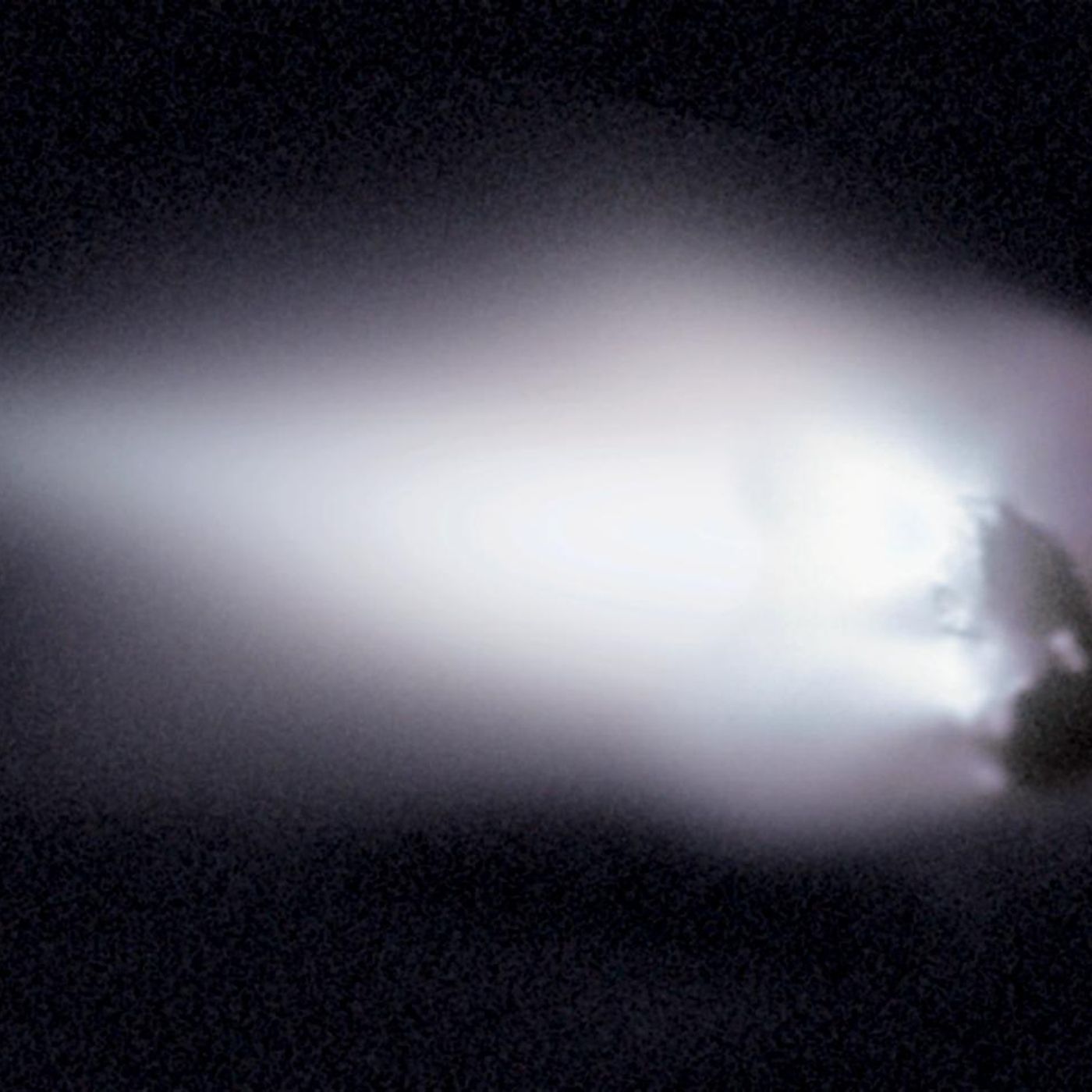
182E-194-Star Wanderer
From the dawn of history, humans have longed to wander amongst the stars. Now we know that comets are able to make such a voyage giving us paths to follow.NASA scientists have suggested that the first interstellar robotic spacecraft could be propelled by a solar sail as large as the state of Texas. Such a mission, perhaps two or three hundred years into the future could follow a comet's path. In this flight of fantasy the spaceship would be inclosed in a reflective spherical heat shield, placed into a Sun grazing orbit, and flung by the Sun's gravity onto a path which will cause it to be ejected from the solar system. After getting to a safe distance from the Sun the robotic spacecraft would deploy its solar sail and use light pressure to accelerate towards its destination. It could be further helped along using a powerful laser projected from the far side of the Moon. In a few decades or maybe even a few centuries it would arrive in a nearby solar system. After that it would be on its own to try to make sense of what is there and to beam information back to its human creators.
You May Also Like
Let's Science
SQPN, Inc.

Accès au Marché Mondial des Dispositifs Médicaux
Pure Global

Human Factors Minute
Human Factors Cast

The Grave Talks | Haunted, Paranormal & Supernatural
Ghost Stores, Haunted, Paranormal & Supernatural Stories
Dr. Chapa’s OBGYN Clinical Pearls
Dr. Chapa’s Clinical Pearls

Eye On The Sky
Vermont Public

Farm Small Farm Smart Daily
The Modern Grower Podcast Network

Stuff To Blow Your Mind
iHeartPodcasts

The Best of Coast to Coast AM
iHeartPodcasts and Coast to Coast AM

BrainStuff
iHeartPodcasts
Let's Science
SQPN, Inc.
Accès au Marché Mondial des Dispositifs Médicaux
Pure Global
Human Factors Minute
Human Factors Cast
The Grave Talks | Haunted, Paranormal & Supernatural
Ghost Stores, Haunted, Paranormal & Supernatural Stories
Dr. Chapa’s OBGYN Clinical Pearls
Dr. Chapa’s Clinical Pearls
Eye On The Sky
Vermont Public
Farm Small Farm Smart Daily
The Modern Grower Podcast Network
Stuff To Blow Your Mind
iHeartPodcasts
The Best of Coast to Coast AM
iHeartPodcasts and Coast to Coast AM
BrainStuff
iHeartPodcasts
Community discussion