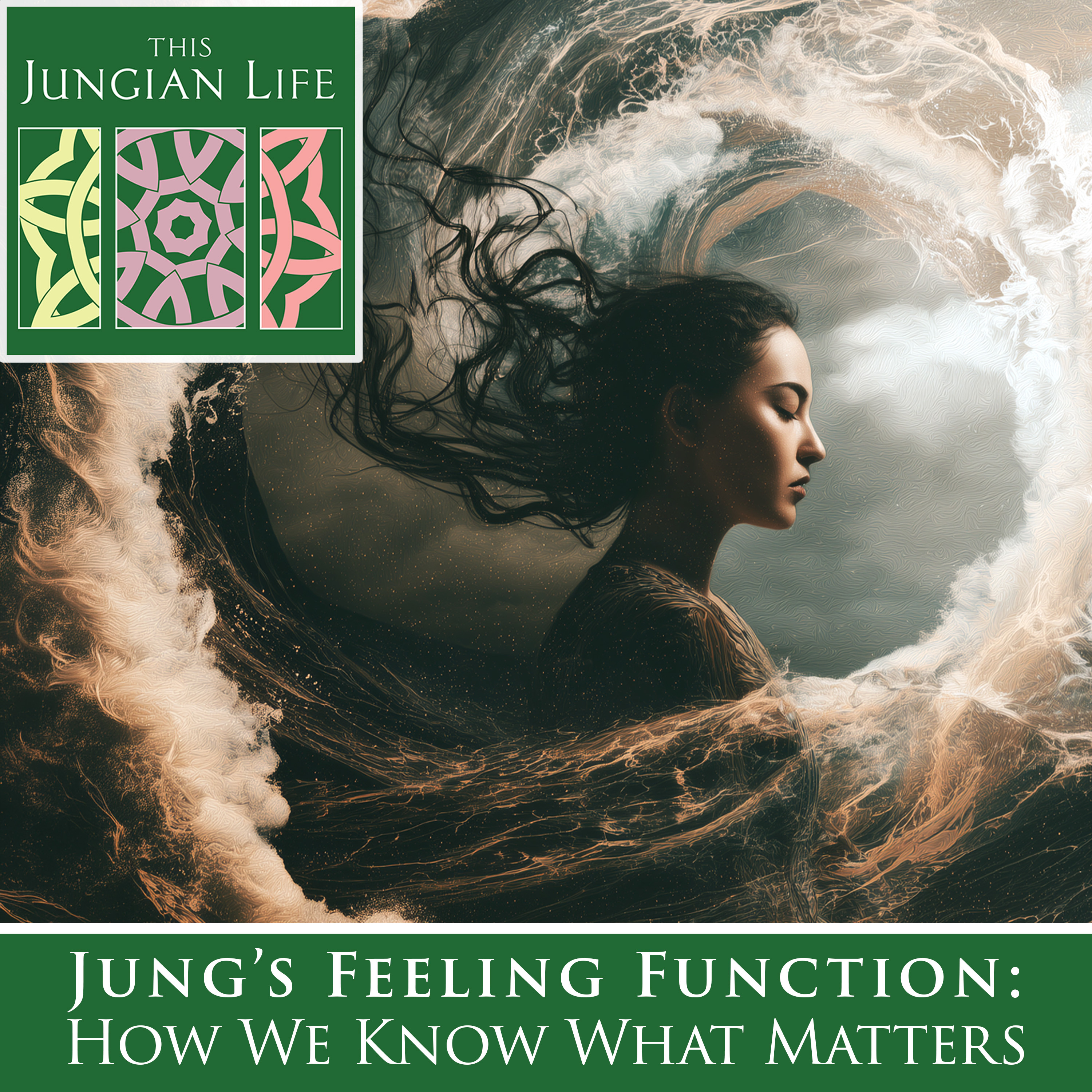
Jung’s Feeling Function: How We Know What Matters
Two people stand at the rim of the Grand Canyon. One is overcome with awe at nature’s grandeur, while the other sees an enormous rift in the landscape. What accounts for the difference? This week, Jungian analyst and scholar JOHN R. WHITE joins Lisa Marchiano and Deborah Stewart to explore Jung’s feeling function, our capacity to discern what matters.
One of Jung’s best-known legacies is his categorization of ego functions: typology. Whether we are extraverted or introverted (terms Jung introduced), our four basic ego functions sort themselves into intuition, sensation, thinking, and feeling. We have all four functions but prefer some over others. Jung’s system led directly to the creation of the widely used Myers-Briggs Personality Type Indicator.
The feeling and thinking functions are both ways of making judgments, but the feeling function is based on personal values: if you were a military commander, would you be like Napoleon, directing his troops from the hilltop -- or like Braveheart, leading his men on the field? When the feeling function is cultivated and differentiated, it illuminates much of how and why we do what we do. Do we tend to prefer a subjective stance based on personal values, or a more objective and strategic stance?
Developing our feeling function may be challenging in the context of a culture that prioritizes thinking and sensate functions over feeling and intuition. It is a task worth taking on, however. Evaluating our experiences up close as well as from the greater distance the thinking function affords can be a profound step toward growth and individuation. Discerning whether the basis of a decision should be subjective or objective builds consciousness and expands choice. Since subjectivity is closely aligned with feelings, we can reflect on what a bruising encounter has made us feel—and choose our response rather than reacting.
We discuss some of the strategies you might use to differentiate your feeling function, including embarking on analysis, writing in your journal, and Eugene Gendlin’s focusing technique, which asks us to tune into the body and carefully name what is felt.
Visit our website to read today’s dream and follow up on the resources we mention.
Connect With This Jungian Life
Take a look at This Jungian Life Dream School, our online course in Jungian dream analysis.
Send a dream for us to analyze on the show
Watch bonus mini-episodes on our Patreon channel
Follow This Jungian Life on Instagram
You May Also Like
The Trauma Therapist
Guy Crawford Macpherson

RELATOS ERÓTICOS
ErosBot

The Peptide Podcast
The Peptide Queen
Be Calm and Relaxed with Rain and Thunder for Sleeping
ColoredJuice Podcast Studio

Por el Placer de Vivir con el Dr. Cesar Lozano
Uforia Podcasts

The Kris Krohn Show
Kris Krohn
Boundless Life
Ben Greenfield

Foodnourish Deep Dives
Pavlos Giorkas

Wits & Weights | Fat Loss, Nutrition, & Strength Training for Lifters
Philip Pape | Strength Training & Fat Loss Over 40

Walking is Fitness
Dave Paul
The Trauma Therapist
Guy Crawford Macpherson
RELATOS ERÓTICOS
ErosBot
The Peptide Podcast
The Peptide Queen
Be Calm and Relaxed with Rain and Thunder for Sleeping
ColoredJuice Podcast Studio
Por el Placer de Vivir con el Dr. Cesar Lozano
Uforia Podcasts
The Kris Krohn Show
Kris Krohn
Boundless Life
Ben Greenfield
Foodnourish Deep Dives
Pavlos Giorkas
Wits & Weights | Fat Loss, Nutrition, & Strength Training for Lifters
Philip Pape | Strength Training & Fat Loss Over 40
Walking is Fitness
Dave Paul
Community discussion