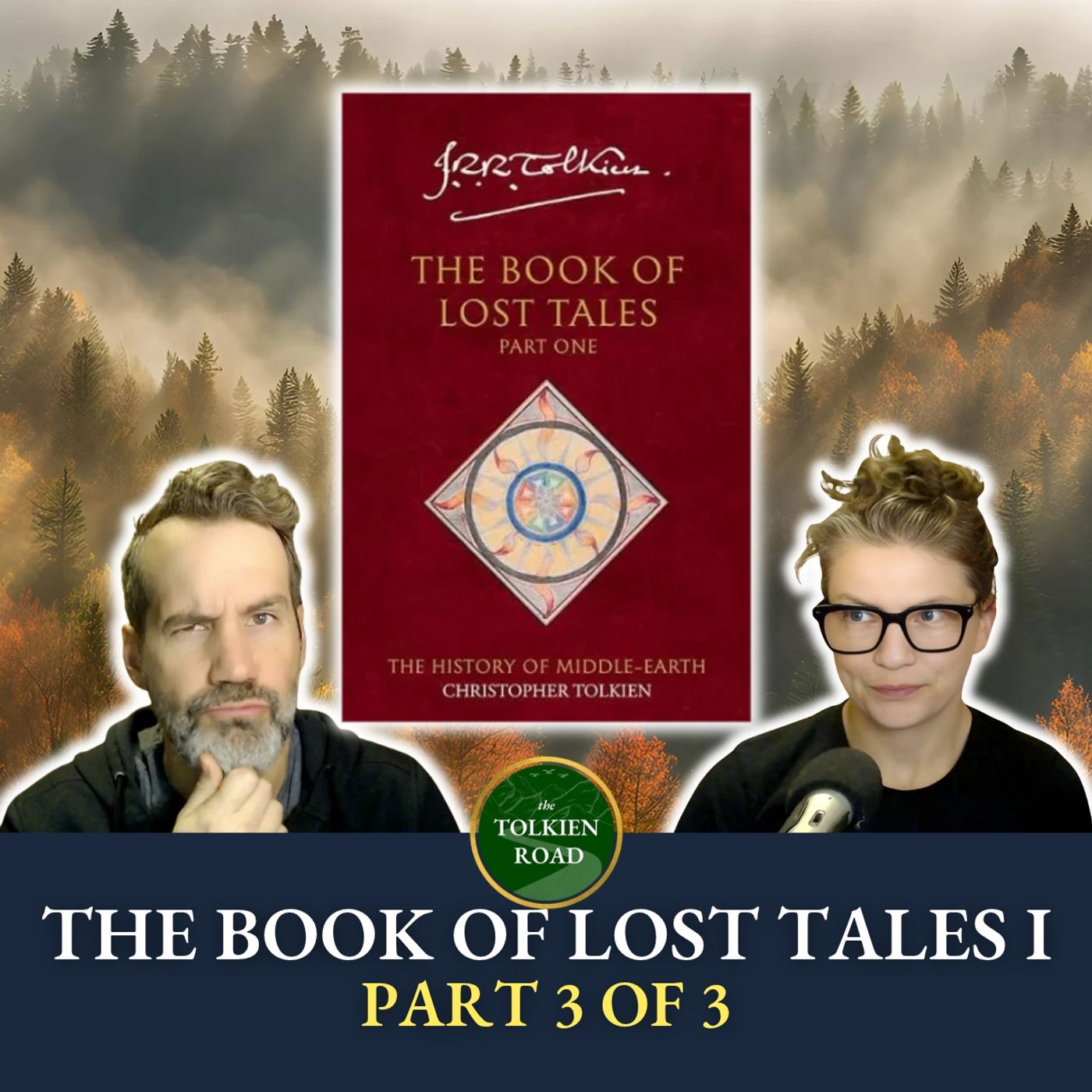
0234: The Book of Lost Tales I » A Completely Different Silmarillion
In Episode 234 of The Tolkien Road, John and Greta complete their survey of The Book of Lost Tales 1 with its final six chapters. Along the way: the awakening of the Elves, the Darkening of Valinor, the Flight of the Noldor, the Sun and Moon, the Hiding of Valinor, and the coming of Men.
━━━━━━━━━━━━━━
CHAPTERS
00:00 — Introduction
01:36 — The Book of Lost Tales 1, Part 3
05:02 — Tolkien Quote of the Week
06:11 — Tolkien Transforming War Into Myth
07:37 — Revisiting the Book of Lost Tales
09:07 — Christopher Tolkien’s Monumental Task
10:15 — The Coming of the Elves and the Making of Kor
11:49 — The Frame Narrative Continues
12:27 — Why Frame Narratives Work
16:38 — How the Early Story Differs
17:26 — Melko Is Released Much Earlier
18:00 — Tolkien’s Early Poem “Kor”
21:23 — The Theft of Melko and the Darkening of Valinor
22:06 — Melko Corrupts the Noldoli
25:01 — The Silmarils Were Barely Important
26:39 — Why This Isn’t Yet “The Silmarillion”
27:23 — The Book of Lost Tales as a Rough Draft
29:58 — The Flight of the Noldoli
34:02 — There Is No Oath of Fëanor
34:30 — The Teleri Were the Solosimpi
34:56 — The Tale of the Sun and Moon
36:02 — Tolkien Knew It Needed Revision
40:52 — The Man in the Moon
41:57 — The Hiding of Valinor
44:25 — Tolkien Condemns the Valar’s Choice
45:08 — Gilfanon’s Tale
47:43 — Where Volume 1 Leaves Us
48:53 — One Volume Down, Eleven to Go
49:22 — Listener Correspondence
57:35 — What’s Coming Next
━━━━━━━━━━━━━━
THE SILMARILS WEREN’T CENTRAL YET
Melko’s corruption of the Noldoli looks surprisingly familiar.
He spreads lies about the Valar and tells the Elves they are being denied their rightful freedom.
But the Silmarils themselves are still relatively unimportant.
Like the One Ring in The Hobbit, something that begins in the background will eventually move to the center of an entire mythology.
━━━━━━━━━━━━━━
NO OATH OF FËANOR
The Flight of the Noldoli contains another enormous difference.
There is no Oath of Fëanor.
Considering how completely the Oath drives the tragedy of the published Silmarillion, its absence shows just how unfinished Tolkien’s conception still was.
Even the Teleri have another name: the Solosimpi.
━━━━━━━━━━━━━━
TOLKIEN’S ROUGH DRAFT
The Book of Lost Tales is essentially Tolkien discovering his mythology through writing.
Ideas move into focus.
Others disappear.
Names change.
Chronology changes.
Entire narrative structures are abandoned.
The finished mythology did not spring into existence fully formed.
━━━━━━━━━━━━━━
THE HIDING OF VALINOR
In this early version, Tolkien treats the Valar’s decision to hide Valinor much more critically.
Their failure to confront Melko is presented as a serious mistake.
That explicit condemnation largely disappears from Tolkien’s later version of the mythology.
━━━━━━━━━━━━━━
THE BIG TAKEAWAY
The Book of Lost Tales 1 shows Tolkien discovering The Silmarillion.
The Silmarils were not always central.
The Oath of Fëanor was not always there.
The Cottage of Lost Play frame eventually disappeared.
Yet the foundations of Middle-earth are already unmistakable.
This is Tolkien’s mythology while it was still becoming itself.
━━━━━━━━━━━━━━
SPECIAL THANKS
• Kaitlyn of Tea with Tolkien
• Liis U
• Andrew T
• John R
• Ms. Anonymous
Become a supporter of this podcast: https://www.spreaker.com/podcast/the-tolkien-road--5222755/support.
The Tolkien Road
SubscribeSign in
Playback speed
×
Share post
Share post at current time
Share from 0:00
0:00
/
1
0234: Book of Lost Tales I » A Completely Different Silmarillion
Tolkien’s Original Silmarillion Was Missing Its Most Important Ideas
John Carswell
1
Share
Transcript
How different was Tolkien’s earliest version of The Silmarillion—and which of its most important ideas had not even taken shape yet?
In Episode 234 of The Tolkien Road, John and Greta complete their survey of The Book of Lost Tales 1 with its final six chapters. Along the way, they encounter the earliest versions of the awakening of the Elves, the Darkening of Valinor, the Flight of the Noldor, the creation of the Sun and Moon, the Hiding of Valinor, and the coming of Men.
What emerges is a mythology that is recognizably Tolkien—but still radically unfinished. The Silmarils are surprisingly unimportant, there is no Oath of Fëanor, familiar peoples have unfamiliar names, and entire narrative structures would eventually disappear.
CHAPTERS
00:00 — Introduction
01:36 — The Book of Lost Tales 1, Part 3
05:02 — Tolkien Quote of the Week
06:11 — Tolkien Transforming War Into Myth
07:37 — Revisiting the Book of Lost Tales
09:07 — Christopher Tolkien’s Monumental Task
10:15 — Chapter 5: The Coming of the Elves and the Making of Kor
11:49 — The Frame Narrative Continues
12:27 — Why Frame Narratives Work
15:10 — Returning to the Coming of the Elves
16:38 — How the Early Story Differs
17:26 — Melko Is Released Much Earlier
18:00 — Tolkien’s Early Poem “Kor”
20:11 — “A Song of Aryador”
21:23 — Chapter 6: The Theft of Melko and the Darkening of Valinor
22:06 — Melko Begins Corrupting the Noldoli
24:27 — Familiar Seeds of the Later Silmarillion
25:01 — The Silmarils Were Barely Important
26:39 — Why This Isn’t Yet “The Silmarillion”
27:23 — The Book of Lost Tales as a Rough Draft
29:34 — Creativity, Rabbit Trails, and Tolkien Roads
29:58 — Chapter 7: The Flight of the Noldoli
31:31 — An Early Version of the Flight
34:02 — There Is No Oath of Fëanor
34:30 — The Teleri Were the Solosimpi
34:56 — Chapter 8: The Tale of the Sun and Moon
36:02 — Tolkien Himself Knew It Needed Major Revision
36:29 — Eriol Asks About the Sun and Moon
40:52 — “Why the Man in the Moon Came Down Too Soon”
41:57 — Chapter 9: The Hiding of Valinor
44:25 — Tolkien Originally Condemned the Valar’s Choice
45:08 — Chapter 10: Gilfanon’s Tale
45:23 — Christopher’s Complicated Reconstruction
47:43 — Where The Book of Lost Tales 1 Leaves Us
48:53 — One Volume Down, Eleven to Go
49:22 — Listener Correspondence
56:40 — The Great Exercise Book Vindication
57:35 — What’s Coming Next
THE COMING OF THE ELVES
Chapter 5 roughly corresponds to “Of the Coming of the Elves” in the published Silmarillion.
But the chronology is already strikingly different.
In the later mythology, the awakening of the Elves helps prompt the Valar to make war on Melkor.
Here, Melko has already been captured and released before the Elves fully enter the story.
He even participates in the debate over what the Valar should do with them.
The chapter also keeps returning to the Cottage of Lost Play frame, reminding us that these legends are being told to Eriol rather than presented as detached history.
MELKO AND THE DARKENING OF VALINOR
Chapter 6 contains many recognizable elements.
Melko secretly works upon the Noldoli, feeding them lies about the Valar and convincing them that they are being restrained from their rightful inheritance.
The basic strategy survives into the later Silmarillion.
But one enormous difference stands out:
The Silmarils themselves are not yet central.
Christopher Tolkien notes how remarkable it is that the jewels exist in this early mythology while remaining relatively unimportant.
That raises an interesting parallel with the One Ring.
Just as the Ring began in The Hobbit as a relatively simple magical object before becoming the center of The Lord of the Rings, the Silmarils gradually moved from the background toward the center of Tolkien’s First Age mythology.
THE BOOK OF LOST TALES AS A ROUGH DRAFT
This leads into a broader discussion of creativity.
The Book of Lost Tales really is the first rough draft of what eventually became The Silmarillion.
Tolkien did not begin with every theme, character, and object assigned its final importance.
He discovered the story by pursuing ideas.
Things moved into focus.
Other ideas disappeared.
Names changed.
The mythology grew through revision.
The episode compares this process to following a creative rabbit trail—or perhaps a Hobbit trail—and seeing where it leads.
THE FLIGHT OF THE NOLDOLI
Chapter 7 contains an early version of one of the central events of The Silmarillion.
But again, major pieces are missing.
Most strikingly:
There is no Oath of Fëanor.
That is an enormous difference given how completely the Oath drives the tragedy of the later Silmarillion.
Even the familiar Teleri have a different name here: the Solosimpi.
The broad outline is recognizable, but the story’s emotional and thematic machinery has not yet taken its final form.
THE SUN AND MOON
Chapter 8 gives the early story of the Sun and Moon.
Christopher himself records that Tolkien considered this tale badly in need of revision, cutting, and perhaps reshaping.
The chapter also introduces Gilfanon more prominently into the frame narrative.
Attached to the material is an early version of “Why the Man in the Moon Came Down Too Soon,” another fascinating example of ideas migrating across Tolkien’s creative life into later works.
THE HIDING OF VALINOR
One especially revealing difference appears in Chapter 9.
In this early mythology, Tolkien treats the Valar’s decision to hide Valinor much more critically.
Their failure to confront Melko is presented as a serious mistake with lasting consequences.
In the later mythology, the Hiding of Valinor remains important, but that explicit condemnation largely disappears.
This is another example of Tolkien not merely changing details, but altering the moral interpretation of his mythology over time.
GILFANON’S TALE
The volume ends with Gilfanon’s Tale, concerning the travail of the Noldoli and the coming of Mankind.
Christopher’s reconstruction becomes particularly complicated here because Tolkien was experimenting with different arrangements for the frame narrative and never fully carried them through.
The unfinished nature of the material becomes impossible to miss.
And yet that incompleteness is part of what makes The History of Middle-earth so revealing.
THE BIG TAKEAWAY
The Book of Lost Tales 1 shows us that Tolkien did not simply invent The Silmarillion and then spend decades polishing it.
He discovered it.
The mythology grew through writing, rewriting, abandoning ideas, recovering others, changing names, shifting chronology, and gradually discovering which elements truly belonged at the center of the story.
The Silmarils were not always central.
The Oath of Fëanor was not always there.
The frame narrative eventually vanished.
And yet the basic world is unmistakably Tolkien.
The Book of Lost Tales lets us see Middle-earth before Tolkien himself fully knew what Middle-earth was going to become.
Discussion about this video
CommentsRestacks
The Tolkien Road reply rules
Podcast
Embark upon a wondrous journey through the realms of Middle-earth and beyond with the Tolkien Road, a podcast dedicated to the enchanting tales and writings of JRR Tolkien. Come, join John, Greta, and our mighty Fellowship as we delve deep into the magic that lingers within the pages of these timeless legends. And always remember: DO NOT BE HASTY!!! Become a supporter of this podcast: https://www.spreaker.com/podcast/the-tolkien-road--5222755/support.
Embark upon a wondrous journey through the realms of Middle-earth and beyond with the Tolkien Road, a podcast dedicated to the enchanting tales and writings of JRR Tolkien. Come, join John, Greta, and our mighty Fellowship as we delve deep into the magic that lingers within the pages of these timeless legends. And always remember: DO NOT BE HASTY!!! Become a supporter of this podcast: https://www.spreaker.com/podcast/the-tolkien-road--5222755/support.
Subscribe
Authors
John Carswell
Recent Posts
0235: Books of Lost Tales II » Tolkien’s First Great Tales
• John Carswell
0394: The Lord of the Rings » Foreword & Prologue » Mailbag
• John Carswell
0399: The State of Tolkien Fandom » Rings of Power, Hunt for Gollum & What Comes Next
• John Carswell
0008: Illustrating Ainulindalë
• John Carswell
0007: The Silmarillion - Ch03 - Of the Coming of the Elves and the Captivity of Melkor
• John Carswell
0393: The Lord of the Rings » Prologue » Mathoms
• John Carswell
0006: On Enjoying Tolkien, Or Reasons Why
• John Carswell
Ready for more?
Subscribe
© 2026 John Carswell · Privacy ∙ Terms ∙ Collection notice
Start your SubstackGet the app
Substack is the home for writing, podcasting, and media founders.
<style> #nojs-banner { position: fixed; bottom: 0; left: 0; padding: 16px 16px 16px 32px; width: 100%; box-sizing: border-box; background: red; color: white; font-family: -apple-system, "Segoe UI", Roboto, Helvetica, Arial, sans-serif, "Apple Color Emoji", "Segoe UI Emoji", "Segoe UI Symbol"; font-size: 13px; line-height: 13px; } #nojs-banner a { color: inherit; text-decoration: underline; } </style> <div id="nojs-banner"> This site requires JavaScript to run correctly. Please <a href="https://enable-javascript.com/" target="_blank">turn on JavaScript</a> or unblock scripts </div>
You May Also Like
RISK!
Kevin Allison

The Splendid Table: Conversations & Recipes For Curious Cooks & Eaters
American Public Media

Mahlakung
Thobela FM

The Losers' Club: A Stephen King Podcast
Bloody FM
War Nerd Radio — Subscriber Feed
Gary Brecher
Magellans at the Movies
Nathan Magalhaes
Podcast Patapoe
0d0a

Классика. Фантастика. Детектив. Аудиокниги
Alexander Abramovich

Les émissions culturelles de France Culture
France Culture
The Food Programme
BBC Radio 4
RISK!
Kevin Allison
The Splendid Table: Conversations & Recipes For Curious Cooks & Eaters
American Public Media
Mahlakung
Thobela FM
The Losers' Club: A Stephen King Podcast
Bloody FM
War Nerd Radio — Subscriber Feed
Gary Brecher
Magellans at the Movies
Nathan Magalhaes
Podcast Patapoe
0d0a
Классика. Фантастика. Детектив. Аудиокниги
Alexander Abramovich
Les émissions culturelles de France Culture
France Culture
The Food Programme
BBC Radio 4
Community discussion