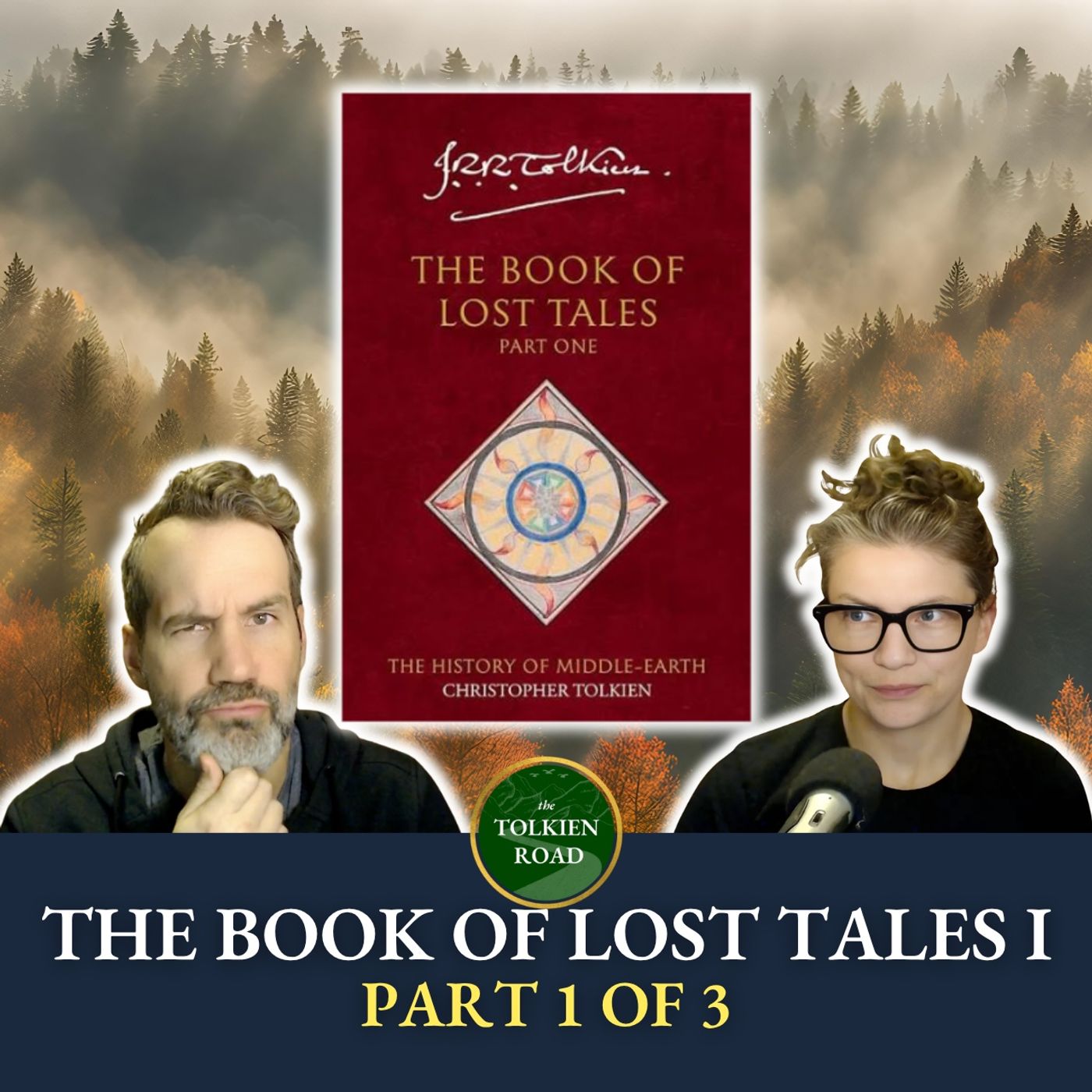
0232: The Book of Lost Tales I » How Tolkien’s Middle-earth Really Began
In this episode of The Tolkien Road, John and Greta begin their journey through The History of Middle-earth with Volume 1, The Book of Lost Tales 1. Along the way, they explore Christopher Tolkien’s difficult task as his father’s literary executor, why The Silmarillion is so challenging, whether a frame narrative might have made it more accessible, and what Tolkien’s earliest surviving mythology reveals about the evolution of Middle-earth.
The episode also begins on a personal note, as John remembers his father, Nat Carswell, who first introduced him to The Hobbit and C.S. Lewis.
━━━━━━━━━━━━━━
CHAPTERS
00:00 — Introduction
03:12 — Remembering John’s Father
04:01 — The Hobbit Book Report That Started It All
05:05 — Narnia, C.S. Lewis, and Tolkien
06:00 — A Tolkienian Farewell
08:39 — Beginning The History of Middle-earth
12:28 — Christopher Tolkien’s Foreword
13:29 — What Is The Book of Lost Tales?
14:03 — How Christopher Created The Silmarillion
15:16 — Did Christopher Do His Father’s Work Justice?
15:48 — Why Publish a Textual History of Middle-earth?
20:26 — Why The Silmarillion Is So Difficult
21:23 — Tolkien’s “Impression of Depth”
24:20 — Does Explaining the Mystery Destroy It?
27:56 — The Problem of the Missing Frame Narrative
29:25 — The Book of Lost Tales Actually Had a Frame
30:20 — Would a Frame Have Improved The Silmarillion?
32:27 — The Silmarillion Tolkien Never Finished
33:41 — The Earliest Version of Tolkien’s Mythology
35:15 — How the Legends Changed Over Time
36:05 — Christopher Tolkien’s Editorial Method
37:16 — Listener Feedback
47:47 — Beren, Lúthien, and Thingol
48:49 — Should There Ever Be a “Special Edition” Silmarillion?
53:03 — What’s Coming Next
━━━━━━━━━━━━━━
CHRISTOPHER TOLKIEN’S PROBLEM
• Tolkien did not leave behind a completed Silmarillion ready for publication.
• Christopher inherited finished passages, unfinished stories, notes, revisions, and competing versions.
• For the 1977 Silmarillion, Christopher synthesized that material into a coherent whole.
• He later became increasingly interested in showing readers what his father had actually written.
• The History of Middle-earth became a textual history of how the mythology evolved.
━━━━━━━━━━━━━━
WHY IS THE SILMARILLION SO DIFFICULT?
• There are no Hobbits to act as relatable intermediaries.
• The style is not conventionally novelistic.
• The book consists of interwoven legends rather than one continuous character-driven narrative.
• Christopher also wrestled with whether publishing the ancient legends would lessen the mysterious “depth” of The Lord of the Rings.
John and Greta argue that discovering the stories behind Tolkien’s allusions does not exhaust the mystery. New answers lead to new questions, and the legendarium remains full of unexplored territory.
━━━━━━━━━━━━━━
WOULD A FRAME NARRATIVE HAVE HELPED?
The published Silmarillion has no central frame narrative.
The Book of Lost Tales originally did.
A traveler comes across the sea and hears the ancient histories of the Elves in the Cottage of Lost Play. Tolkien later also considered connections involving Bilbo and the Red Book of Westmarch.
John and Greta discuss whether a frame—perhaps Bilbo telling Frodo the ancient legends—could have helped readers gain traction and provided a familiar doorway into the mythology.
━━━━━━━━━━━━━━
WHAT IS THE BOOK OF LOST TALES?
• Tolkien began the work around 1916–17 during the First World War.
• It contains the earliest substantial narrative versions of stories that eventually became The Silmarillion.
• The texts were never...
The Tolkien Road
SubscribeSign in
Playback speed
×
Share post
Share post at current time
Share from 0:00
0:00
/
0232: The Book of Lost Tales I » How Tolkien’s Middle-earth Really Began
Explore Tolkien’s earliest Middle-earth writings, why Christopher published them, and how they became the foundation of The Silmarillion.
John Carswell
Share
Transcript
Why did Christopher Tolkien devote twelve volumes to tracing the development of Middle-earth—and what can Tolkien’s earliest writings tell us about the legendarium we know today?
In this episode of The Tolkien Road, we begin our journey through The History of Middle-earth with Volume 1, The Book of Lost Tales 1, exploring Christopher Tolkien’s reasons for undertaking the massive project and the earliest surviving form of his father’s mythology.
00:00 — Introduction: The Book of Lost Tales 1
03:12 — Remembering Nat Carswell
08:33 — Beginning The History of Middle-earth
12:28 — What Is The Book of Lost Tales?
13:42 — Why Did Christopher Tolkien Go Back to the Beginning?
15:13 — Christopher’s Concerns About The Silmarillion
16:00 — Preserving Tolkien’s Actual Writings
19:55 — Why Is The Silmarillion So Difficult?
20:26 — Problem #1: No Hobbits
20:49 — Problem #2: It Isn’t a Conventional Novel
21:23 — Problem #3: Does Explaining the Past Destroy the Mystery?
27:56 — Would The Silmarillion Be Better with a Frame Narrative?
29:19 — The Original Frame: The Cottage of Lost Play
32:27 — The Unsolvable Problem of Tolkien’s Unfinished Mythology
33:41 — The Earliest Version of The Silmarillion
35:15 — How Tolkien’s Mythology Changed Even in the Beginning
36:05 — Christopher Tolkien’s Editorial Method
37:16 — Listener Correspondence
Beginning The History of Middle-earth
The Book of Lost Tales 1 is the first volume of Christopher Tolkien’s History of Middle-earth
The series traces how Tolkien’s mythology developed over the course of his life
Rather than presenting polished stories, Christopher increasingly sought to show readers Tolkien’s actual manuscripts and how they changed over time
Unfinished Tales served as an early step toward this much larger project
Why Christopher Went Back to the Beginning
Christopher remained uneasy about how much editorial reconstruction had been required to publish The Silmarillion
He wanted readers to have access not only to the finished synthesis but also to what Tolkien actually wrote
That meant returning to the earliest manuscripts and tracing their development
His goal became less about completing Middle-earth and more about documenting its textual history
Why the Earlier Mythology Is Difficult
Christopher discusses several reasons Tolkien’s pre-Lord of the Rings mythology can be harder to approach:
There are no Hobbits to provide an ordinary, relatable point of view
The structure is not conventionally novelistic and instead resembles an interconnected collection of myths and legends
Publishing the ancient stories might seem to reduce the “impression of depth” that makes The Lord of the Rings so compelling
Yet exploring the earlier mythology arguably creates even more questions rather than exhausting the mystery.
Does Knowing More Destroy the Mystery?
Part of the appeal of The Lord of the Rings comes from references to vast stretches of unexplained history
Tolkien himself wondered whether publishing those histories might diminish that sense of depth
The episode argues that deeper exploration tends to reveal even more unexplored territory
Characters, events, languages, and competing versions continue to generate new questions
The Missing Frame Narrative
The published Silmarillion lacks the kind of narrative frame found in The Hobbit and The Lord of the Rings
A frame involving Bilbo, Frodo, Rivendell, or the Red Book could potentially have made the stories more accessible
Interestingly, Tolkien’s earliest mythology actually did have such a frame
The Book of Lost Tales presents the stories through a traveler who encounters the Elves and hears their ancient traditions
This frame becomes part of the larger “Cottage of Lost Play” concept
What Is The Book of Lost Tales?
Tolkien began these writings around 1916–17 during the First World War
They represent the earliest substantial narrative form of what eventually became The Silmarillion
The material survives in notebooks rather than in a publication-ready manuscript
Many familiar characters and stories appear, but names, details, and even fundamental concepts can differ dramatically
Tolkien was already revising and expanding the mythology even at this earliest stage
Christopher Tolkien’s Editorial Method
Christopher’s approach is deliberately scholarly:
Describe the physical manuscript or notebook
Present Tolkien’s text as faithfully as possible
Explain revisions and textual variations
Provide commentary and notes afterward
Allow readers to witness the mythology developing rather than pretending there was ever one fixed version
The Big Takeaway
The Book of Lost Tales takes us back before The Silmarillion—to the point where Middle-earth itself was still taking shape.
Christopher Tolkien’s great project was not simply to give readers more stories. It was to preserve the creative history of his father’s mythology: the revisions, abandoned ideas, changing names, alternate traditions, and unfinished possibilities.
And in doing so, The History of Middle-earth reveals that Tolkien’s legendarium was never truly static. It was a living mythology that continued to shift and grow for most of his life.
SPECIAL THANKS
Kaitlyn of Tea with Tolkien
Liis U
Andrew T
John R
Ms. Anonymous
Shannon S
Brian O
Emilio P
Zeke F
James A
James L
Chris L
Chuck F
Asya V
Ish of the Hammer
Teresa C
David of Pints with Jack
Jonathan D
Eric S
Joey S
Eric B
Matt L
Johanna T
Sam N
Mike M
Dyrenair
Robert H
Discussion about this video
CommentsRestacks
The Tolkien Road reply rules
The Tolkien Road
Embark upon a wondrous journey through the realms of Middle-earth and beyond with the Tolkien Road, a podcast dedicated to the enchanting tales and writings of JRR Tolkien. Come, join John, Greta, and our mighty Fellowship as we delve deep into the magic that lingers within the pages of these timeless legends. And always remember: DO NOT BE HASTY!!! Become a supporter of this podcast: https://www.spreaker.com/podcast/the-tolkien-road--5222755/support.
Embark upon a wondrous journey through the realms of Middle-earth and beyond with the Tolkien Road, a podcast dedicated to the enchanting tales and writings of JRR Tolkien. Come, join John, Greta, and our mighty Fellowship as we delve deep into the magic that lingers within the pages of these timeless legends. And always remember: DO NOT BE HASTY!!! Become a supporter of this podcast: https://www.spreaker.com/podcast/the-tolkien-road--5222755/support.
Subscribe
Listen on
Substack App
RSS Feed
Appears in episode
John Carswell
Recent Episodes
0233: The Book of Lost Tales I: The Early Forms of Middle-earth
• John Carswell
0005: The Silmarillion » Ch 2 » Of Aulë and Yavanna (2015 version)
• John Carswell
0004: The Silmarillion » Ch 1 » Of the Beginning of Days (2015 version)
• John Carswell
0002: The Silmarillion - Ainulindalë (2015 version)
• John Carswell
0231: Unfinished Tales » What’s In The Book?
• John Carswell
0001: The Silmarillion - Introduction (2015 version)
• John Carswell
Three Major Problems with The Silmarillion
• John Carswell
Ready for more?
Subscribe
© 2026 John Carswell · Privacy ∙ Terms ∙ Collection notice
Start your SubstackGet the app
Substack is the home for writing, podcasting, and media founders.
<style> #nojs-banner { position: fixed; bottom: 0; left: 0; padding: 16px 16px 16px 32px; width: 100%; box-sizing: border-box; background: red; color: white; font-family: -apple-system, "Segoe UI", Roboto, Helvetica, Arial, sans-serif, "Apple Color Emoji", "Segoe UI Emoji", "Segoe UI Symbol"; font-size: 13px; line-height: 13px; } #nojs-banner a { color: inherit; text-decoration: underline; } </style> <div id="nojs-banner"> This site requires JavaScript to run correctly. Please <a href="https://enable-javascript.com/" target="_blank">turn on JavaScript</a> or unblock scripts </div>
You May Also Like

Art Problems
Paddy Johnson

dc
Salai Dawtcemsang

The Newest Olympian
Mike Schubert
RISK!
Kevin Allison

Tony Katz Today
Tony Katz

The Splendid Table: Conversations & Recipes For Curious Cooks & Eaters
American Public Media

Mahlakung
Thobela FM

The Losers' Club: A Stephen King Podcast
Bloody FM
War Nerd Radio — Subscriber Feed
Gary Brecher

92NY Talks
92NY
Art Problems
Paddy Johnson
dc
Salai Dawtcemsang
The Newest Olympian
Mike Schubert
RISK!
Kevin Allison
Tony Katz Today
Tony Katz
The Splendid Table: Conversations & Recipes For Curious Cooks & Eaters
American Public Media
Mahlakung
Thobela FM
The Losers' Club: A Stephen King Podcast
Bloody FM
War Nerd Radio — Subscriber Feed
Gary Brecher
92NY Talks
92NY
Community discussion