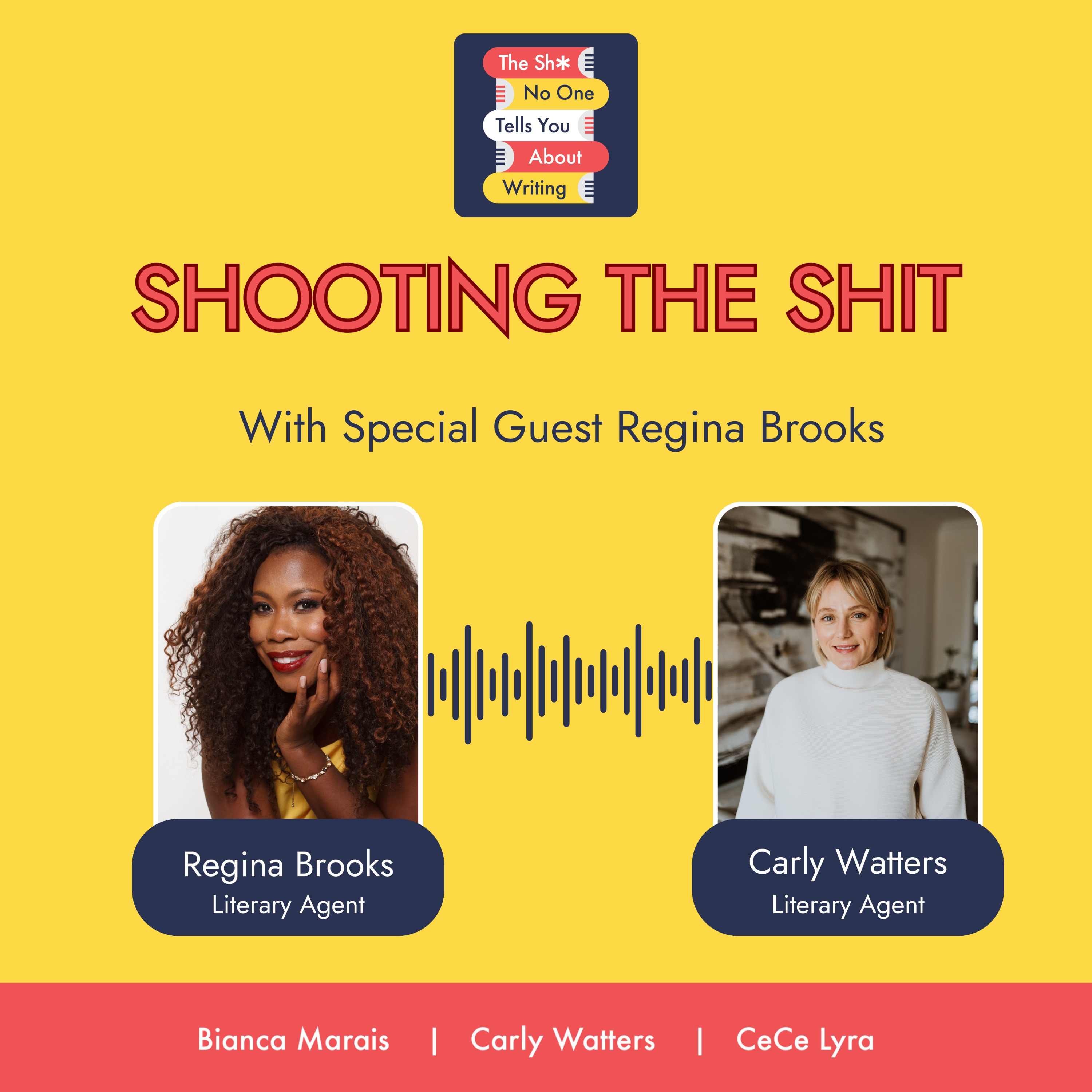
0:01 [SPEAKER_01]: Welcome to another episode of Shooting the Shit with Literary Agents, Carly Waters, and CC Lyra. 0:08 [SPEAKER_01]: Where we dissect publishing gossip, discuss book industry trends, and the overall state of the book business. 0:14 [SPEAKER_01]: If you'd ever wanted to grab a coffee with two literary agents, grab your mug, and pull up a chair. 0:26 [SPEAKER_01]: Hello everybody! 0:27 [SPEAKER_01]: So I was away for a couple of weeks and then CC did some solo episodes and now it's me with the special guest today and I'm very excited. 0:34 [SPEAKER_01]: We have Ms. Regina Brooks with us who is the founder and CEO of Sir Deputy Literary Agency based in New York where she represents established diverse base of award-winning clients and adult and young adult fiction, nonfiction, children's literature, her clients have received the 0:53 [SPEAKER_01]: National Book Awards honors. 0:55 [SPEAKER_01]: She's currently the president of the Association of American Literary Agents, which we call the AALA. 1:01 [SPEAKER_01]: She co-produces the people publishing conference, which you guys have heard us talk about. 1:05 [SPEAKER_01]: She's also written some books, writing great books for young adults, everything you need to know with source books, and you should really write a book with St. Martin's press. 1:13 [SPEAKER_01]: We're just so happy to have her. 1:15 [SPEAKER_01]: She's, you know, done all of the things on the agency side. 1:18 [SPEAKER_01]: And she's done all the things in terms of representing clients, she is the president of the association and which agents are connected to and just such a wealth of knowledge and we're so glad to have you so thanks for coming on the show Regina. 1:29 [SPEAKER_01]: Carly, thank you so much for having me, I'm excited to be here. 1:33 [SPEAKER_01]: Yes, awesome. 1:34 [SPEAKER_01]: We have a few things to talk about, so on the show, so this is our kind of like Monday episode, it goes live on Mondays where we just kind of talk about publishing what's going on and publishing. 1:43 [SPEAKER_01]: So we've filled in our listeners. 1:45 [SPEAKER_01]: on different things like a one with the ALA. We've mentioned some changes to the Canon, but I just since we have you, I would just love to focus on the writer side of this. 1:54 [SPEAKER_01]: Obviously, there are agents, and this is the ALA, but our audience is mostly writers, and so I would just love to hear from you, you know, some changes to the Canon, and then how you think that these are beneficial to writers, because obviously our goal at the end of the day is to have the best possible service. 2:13 [SPEAKER_01]: to our clients, and I would just love to get the rundown officially, because these, you know, we're kind of stumbling when we were trying to run through all the changes that I know you probably are much more first than them, you know, being ahead of the ALA, so we would just love for you to, yeah, give us the rundown, and yeah, how these are beneficial to writers. 2:31 [SPEAKER_02]: All right, so, you know, one of the things that I definitely want to share before we finish, 2:37 [SPEAKER_02]: I'll talk a little bit about the canon, but before we finish, I want to share a few questions that authors can ask editorial services individuals and professionals as well as agents who may be working with them in an editorial capacity so that they are very clear about how to establish. 2:56 [SPEAKER_02]: Those relationships, it weighs that feel like there is no conflict of interest and that they're fully informed. 3:03 [SPEAKER_02]: So, you mentioned that you talked a little bit about the canon, let me just give a little background on the canon. 3:09 [SPEAKER_02]: So, the canon of ethics is designed to create ethical guidelines for literary agents as they're working through their businesses. 3:17 [SPEAKER_02]: Now, agents have all different business models, you know, [SPEAKER_02]: When people think about agenting, primarily, there is no fee associated with agenting, meaning if you start working with an agent, there is not an upfront fee. 3:31 [SPEAKER_02]: Historically, there have been four fee agents and then there have been not for fee agents. 3:35 [SPEAKER_02]: And the canon, as established in the 1900s, which feels like 20th century, it is 20th century. 3:43 [SPEAKER_02]: There was no possibility for the organization 3:50 [SPEAKER_02]: associated with the agenting process. 3:52 [SPEAKER_02]: What that means is you can't pay an agent to represent you. 3:58 [SPEAKER_02]: That has historically been the ethical guideline that has associated with the canon. 4:04 [SPEAKER_02]: And that's still the case. 4:06 [SPEAKER_02]: You can't pay an agent to represent you. 4:09 [SPEAKER_02]: The organization before had, and it was very exclusive organization, meaning you had to have, in order to join, 4:18 [SPEAKER_02]: nominate you from the organization and you had to sold a certain number of rights in order to apply to even be a part of the organization. 4:27 [SPEAKER_02]: But in 2022, we made a change to the membership model. 4:31 [SPEAKER_02]: We changed it from being an exclusive organization to an inclusive organization. 4:35 [SPEAKER_02]: With the mindset that, you know, you shouldn't have to have been in the industry for a long time in order to join the organization because we want to build and educate [SPEAKER_02]: and provide professional development for the next generation of literary agents. 4:52 [SPEAKER_02]: And there was a number of things that were coming so much disruption and so much change. 4:56 [SPEAKER_02]: And because this is a primarily in a pronounced type business, we wanted to make sure that people who are out there representing themselves as agents, they really understood what it meant to be an agent. 5:10 [SPEAKER_02]: So we changed that, we changed the model. 5:13 [SPEAKER_02]: So you still have to apply, but you no longer have to get to people within the organization to nominate you, and you have to commit to adhering to the canon of ethics. 5:24 [SPEAKER_02]: So I wanted to just kind of start there, and also when we opened up the membership, and when I say opened up the membership, I mean changed from an exclusive to an inclusive, we also realized that there are people who work at agencies who would also get a lot of value 5:43 [SPEAKER_02]: So assistants, they're not necessarily selling rights, but they're a part of our ecosystem, and it will be great for them to understand what we do and to take our courses and our programming. 5:55 [SPEAKER_02]: Also, there are lawyers who work within our ecosystem, but there are rights managers. 6:01 [SPEAKER_02]: So you don't necessarily just have to be a seller of rights in order to be a part of our organization now. 6:08 [SPEAKER_02]: And with that change, because we now had a membership that was a little bit broader, we recognized that people were doing things and they were, their business models were all different. 6:20 [SPEAKER_02]: And we need to establish a canon that took into effect as many of the different business models as we could. 6:26 [SPEAKER_02]: And that was one of the things that initiated the change in the canon. 6:32 [SPEAKER_02]: So I wanted to give that background 6:36 [SPEAKER_02]: maybe thinking that we made the change so that agents can make more money, and that wasn't the initial rationale for making these changes. 6:45 [SPEAKER_02]: The other thing to think consider was the fact that when the cannon was first established, the cannon was set up under a different type of business model, where agents were doing things pretty much on commission only. 6:58 [SPEAKER_02]: But not all agencies work 7:06 [SPEAKER_02]: that had a different business model, we needed to create guardrails and ethical standards that address those different business models. 7:15 [SPEAKER_02]: So that was part of the rationale for the change. 7:19 [SPEAKER_02]: And the other piece of the change, too, was that the language in the canon was a little hard to understand, so we wanted to simplify it so that people could really have a true understanding, especially because now when you apply, you have to basically sign off 7:35 [SPEAKER_02]: to the canon. 7:36 [SPEAKER_02]: And if you don't understand it, you know, that's not good. 7:40 [SPEAKER_02]: So I wanted to start there. 7:41 [SPEAKER_02]: Where do you want me to start in terms of the changes? 7:44 [SPEAKER_02]: Because I could we make several changes. 7:48 [SPEAKER_02]: That would be the whole thing on a subject with the, yeah, could be the entire conversation. 7:53 [SPEAKER_01]: So yeah, yeah, that's a great primer. 7:55 [SPEAKER_01]: I was caught wanted to come at it from the kind of like writers perspective, right? 7:59 [SPEAKER_01]: So let's just say somebody who doesn't know much about the business or an author who aspiring author, going their own submission for the first time, 8:09 [SPEAKER_01]: How do you think that the changes to not maybe not just necessarily the canon, but also the agenting landscape that large, you know, how do you think that we can use the ALA or use the canon as a way to I don't just benefit authors as much as possible, is that if you're making sense? 8:27 [SPEAKER_02]: Yeah sure. 8:28 [SPEAKER_02]: Sure. 8:28 [SPEAKER_02]: I mean, I think that it's important to know that the the canon of ethics that we've established. 8:34 [SPEAKER_02]: we're very much committed to it. 8:36 [SPEAKER_02]: So for example, if you're working with an agent, first of all, you can go to our website a-a-l-a-l-a-lithagence.org. 8:44 [SPEAKER_02]: You can go to that site and you can look up agencies, find out what they're interested in. 8:50 [SPEAKER_02]: So if you're trying to find an agent for your topic or area of interest, you can go to the website and [SPEAKER_02]: basically scroll through and research and decide, oh, this is an agent that I might want to submit my book work to. 9:03 [SPEAKER_02]: So it's a resource in that way. 9:05 [SPEAKER_02]: And second, any agent that is a part of the organization again has committed to the canon of ethics. 9:11 [SPEAKER_02]: And so what that means is, 9:13 [SPEAKER_02]: If you find that they are not adhering to it or you have questions, and you think that they are not in alignment with the ethics that we have established, you can submit an email, a complaint, a grievance to our ethics committee, and we take those grievances very, very, they're very, very important, and we take them very, very seriously. 9:34 [SPEAKER_02]: So that's one thing. 9:35 [SPEAKER_02]: I think it's important that authors know that they that we really take authors, 9:43 [SPEAKER_02]: authors are a lifeblood, right? 9:45 [SPEAKER_02]: And so we really make sure that we are adhering to and doing what's best for authors. 9:53 [SPEAKER_02]: I wanted to just talk a little bit again at the beginning, I mentioned that I want to share some questions that authors can ask their agents. 10:02 [SPEAKER_02]: So the typical process is you submit 10:11 [SPEAKER_02]: And I know authors get really excited about the fact that, oh gosh, I've been offered representation. 10:17 [SPEAKER_02]: But before you sign a contract, I think it's important that you understand if you reach out to an agent and the agent says to you, oh, this is a good idea, but this is not a project that is ready to go. 10:31 [SPEAKER_02]: You can pay for editorial services that is not in compliance with our new cannon. 10:41 [SPEAKER_02]: you can't do that. 10:42 [SPEAKER_02]: If someone send, if you're an author and you send the material to an agency and then they offer you services, you can't do that. 10:50 [SPEAKER_02]: But if you have a project and you recognize that there is an agent who also offers editorial services, you can reach out to them for editorial services. 11:02 [SPEAKER_02]: Here are some questions that you can ask. 11:04 [SPEAKER_02]: Am I paying for a service or are 11:12 [SPEAKER_02]: ask because those two things are not coupled. 11:17 [SPEAKER_02]: Representation is separate from services. 11:21 [SPEAKER_02]: Whether that's editorial services or services to help you put together a marketing plan or website all of those services are different. 11:30 [SPEAKER_02]: I think the second question is does purchasing this service have any bearing on whether you will represent me? 11:36 [SPEAKER_02]: The answer to that question should be no. 11:39 [SPEAKER_02]: Okay, what happens to the fees I've paid you if later you offer me representation and is that document minute before we begin you definitely want to ask that question because in 2022 the way the cannon was written was if a person if an agency or someone was offering you editorial services and you paid for those editorial services. 12:06 [SPEAKER_02]: If they later offered you representation, they would then have to pay that money back to you, the money for editorial services. 12:15 [SPEAKER_02]: We've now decoupled that. 12:17 [SPEAKER_02]: So at the beginning of the engagement, it's very important to ask what happens to the fees I've paid you if you later offer representation. 12:29 [SPEAKER_02]: And is that document before we begin? 12:31 [SPEAKER_02]: Ideally, I'm encouraging people to document that, [SPEAKER_02]: The person who's offering the services will say to you, yes, I will pay those fees back or no, this is a fee for those services and they will not be paid back. 12:46 [SPEAKER_02]: But I think it's very important that the author understand what that business relationship is. 12:52 [SPEAKER_02]: The other question is, do you have any financial interest in the additional services you recommend? 12:58 [SPEAKER_02]: So sometimes the agent might not [SPEAKER_02]: offer the service, but they may know other people who do offer the service. 13:08 [SPEAKER_02]: And there should be no coupling of referral fees. 13:14 [SPEAKER_02]: What I mean by that is, if there is a referral fee that [SPEAKER_02]: author needs to be very clear about the fact that, oh yeah, I have a relationship, a business relationship with this service, but you do not have to use this service. 13:31 [SPEAKER_02]: I can give you a list of services. 13:33 [SPEAKER_02]: If I give you a list of 10, I will indicate to you that number 8, that one, I do have a financial interest in because I get a referral fee. 13:43 [SPEAKER_02]: So you should be very clear 13:50 [SPEAKER_02]: The final question is, am I free to decline paid services without jeopardizing my opportunity for representation? 13:57 [SPEAKER_02]: Again, those things should not be coupled, representation, and editorial services. 14:03 [SPEAKER_02]: So those are the, I think, the big five and there are others as well, but those are the big five that I would encourage people to ask. 14:12 [SPEAKER_01]: Yeah, yeah, I know that that makes sense. 14:15 [SPEAKER_01]: Yeah, I think I just, I know how many writers listen to this show and I think that it's been confusing for them because they've always been told, you know, agents don't charge anything, don't front fees, and I think it's, you know, the narrative then becomes a bit confusing in the sense of, oh, well, this agency, they're a reputable agency and then they also have this, you know, editorial arm or marketing arm 14:41 [SPEAKER_01]: And then I think, yeah, there's this inherent conflict where what they've been told is now different than the reality. 14:47 [SPEAKER_01]: And so, I just think we're on the cost of this big change. 14:50 [SPEAKER_01]: And it's been really interesting to see some of the responses. 14:54 [SPEAKER_01]: And I was really interested in the warnings that you use about we went from being an exclusive association to an inclusive association, because I've told this story on the show before, where I've been an agent for 17 years. 15:07 [SPEAKER_01]: And it took, [SPEAKER_01]: a very long time for me to work up enough sales, you know, like there was a qualification where it was like, I forgot how many it was, but it was like a lot of sales within two years. 15:16 [SPEAKER_01]: It was 10, 10, right? 15:19 [SPEAKER_01]: It was 10 in two years plus you needed to let us refer in plus, I don't know. 15:24 [SPEAKER_01]: There was a couple other boxes here to check. 15:26 [SPEAKER_01]: And it took me a long time to work up to that level, and like you said, there was so many services that the ALA provided that younger agents can benefit from, but then there's the whole, we had this agency on such a, I don't know, a pedestal of things like, oh, you know, when you've made it, then you can join the ALA, which was such an interesting, 15:45 [SPEAKER_01]: narrative. 15:45 [SPEAKER_01]: Anyways, the year that I put in my application, I remember the writing back and it was taking a while and I was like, how are you just making sure you guys got my application? 15:52 [SPEAKER_01]: They were like, this was the year that they were changing all of the qualifications. 15:55 [SPEAKER_01]: So you didn't have to do all of the steps and everything like that. 15:59 [SPEAKER_01]: So yeah, it's interesting seeing the association evolve over the years and how obviously trying to be accommodating to the realities of how agents are running their businesses and how they're all running and differently. 16:11 [SPEAKER_01]: We'll also try to be really upfront with authors and writers, aspiring writers about how, you know, I don't know, just how they can interact with agents and anyway, I've always found that really interesting the other. 16:22 [SPEAKER_02]: Can I just go back, I just want to make sure that your audience is clear about the fact that. 16:27 [SPEAKER_02]: The lion's share of the agents that are part of our organization, they don't offer services. 16:34 [UNKNOWN]: Yeah. 16:34 [SPEAKER_02]: When we did our survey, and this was in 2025, we asked that question, and we had, I think, 11% of the people who completed our survey said that they offered services. 16:49 [SPEAKER_02]: And I think that's important to know, and I think it's also important to know that most agents, 16:57 [SPEAKER_02]: We've created guardrails around how to do it if you decide that you do want to offer services. 17:03 [SPEAKER_02]: Most of them don't have time, energy, or time, the energy, or interest, really, in off-review services. 17:13 [SPEAKER_02]: I think that's important to her. 17:14 [SPEAKER_02]: Yeah. 17:15 [SPEAKER_01]: Yeah, that's a super interesting statistic. 17:17 [SPEAKER_01]: I hadn't really thought about it from a statistics point of view. 17:19 [SPEAKER_01]: I was under the assumption, and maybe completely incorrectly, 17:23 [SPEAKER_01]: one of the reasons for the change in the can was because there was such an influx of these services, but I think you're saying, I was actually such a small percentage of the membership, but it is just, yeah, as you said, creating guardrails around that. 17:36 [SPEAKER_02]: Right. 17:37 [SPEAKER_02]: Yeah, because if we don't talk about it, then it's easier, if we don't have guardrails for those people who are part of the 17:48 [SPEAKER_02]: we don't have guardrail. 17:50 [SPEAKER_02]: So authors are not protected under our canon of ethics. 17:53 [SPEAKER_02]: And so what we did was, okay, for those people who are offering services, this is how you need to do it in an ethical way. 18:02 [SPEAKER_02]: So it was important to say that. 18:04 [SPEAKER_02]: And also the other thing too is it hasn't changed that in preparation for the manuscript or proposal to go out to [SPEAKER_02]: publisher. 18:16 [SPEAKER_02]: Agents are still doing that editorial work and it's still a part of what we do. 18:21 [SPEAKER_02]: Editorial service is really different. 18:24 [SPEAKER_02]: It's more developmental editing. 18:26 [SPEAKER_02]: It's not editing and preparation for selling the book. 18:30 [SPEAKER_02]: So authors for the most part and every again, we can't dictate as an organization. 18:37 [SPEAKER_02]: What the business model is that each agency uses, we can't 18:44 [SPEAKER_02]: It's just not something that we're able to do, but what we do is we look at all the many different ways that people are doing their work and trying to create guidelines around those. 18:56 [SPEAKER_02]: So I want to make sure that people are very clear about that. 18:59 [SPEAKER_01]: Yeah, and I think it's interesting also what you said about like, you know, editing the go on submission versus developmental editing because so many agents as, you know, you and myself included, you know, there's different levels of editing you do for this right clients and sometimes it is developmental, but we don't charge for it because it's obviously part of our goal of selling the book and so it's interesting because there is obviously an opportunity for authors to be preyed on in the sense of like, hey, you know, somebody hangs their hat as an agent, they say, hey, I'm gonna, you know, off of these services, but as you 19:27 [SPEAKER_01]: You know, authors and anybody listening should be checking, like is this person a member of the ALA, you know, you can check their guidelines. 19:33 [SPEAKER_01]: Obviously on their website check it against the ALA's website for the legitimacy. 19:36 [SPEAKER_01]: Yeah. 19:37 [SPEAKER_02]: Let me just ask when you say it. 19:38 [SPEAKER_02]: There's a way for the offers to be preyed on. 19:40 [SPEAKER_02]: Explain what you mean by that. 19:43 [SPEAKER_01]: Oh yeah, yeah, great question. 19:44 [SPEAKER_01]: So I, and maybe I'm just, you know, I've been on the internet too long and seen too many scams going around. 19:51 [SPEAKER_01]: I think there's an opportunity for authors to be preyed on because authors are just in such a vulnerable position, right? 19:57 [SPEAKER_01]: Because there's so many of them, there's so hungry for information or attention on their manuscript where anybody can call themselves an agent. 20:08 [SPEAKER_01]: You know, whether they're a member of the ALA, 20:13 [SPEAKER_01]: and there's obviously such an opportunity with AI for people to make a fake AI website and call this a division. 20:18 [SPEAKER_01]: And there are tons as you and I both know, you know, we get emails all the time but people pretending to be agents for a company. 20:23 [SPEAKER_01]: We pretend to be. 20:25 [SPEAKER_01]: Yeah, I know it happens all the time. 20:27 [SPEAKER_01]: We talk about it tons on the show because we want people to be aware. 20:30 [SPEAKER_01]: So there's just, yeah, I just think there's an opportunity for office to be preyed on just based on the internet alone and then you add in the AI piece. 20:37 [SPEAKER_01]: And just authors not having as much information to know what is a good agent, what is not a good agent and that's obviously one of the reasons we have this show this podcast and obviously one of the reasons we want to have you on. 20:48 [SPEAKER_02]: Yeah, I think that I was telling a friend of mine. 20:51 [SPEAKER_02]: the other day that people don't, you don't get mugged in the street anymore. 20:55 [SPEAKER_02]: It's all digital theft. 20:58 [UNKNOWN]: Yes. 20:59 [SPEAKER_02]: They steal your name, your website. 21:02 [SPEAKER_02]: It's just all kinds of things or photos. 21:04 [SPEAKER_02]: Your photos, effects, someone sent me an email. 21:08 [SPEAKER_02]: And they basically had scraped my entire website and said, here, here's a better website for you. 21:13 [SPEAKER_02]: Like, oh my gosh, they had a whole created a whole new website for me. 21:17 [SPEAKER_02]: So yeah, in that regard, I absolutely understand [SPEAKER_02]: I think it's important when we talk about being preyed on two different things. 21:26 [SPEAKER_02]: One, the author is coming to the agent, either for representation, and then they're coming to a person who's offering editorial services. 21:39 [SPEAKER_02]: So it's important that you know that agents are not going to be going out to [SPEAKER_02]: authors praying on them. 21:47 [SPEAKER_02]: So if you have an author, if an author is receiving an email that says, hey, I'll offer you representation for your manuscript, but you have to pay me for editorial services on it. 22:00 [SPEAKER_02]: That's, you're not going to get agents doing that, at least not agents for the 22:11 [SPEAKER_01]: Yeah, yeah, great point. 22:12 [SPEAKER_01]: Yeah, great point. 22:13 [SPEAKER_01]: Okay, so now I'm going to talk about the survey you mentioned it. 22:15 [SPEAKER_01]: I've talked about it a bunch on the show. 22:16 [SPEAKER_01]: I'm like endlessly fascinated with the survey and I know this year's which was the 2025 survey was really in depth in different areas, which I thought was really fascinating and I've talked as I said, I've talked about on the show before. 22:29 [SPEAKER_01]: One of the things I find is so fascinating is [SPEAKER_01]: the section on just the the high input and then the low versus high reward. 22:39 [SPEAKER_01]: So high input meaning as I just said agents we put in so much work for clients, right? 22:43 [SPEAKER_01]: We're you know we're doing editing and client management and all of this stuff and it feels like especially as a new agent you're just you just go go go, right? 22:50 [SPEAKER_01]: Just delivery so much for your clients because it's our dream job and we love it and then the reward piece is interesting, right? 22:56 [SPEAKER_01]: Does the agent feel like for all of that high input that they're getting a low reward versus a high reward and 23:02 [SPEAKER_01]: As I said, I've talked about in the show before, but it's basically like the percentage of, you know, just job, like job satisfaction starts to balance out when agents start to make more money, obviously, and the job is such a balance of all of these things. 23:18 [SPEAKER_01]: So I guess my question to you, if I could frame this as a question, it also kind of comes back to what you were saying about the exclusivity of the ALA versus the inclusivity of the ALA, because 23:28 [SPEAKER_01]: Now that the association has a lower barrier to entry, meaning where people can join, which is more inclusive, I think the data could be read a couple different ways, which is really interesting. 23:38 [SPEAKER_01]: In this sense that arguably, and this is something I want to talk to you about, you know, people say it's harder than ever to make a living as a literary agent and some of the data in the survey suggests this. 23:49 [SPEAKER_01]: But we also know there are a lot of what I call hobby agents. 23:53 [SPEAKER_01]: Maybe agents who don't do it 23:57 [SPEAKER_01]: they have other work that they do to supplement this such as it, you know, other services that they offer. 24:02 [SPEAKER_01]: And so I don't know, I read this survey, especially this section with that lens of is it that people aren't getting as much job satisfaction because the job's harder than offer or is it because, you know, agents are having to cobble together a few different things in their career to make it work? 24:21 [SPEAKER_01]: Is that resonating with you at all? 24:22 [SPEAKER_01]: Does that make sense? 24:25 [SPEAKER_02]: Yeah, I mean, I think there are a number of pressures that are bearing down on publishing in general, but especially agents and authors, because I think one thing that it's important to remember is agents are tethered to the author. 24:43 [SPEAKER_02]: So if the authors are having issues and having challenges both financially or making a living at it, then agents are 24:53 [SPEAKER_02]: having it even harder time for the most part because it's not across the board, but many ages get 15%. 25:01 [SPEAKER_02]: So if an author is not making as much money, then that means the agent is not making as much money either. 25:07 [SPEAKER_02]: And I think that what I found in the industry is there is very much the haves and the havenots, meaning, you know, historically you could get some mid-sized deals, [SPEAKER_02]: and you could have 10 to 15 of those mid-to-sized deals and really have a career. 25:26 [SPEAKER_02]: But one of the things that came from the survey was that many of the agents and who were working full time, not having extra jobs, even those who were on salary, were making less than $50,000 a year. 25:43 [SPEAKER_02]: and New York, that's, I mean, not all ages are in New York, but in New York City, $50,000 a year, that's not enough money to live off of. 25:52 [SPEAKER_02]: And if you work in house as an editorial assistant, most of the big five have increased the entry-level salaries to, I think, $55,000. 26:02 [SPEAKER_02]: So there are people who have been working as agents, you know, five plus years who are still yet to be making the entry-level salary of an editorial assistant. 26:13 [SPEAKER_02]: And one other piece of data from our survey was taking ages between 10 and 15 years to get to $100,000 a year. 26:23 [SPEAKER_02]: And most of these agents have master's degrees and some had PhDs. 26:28 [SPEAKER_02]: So I think those numbers speak to the amount of work that we have to do to actually make a career of it of this. 26:38 [SPEAKER_02]: And I was just anecdotally, I've been talking to a lot of agents about, you know, the difference, I've been in an agent for 26 years and I've been asking them, you know, how is it different for you from 15 years ago or from 20 years ago than it is now. 26:56 [SPEAKER_02]: And there are some significant differences. 26:58 [SPEAKER_02]: Number one, we only have five big publishers. 27:00 [SPEAKER_02]: We used to have more, right? 27:02 [SPEAKER_02]: So the consolidation. 27:04 [SPEAKER_02]: is definitely an issue. 27:05 [SPEAKER_02]: And with consolidation, that means a lot of imprints have closed down. 27:09 [SPEAKER_02]: So the number of places that you could actually submit your work to has decreased. 27:14 [SPEAKER_02]: The number of agents has increased. 27:16 [SPEAKER_02]: So editors are having a lot more to review and to provide feedback on or to get answers. 27:25 [SPEAKER_02]: And that process as a result of so much, that means that the editors are not getting back to us in a timely fashion. 27:34 [SPEAKER_02]: You know, six weeks to get a response or three to four weeks if you had a really great relationship with it with the editor is now moving into three months and so if it takes three months for you to even get a response, you know, think about the course of a year, how many books you have to actually get out into the marketplace to to be evaluated so that's no that's that's an issue and then the contracts and how long it takes to get contracts completed I mean there's just a lot of bottlenecks within the system. 28:04 [SPEAKER_02]: And because of those bottlenecks, that affects how much money an agent can make. 28:11 [SPEAKER_02]: And I think that, go back to your question about whether or not, you know, people were trying to cobble together. 28:17 [SPEAKER_02]: I think that there are agents who are on a draw, there are agents who are on salary, and even when I talk to those folks, they're stressed about it too. 28:27 [SPEAKER_02]: I think that the industry [SPEAKER_02]: is gonna have to come up with some really good answers and a new way of operating. 28:34 [SPEAKER_02]: I mean, think about the number of times that you have to read a manuscript before you feel comfortable with it, you know, submitting it. 28:40 [SPEAKER_02]: And I always talk to authors about the fact that, you know, it may take me, depending on what else is going on at the time, if you have a 300-some-out page manuscript and I'm really looking at it with an editor's eye. 28:54 [SPEAKER_02]: It may take me six to eight hours. 28:55 [SPEAKER_02]: And if I have to read that twice or three times, there's just a lot of time that goes into it. 29:01 [SPEAKER_02]: And so one of the things that we asked in the survey was the high input lower award. 29:09 [SPEAKER_02]: You can do all of this work over the course of six to nine months or two a year. 29:13 [SPEAKER_02]: And then get an offer of like $10,000. 29:18 [SPEAKER_02]: And you're thinking, oh my gosh, I don't even want to think 29:23 [SPEAKER_02]: what my hourly wage was for this project, and you know, I think most agents who come into the business are very optimistic, and we believe in the dream too. 29:36 [SPEAKER_02]: And so the idea that we, even if we get a relatively nominal advance, we're like, let's go to sell on the back end. 29:45 [SPEAKER_02]: You know, we're going to go back in. 29:48 [SPEAKER_01]: So I think that's foreign rights, there's TV film. 29:50 [SPEAKER_02]: There's a lot of people in the world who get this. 29:53 [SPEAKER_02]: Yes, we've got this, yes, yes, yes. 29:56 [SPEAKER_02]: Yeah, we're not thinking about just one sales channel, you know, like all the other ways that this can be monetized. 30:02 [SPEAKER_02]: But I will say that in this last survey, and we're doing another one in 27th top of the year. 30:09 [SPEAKER_02]: that the results from 25, it's going to be interesting to see the shift from 25 to 27 because our 25 results only kind of was the tip of the iceberg as it relates to AI. 30:21 [SPEAKER_02]: Yeah. 30:21 [SPEAKER_02]: It was, it was pre the anthropic theft of our bones. 30:27 [SPEAKER_01]: Yeah. 30:28 [SPEAKER_01]: Absolutely. 30:29 [SPEAKER_01]: Yeah. 30:29 [SPEAKER_01]: Yeah. 30:29 [SPEAKER_01]: Yeah. 30:29 [SPEAKER_01]: I wrote down a couple things as you were talking because I want to don't let you go on your beautiful rant. 30:33 [SPEAKER_01]: Another thing is like open across of agencies. 30:36 [SPEAKER_01]: No, it was great. 30:36 [SPEAKER_01]: It's perfect. 30:37 [SPEAKER_01]: That's a podcast or forest talking. 30:40 [SPEAKER_01]: operating costs right have gone up so you add that's kind of where I was going to go so you talk about you know obviously the Anthropics stuff like agencies even though they weren't directly related to it in terms of obviously the results. 30:52 [SPEAKER_01]: lot of time. 30:53 [SPEAKER_01]: I know some agents who were trying to help authors, you know, put them in touch with lawyers and you know, just try to, you know, be the best support that they could possibly be. 31:01 [SPEAKER_01]: So the operating cost of agencies, the past couple of years has gone up some agencies not my agency. 31:06 [SPEAKER_01]: I know some agencies are spending money on paying Graham or other services to kind of help them. 31:10 [SPEAKER_01]: you know sort through all the AI, swap that we're getting, and also one more thing is the contracts, right? 31:16 [SPEAKER_01]: So with these contracts takes so long, then that again leads on all the operating costs of the agency. 31:20 [SPEAKER_01]: So I'm just noticing also all of these resources on the agency side in terms of running the business or going up as well. 31:29 [SPEAKER_02]: I mean, if you think about it, not every agency has a subscription to Sircata or book scan, but there's the annual fee for Sircata, then there's any trait opportunities. 31:40 [SPEAKER_02]: Like, yeah, magazines and periodicals and such as publishers marketplace and publishers weekly so that the agent can keep, you know, their finger on the pulse of what's going on in the industry, so there's that cost. 31:52 [SPEAKER_02]: I mean, there's the cost of just operating your website. 31:56 [SPEAKER_02]: And then, historically, we never had to really do social media. 32:00 [SPEAKER_02]: And now most agencies have to do social media. 32:03 [SPEAKER_02]: So whether they're doing that in-house, or they've hired so most to support that, there's that cost, there's payroll, the ADPs, or the PHAXes of the world, if you're going to be a part of that, there's just a number of operational costs that have definitely skyrocketed. 32:21 [SPEAKER_02]: Absolutely. 32:22 [SPEAKER_01]: Yeah, I'm like as you were talking with rattling off all of the subscriptions I pay for like airtable and you know the stuff to run the business. 32:29 [SPEAKER_01]: So yeah, absolutely. 32:30 [SPEAKER_01]: That'll make sense. 32:31 [SPEAKER_01]: Okay, so I wanted to move on. 32:32 [SPEAKER_01]: You mentioned AI. 32:33 [SPEAKER_01]: So let's go there. 32:35 [SPEAKER_01]: It's a really complicated time. 32:37 [SPEAKER_01]: You know, obviously, agents. 32:39 [SPEAKER_01]: We've received as, yes, everybody knows so many submissions. 32:42 [SPEAKER_01]: All the time we're getting tons of AI, sloppy submissions. 32:45 [SPEAKER_01]: We're getting writers who are not using AI at a pitch, but then they're using AI to maybe edit their materials. 32:52 [SPEAKER_01]: I mean, my strategy is to have a really frank and early conversation with an author, especially in the submission phase of receiving their submission. 33:01 [SPEAKER_01]: Did you use this at all and how did you use it? 33:02 [SPEAKER_01]: And I really just want to understand everybody's workflow. 33:05 [SPEAKER_01]: But on the publisher side of things, it's also getting more complicated because we don't know what the publisher is doing. 33:12 [SPEAKER_01]: And I also feel personally just like a classic middleman, you know, of like, my job is to ferry this information back and forth and take people at their word. 33:19 [SPEAKER_01]: And I don't know what's going on at the publisher. 33:22 [SPEAKER_01]: I don't, maybe not every author is being truthful with me about what they're doing. 33:25 [SPEAKER_01]: How do you think about this, you know, in terms of the agent being the middleman here in this really complicated AI time? 33:36 [SPEAKER_01]: Some committee and yeah, and all this work that they're doing, but how I don't you can talk personally as an agent or as the association, how are you thinking about this challenging time. 33:45 [SPEAKER_01]: Well, talk about it from two perspectives. 33:47 [SPEAKER_02]: One, our AI committee is wanted. 33:51 [SPEAKER_02]: They're very much making sure that they understand things from a policy standpoint. 33:57 [SPEAKER_02]: they're in conversations with publishers to try to understand what they're doing, asking them for transparency. 34:02 [SPEAKER_02]: We work in tandem with the author's guild. 34:06 [SPEAKER_02]: We just partnered with them on an Amicus brief where they were going after one of the AI companies. 34:12 [SPEAKER_02]: We also have been trying to educate agents on how to navigate the AI space. 34:19 [SPEAKER_02]: And we've also, the AI committee has also shared information [SPEAKER_02]: information that they can share with their authors. 34:27 [SPEAKER_02]: So AI moves so fast. 34:31 [SPEAKER_02]: So I don't even think the AI company, the frontier models, can keep up with what's going on. 34:36 [SPEAKER_02]: Let alone agents who are focused as definitely in another direction. 34:41 [SPEAKER_02]: But we have done, I think, the AI committee I'm very proud of them as staying on top of it, especially with the anthropic. 34:48 [SPEAKER_02]: We were really trying to make sure that our agents were aware of what was happening [SPEAKER_02]: And then on a personal level, I am a big, big fan of innovation. 34:59 [SPEAKER_02]: Before I came into publishing, I worked as a aerospace engineer. 35:03 [SPEAKER_02]: So I'm really like, oh, what is this? 35:05 [SPEAKER_02]: Let me tinker, let me fight out. 35:06 [SPEAKER_02]: So I'm really interested in understanding how these tools work, and how AI can support things apparitionally. 35:16 [SPEAKER_02]: But it's a challenge. 35:17 [SPEAKER_02]: It's a number one. 35:17 [SPEAKER_02]: It's a challenge to stay on top of things. 35:24 [SPEAKER_02]: are starting to infiltrate our business. 35:28 [SPEAKER_02]: And I say, use the word infiltrate. 35:29 [SPEAKER_02]: I don't mean that in an negative way, necessarily. 35:31 [SPEAKER_02]: But they're becoming a part of the workflow, especially for publishers in-house. 35:36 [SPEAKER_02]: And it's important that agents have a better understanding of what the usage is in-house at the publishing companies so that we can be clear with our authors. 35:48 [SPEAKER_02]: And speaking of [SPEAKER_02]: another thing that ages have to do now is create AI policies. 35:55 [SPEAKER_02]: We're encouraging people to share either on their website or with their authors, what their policy is going to be in regards to AI usage. 36:03 [SPEAKER_02]: Some agents don't want any parts of it. 36:05 [SPEAKER_02]: Some agents, while just say if you submit a manuscript that has been AI generated, the publishers can't copyright it. 36:14 [SPEAKER_02]: And so without a copyright, that means no one [SPEAKER_02]: So helping authors really understand the distinction between what is AI-generated, what is AI-assisted, and it's very nuanced. 36:28 [SPEAKER_02]: Does that mean putting something in and putting a paragraph into an LLM and then having the LLM send you back that paragraph rewritten, is that AI-assisted, or is that AI-generated? 36:42 [SPEAKER_02]: So I think the education of this is really important for agents. 36:46 [SPEAKER_02]: And in order for ages to educate, that means that they have to know a little bit about themselves, which is another lift for many, many agents. 36:54 [SPEAKER_02]: Even if you don't want to, you don't want to deal with AI at all, your anti-AI, I think it's important to at least understand it. 37:02 [SPEAKER_02]: And in terms of power on working with my clients, I most of my clients, especially because I've been doing this for 26 years, I know they're writing, I can tell when something is like, oh, I don't 37:14 [SPEAKER_02]: But I think I'm asking for transparency. 37:17 [SPEAKER_02]: And I ask very simply, like, okay, did you use AI for any of this and how to do use it? 37:23 [SPEAKER_02]: And recently I've been really considering and I hate it, but I've been considering asking my authors to just keep track of their drafts just in case there is any issue. 37:35 [SPEAKER_02]: And especially because I represent a lot of people of color, [SPEAKER_02]: And a lot of the cases that have been coming against using pan-gram and these AI detection tools have been coming up against African writers and F of Dites for writers. 37:49 [SPEAKER_01]: Yeah, absolutely. 37:50 [SPEAKER_01]: Yeah, I'm just also something we've talked about on the show. 37:52 [SPEAKER_01]: That's a whole other conversation, but thank you for bringing that up. 37:55 [SPEAKER_01]: Okay, so I think we have time for one more question, which is, what do you think this single, I mean, we talked about this throughout the conversation, but if we haven't touched on something, I'd love to hear it. 38:06 [SPEAKER_01]: What do you think this single biggest challenge is for literary agents working in the business today? 38:10 [SPEAKER_01]: If we haven't touched on it yet, or if you want to underscore something, now we've already talked about. 38:14 [SPEAKER_02]: Single, just single? 38:16 [SPEAKER_02]: Zed. 38:17 [SPEAKER_02]: I mean, I guess I would say, just staying educated. 38:22 [SPEAKER_02]: You know, being educated on all the various aspects of what's happening in the business. 38:28 [SPEAKER_02]: I mean, that's one of the reasons why we started the people of publishing conference because professional development in this space is very slim, you know? 38:38 [SPEAKER_02]: And whenever new things come into our environment, there's like this catches catch can to try to understand what's going on. 38:48 [SPEAKER_02]: we hope as an organization and as a conference that we can be the definitive professional development opportunity for agents. 38:56 [SPEAKER_02]: So they know, okay, if I can't find the answer, I know the ALA will find it for us. 39:01 [SPEAKER_01]: Yeah, well, we're very aligned in that because that's what this podcast tries to do is educate people as much as humanly possible and there's so much misinformation out there and I really appreciate all the work that the alien does. 39:12 [SPEAKER_01]: I was going to give a shout out also to the AI committee because they have a great risk assessment checklist for agents, which is great. 39:18 [SPEAKER_01]: The people at Publishing Conference, I went last year in the Michael Post CC with this year, so we love it, keep it up and obviously keep up all the great work that the ALA is doing because we need all these professional development supports and you guys do such great programming. 39:32 [SPEAKER_01]: So any agents that are listening who aren't a member definitely checking out because they're so much value there. 39:38 [SPEAKER_01]: So thank you for being with us, Regina. 39:40 [SPEAKER_01]: Thank you, Carly. 39:41 [SPEAKER_01]: I really enjoyed it. 39:44 [SPEAKER_02]: Let me know if you need me to come back with more information. 39:48 [SPEAKER_01]: Absolutely, thank you. 39:50 [SPEAKER_02]: Thank you so much. 39:51 [SPEAKER_00]: CC Lera is a literary agent at Wendy Sherman Associates. 39:56 [SPEAKER_00]: If you'd like to query CC, please refer to the submission guidelines at www.wshoman.com. 40:04 [SPEAKER_00]: CalliWaters is a literary agent at PS Literary Agency. 40:09 [SPEAKER_00]: But a work on this podcast is not affiliated with the agency. 40:13 [SPEAKER_00]: and the views expressed by Kali on this podcast are solely that of her as a podcast co-host and do not necessarily reflect the views, opinions, policies, or position of PS literary agency.









Community discussion