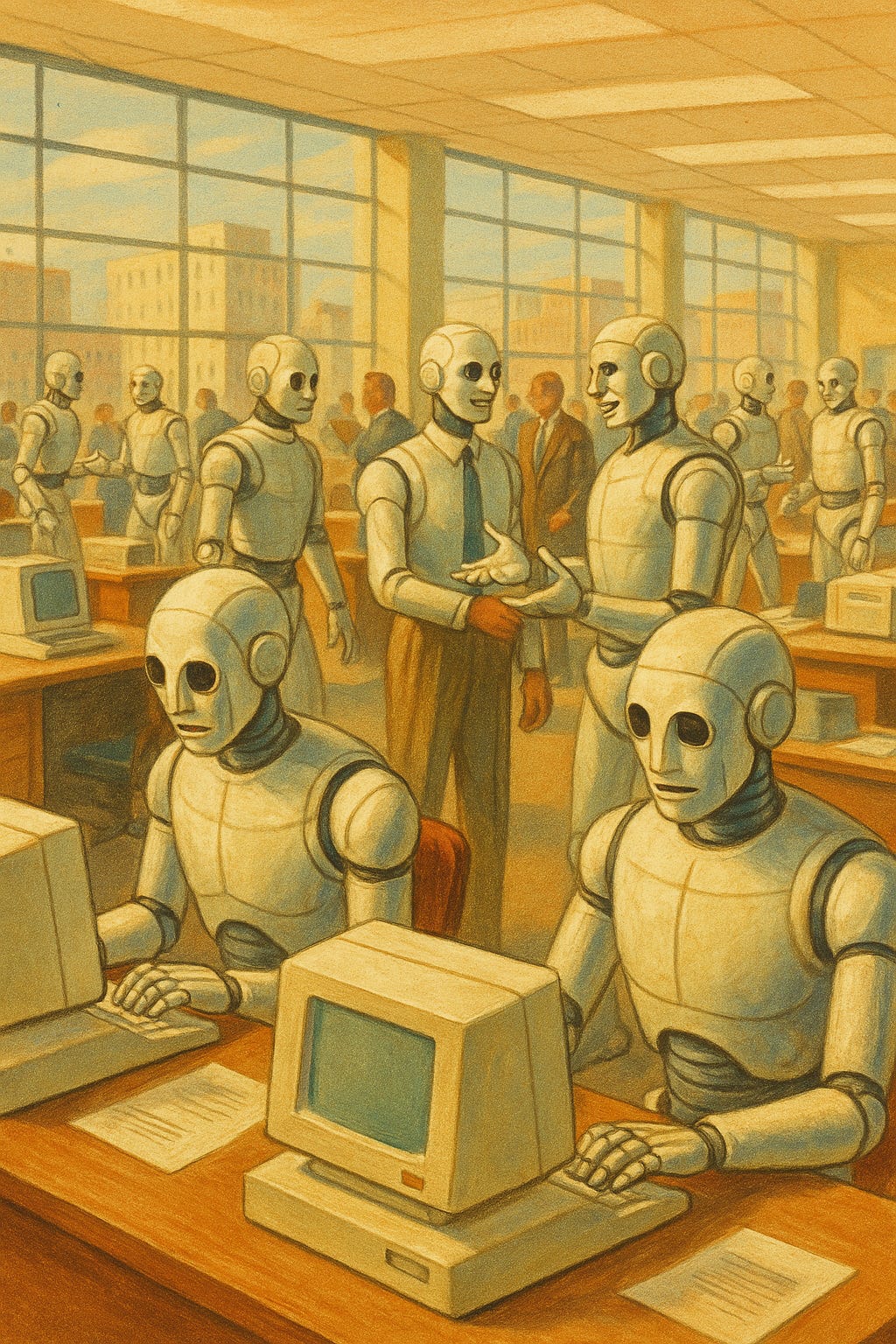
Today’s Letter is brought to you by The Bitcoin Dolce Visa ! You can now access Italy’s Investor Visa with a €250K equity investment into Bitizenship Italia, a Milan-based Bitcoin startup. Visa approval arrives first, investment happens only after authorization. The company operates with a Bitcoin-aligned treasury, non-custodial L2 staking, and clear redemption windows every 24 months. To date, Bitizenship has facilitated €25M+ in Bitcoin-aligned residency investments. A compliant, Bitcoin-native pathway into one of Europe’s strongest economies. Private placements now open. 1 To investors, The US economy is getting hit with multiple deflationary forces at the same time. These converging trends are forcing the hand of the Federal Reserve towards lower interest rates and more money printing. First, we know that artificial intelligence and robotics are squeezing an insane amount of inefficiency out of every corner of the system. Companies can now drive more profits with fewer employees, which is usually referred to as “good deflation.” This is when supply expands faster than demand. So where can we see this happening in today’s economy? We see example after example of productivity surges, cost compression, and quality enhancements. This fosters a “deflationary boom,” where goods and services become cheaper, enhancing consumer purchasing power and supporting GDP growth without overheating. AI is not only making companies more productive, but we are reaching a point where AI can write its own software. Eventually, technologists promise us that humanoid robots will be doing many things in society, including manufacturing and assembling more humanoid robots. This type of exponential productivity is hard to understand today. It is probably the most important deflationary trend though. Elon Musk, the founder of numerous multi-billion dollar companies at the intersection of AI and robotics, recently discussed how these technologies should create deflation and help address the national debt crisis. Take a listen: It seems like deflation is the obvious end state when Elon explains his view on these technologies in relation to the growth of America’s money supply. But Elon understands that AI and robotics are still not making a big enough impact on the economy to reach a deflationary state yet. Part of that gap is because of the ridiculous amount of money that is being printed by the US government, but another aspect is that AI and robotics remain in a relatively nascent stage. Elon’s estimation is that the US economy will hit a deflationary period in three years: Now Elon Musk is known for aggressive timelines and plenty of critics will argue that his estimation is off by a decade or more. I wouldn’t be so sure though. The pace of innovation, and the acceleration in adoption for AI and robotics, tells me the deflationary impact is much closer than most people realize. These technology trends are not happening in a silo either. The second big trend we have to pay attention to are demographics and proposed policy shifts. Both of these are curbing consumer demand and shrinking the labor supply, creating a potential “deflationary shock.” Economist David Rosenberg highlights three converging forces: * Aging workforce : The US median age is 42.3 (up from 36 in 2000), with the dependency ratio (the number of non-working people vs people of working age) rising to 37% by 2035, reducing spending on discretionary goods. * Immigration restrictions : Tighter policies limit population growth and low-wage labor inflows, suppressing household formation and service-sector demand. * Tariffs : broad tariffs (e.g., on imports) could slash consumer spending by raising costs, leading to a demand cliff. These three factors could weaken aggregate demand, which can cause prices to fall as businesses face oversupply and cut prices to clear inventory. On the positive side, lower demand might stabilize housing and services inflation, but it risks a vicious cycle of delayed spending and job losses, especially in retail and construction. Getting this balance right is very important. You want deflation without recession. This can only be done by creating positive supply-side factors rather than a collapse in demand. This is often called “good deflation” or “growth deflation,” where prices fall due to increased productivity, technological advancements, or efficiency improvements that boost output and real incomes. As one example, we are seeing this “good deflation” happen in energy costs over the last year. The decline in energy costs are due to increased domestic production, milder global demand, and efficiency gains from renewables and AI-optimized grids. US gasoline prices are projected to drop 3% (11 cents/gallon) in 2025 vs. 2024, with energy inflation at -1.6% year-over-year as of July 2025. These cheaper energy prices act as a broad disinflationary tailwind, including lower input costs for manufacturing and transportation. This boosts househol