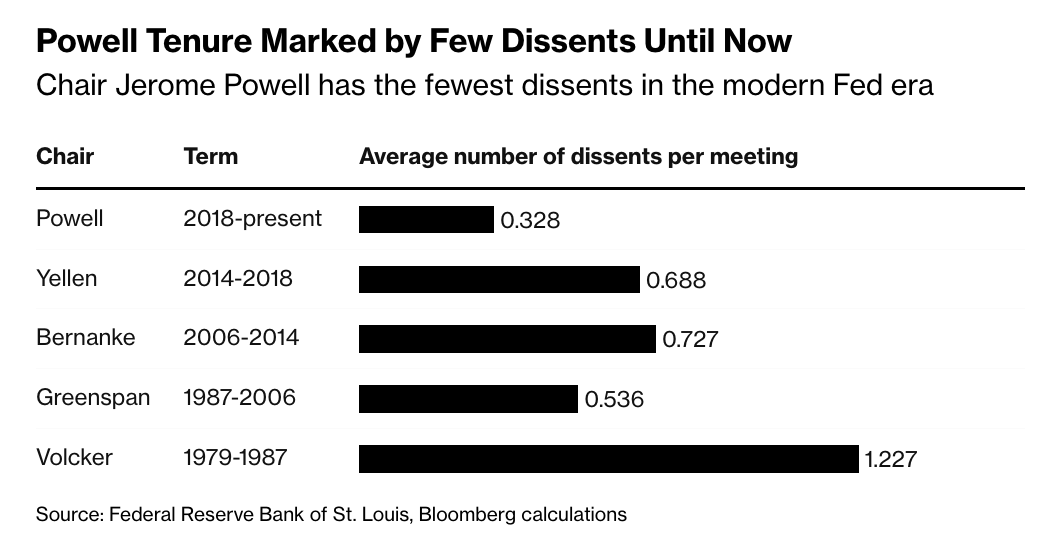
Today’s letter is brought to you by Lava ! Lava’s bitcoin-backed line of credit allows you to unlock your bitcoin’s purchasing power— instantly, flexibly, and securely— without selling your bitcoin. Borrow dollars in real time with no monthly payments, open terms, and the lowest fixed interest rates in the industry— starting at just 5%. Lava is the only bitcoin lending platform available globally—you can borrow from any country or state. With Lava, you can access a full suite of bitcoin-powered financial tools : → Borrow dollars instantly → Earn 5% APY on your USD balance → Buy bitcoin with zero fees It’s everything you need to grow your bitcoin wealth— without ever selling your bitcoin. To investors, The Federal Reserve and the Board of Governors have a history of debating policy decisions behind closed doors, yet they almost always put on a united front when it comes time for their periodic vote on monetary policy. That is why it was such a big deal when two Fed Governors dissented at the same time back in July of this year. Not one, but two Governors dissenting in the same meeting. We had not seen two Fed Governors dissent in the same meeting since 1993, so the rarity of the situation raised eyebrows. At the time, most people wrote off the anomaly as a politically driven outcome. Fed Chairman Jerome Powell doesn’t seem to be a fan of Donald Trump and the two Fed Governors who dissented were Trump nominees. The Fed is supposed to be independent, but if you believe that I have a bridge to sell you. The institution is made up of humans. Humans are biased. That bias doesn’t have to surface in a malicious or nefarious way, but every human is affected by their personal beliefs. That is how human nature works. No one, not even a central bank, is safe from it. But now we are getting information that those two Governor dissents in July may have been the warning sign of things to come. Bloomberg’s Catarina Saraiva published an article over the weekend titled Fed Watchers Turn to Vote Counting as December Rate Drama Grows . In the article, Catarina writes: “Division at the Federal Reserve has intensified in recent weeks, with officials staking out disparate positions ahead of the central bank’s December policy meeting — all while Chair Jerome Powell stays silent. The drama was amped up Friday when New York Fed President John Williams, sometimes seen as a proxy for the Fed chief, signaled his support for a rate cut after several other policymakers came out leaning against one. Powell himself hasn’t spoken publicly since the central bank’s last rate decision on Oct. 29. But a tally of recent remarks suggests the other voting members of the rate-setting Federal Open Market Committee are now nearly evenly split over what to do, all but ensuring some will vote against the Dec. 10 decision regardless of the outcome.” These dissents are a big deal because they show cracks in the central banks’ armor. You can think of the constant dissents, especially from Fed Governors, as a very negative signal. There is no consensus. There is no peace. These dissents also highlight how difficult and complex the current economic environment is. The recent disagreements are even more pronounced because Chairman Powell has done a good job driving consensus during his tenure , but that is all changing now. This situation reminds me of the book Lords of Easy Money , which is the best break down of the Federal Reserve’s actions during the Global Financial Crisis. The book is important because it lays out what many people are afraid to say in public: the Federal Reserve may have done more harm than good to the US economy in the last 20 years. The book’s description states: “If you asked most people what forces led to today’s unprecedented income inequality and financial crashes, no one would say the Federal Reserve. For most of its history, the Fed has enjoyed the fawning adoration of the press. When the economy grew, it was credited to the Fed. When the economy imploded in 2008, the Fed got credit for rescuing us. But here, for the first time, is the inside story of how the Fed has reshaped the American economy for the worse…The Lords of Easy Money skillfully tells the fascinating tale of how quantitative easing is imperiling the American economy through the story of the one man who tried to warn us.” That one man was Thomas Hoenig and he looks very smart in hindsight. So what did Hoenig do? His legacy is explained with the following: “In the aftermath of the 2007 recession, Hoenig was thrust upon a national stage as he spoke out frequently about the financial crisis and its causes, as well as the response to the crisis in terms of both regulatory changes and monetary policy. He cast the lone dissenting vote against the FOMC’s easy money policies at each of the eight FOMC meetings in 2010 and was troubled by the FOMC’s stated promise of keeping the federal fund rates at a historic low for “an extended period.” He also spoke out frequently abo