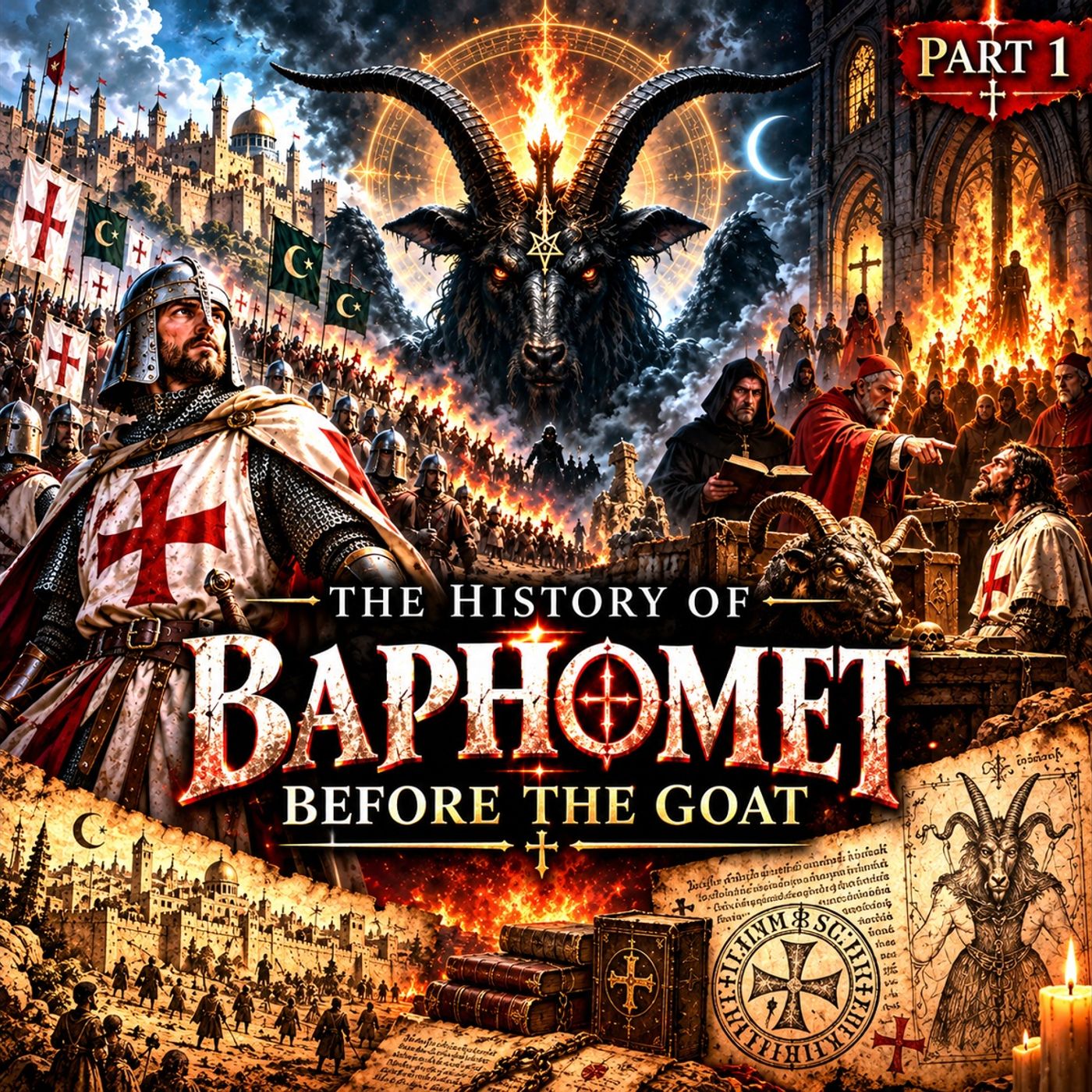
The History of Baphomet Part 1: Before The Goat
Links For The Occult Rejects
https://linktr.ee/theoccultrejects
Occult Research Institute
https://www.occultresearchinstitute.org/
Substack
https://substack.com/@theoccultrejects?r=7auau0&utm_campaign=profile&utm_medium=profile-page
Cash App
https://cash.app/$theoccultrejects
Venmo
@TheOccultRejects
Patreon
https://www.patreon.com/TheOccultRejects
PRIMARY AND MEDIEVAL SOURCES
Anselm of Ribemont. Letter concerning the First Crusade and Antioch, 1098. Important for the early form Baphometh and the Crusading context in which the word first appears.
Gavaudan. Senhors, per los nostres peccatz. Late twelfth-century Occitan crusading poem. Consult the critical text and commentary available through RIALTO, especially the occurrences of Bafometz in an explicitly Christian-Muslim polemical context.
Austorc d’Aorlhac. Ai Dieus, per qu’as facha tan gran maleza. Mid-thirteenth-century Occitan lament. RIALTO’s commentary identifies Bafomet as probably referring to Muhammad and discusses the deformation of Muhammad’s name.
Ramon Llull tradition / Occitan Doctrina pueril. Medieval Occitan material containing the heading De Bafomet, useful as part of the broader linguistic history of forms associated with Muhammad and Islam.
Michelet, Jules, ed. Le Procès des Templiers. Paris: Imprimerie Royale, 1841–1851. Major published collection of the French Templar proceedings and an important source for testimony involving heads, idols, Baffometi, Baphometi, and related accusations.
Clement V. Vox in excelso, 22 March 1312. Papal decree suppressing the Order of the Temple.
The Chinon Parchment, August 1308. Papal record concerning the interrogation, penitence, absolution, and reconciliation of senior Templar leaders.
MODERN SCHOLARSHIP ON THE TEMPLARS
Barber, Malcolm. The Trial of the Templars. 2nd ed. Cambridge: Cambridge University Press, 2006.
Barber, Malcolm. The New Knighthood: A History of the Order of the Temple. Cambridge: Cambridge University Press, 1994.
Demurger, Alain. The Last Templar: The Tragedy of Jacques de Molay, Last Grand Master of the Temple. London: Profile Books, 2009.
Demurger, Alain. The Knights Templar: A New History. Translated by Teresa Lavender Fagan. London: Profile Books, 2007.
Nicholson, Helen J. The Knights Templar: A New History. Stroud: Sutton Publishing, 2001.
Partner, Peter. The Knights Templar and Their Myth. Rochester, VT: Destiny Books, 1990.
Frale, Barbara. “The Chinon Chart: Papal Absolution to the Last Templar, Master Jacques de Molay.” Journal of Medieval History 30, no. 2 (2004).
Wright, Thomas. Narratives of Sorcery and Magic. London, 1851. A nineteenth-century secondary compilation preserving discussion of the Templar testimony involving “Baffomet,” “Baphomet,” “Yalla,” and “Mahomet”; useful as a reception source and pointer back toward the trial editions rather than as a substitute for the medieval records.
RENAISSANCE ALCHEMY AND THE PRE-LÉVI VISUAL LANGUAGE
Rosarium Philosophorum. Frankfurt, 1550. Important for the illustrated alchemical conjunction of solar and lunar, masculine and feminine principles and for the hermaphroditic imagery that predates Lévi by three centuries.
Khunrath, Heinrich. Amphitheatrum Sapientiae Aeternae. First edition, 1595; expanded later edition, 1609. Essential for the Adam Androgyne and the Alchemical Hermaphrodite or Rebis, including the paired Solve / Coagula language later recalled by Lévi.
Forshaw, Peter J. The Mage’s Images: Heinrich Khunrath in His Oratory and Laboratory. Leiden: Brill, 2025. Major modern study of Khunrath’s engravings; especially useful for the sequence of the 1595 circular images, the Rebis, and the detail explicitly catalogued as “Solve [et] Coagula.”
Hesteau de Nuysement, Clovis. Traittez de l’harmonie et constitution généralle du vray sel, secret des philosophes, et de...
You May Also Like

Let the Bible Speak Radio
Dr. Alan Cairns

Next Level Soul Podcast with Alex Ferrari
Alex Ferrari

Shine FM
Touch Canada

Quazi Johir
Quazi Johir

Brant & Sherri Oddcast
Brant Hansen

Manna: Daily Scripture Meditations
Reformed Perspective

The Bible For Busy People
Purposely

Dan Seaborn
Dan Seaborn

Light + Truth
Desiring God

LifeBridge Church Podcast
LifeBridge Church Podcast
Let the Bible Speak Radio
Dr. Alan Cairns
Next Level Soul Podcast with Alex Ferrari
Alex Ferrari
Shine FM
Touch Canada
Quazi Johir
Quazi Johir
Brant & Sherri Oddcast
Brant Hansen
Manna: Daily Scripture Meditations
Reformed Perspective
The Bible For Busy People
Purposely
Dan Seaborn
Dan Seaborn
Light + Truth
Desiring God
LifeBridge Church Podcast
LifeBridge Church Podcast
Community discussion