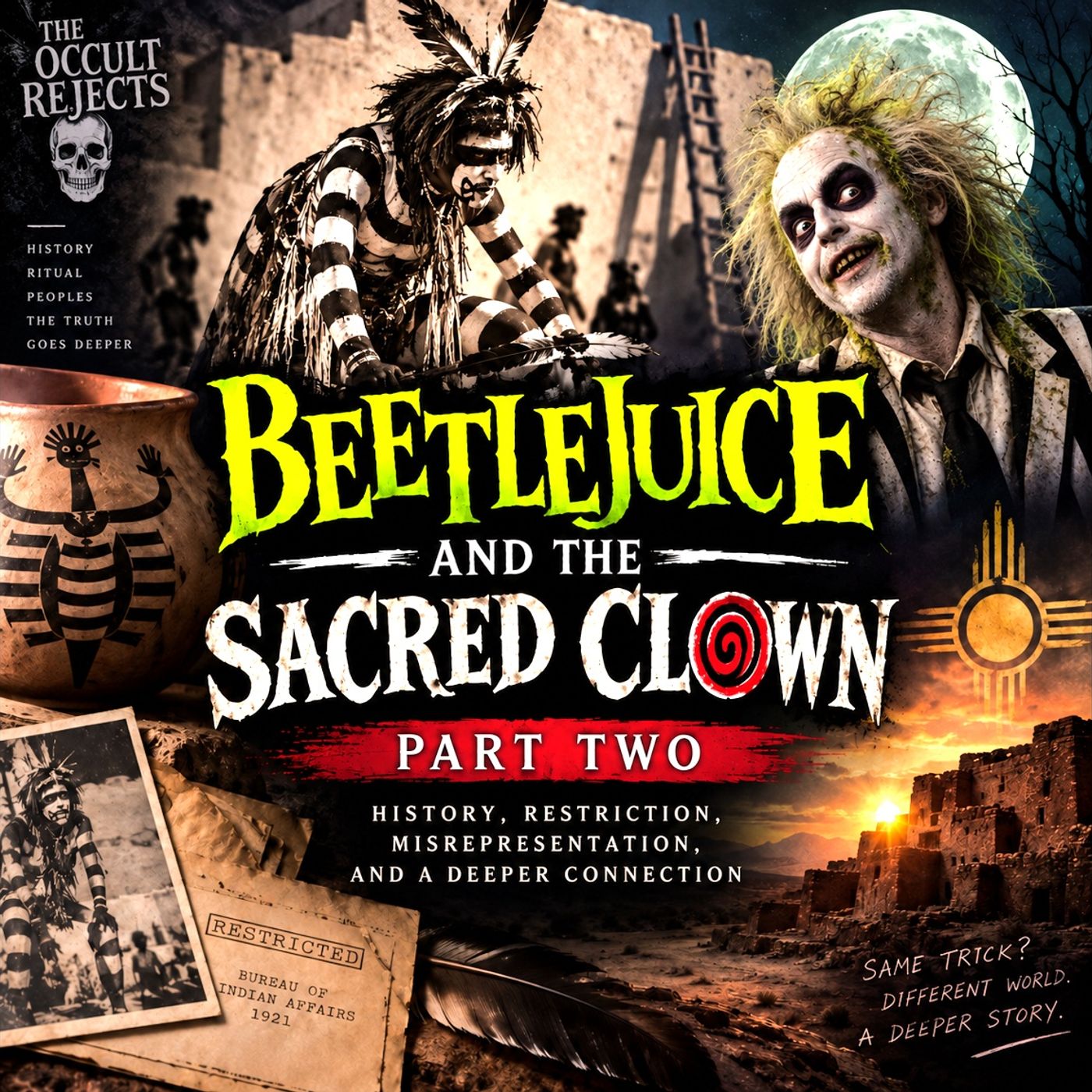
Beetlejuice and The Sacred Clown Part 2: History, Restriction, Misinterpretation, and a Deeper Connection
Links For The Occult Rejects
https://linktr.ee/theoccultrejects
Occult Research Institute
https://www.occultresearchinstitute.org/
Substack
https://substack.com/@theoccultrejects?r=7auau0&utm_campaign=profile&utm_medium=profile-page
Cash App
https://cash.app/$theoccultrejects
Venmo
@TheOccultRejects
Patreon
https://www.patreon.com/TheOccultRejects
BIBLIOGRAPHY
Babcock, Barbara A., ed. The Reversible World: Symbolic Inversion in Art and Society. Ithaca, NY: Cornell University Press, 1978. This is one of the major theoretical works behind our discussion of symbolic inversion, reversal, reflexivity, and why societies sometimes institutionalize behavior that deliberately contradicts ordinary norms.
Black Elk [Nicholas Black Elk], as told through John G. Neihardt. Black Elk Speaks. Originally published 1932; complete annotated edition, Lincoln: University of Nebraska Press. Chapter 16, “Heyoka Ceremony,” is the important material for our comparison, particularly Black Elk’s explanation that Heyoka authority is connected with visions of the Thunder Beings and that sacred power is expressed through apparently foolish or reversed behavior. The modern Nebraska edition includes annotations by Lakota scholar Raymond J. DeMallie and additional contextual material.
Burke, Charles H. “Circular 1665: Indian Dancing.” Office of Indian Affairs, April 26, 1921; “Supplement to Circular No. 1665: Indian Dancing,” February 14, 1923; and “To All Indians,” February 24, 1923. Copies are preserved in the Indian Rights Association Papers, reel 40, D’Arcy McNickle Center for American Indian and Indigenous Studies, Newberry Library. These are the crucial primary federal documents behind our discussion of attempts to discourage, regulate, and suppress Native dances. Contemporary archival citations confirm the dates and repository.
Mathiowetz, Michael D. “The Keepers of Tradition: Clown Societies in the Casas Grandes and Puebloan Worlds.” KIVA: Journal of Southwestern Anthropology and History 91, no. 2 (2025). https://doi.org/10.1080/00231940.2025.2461803. This is the major new archaeological source in Part Two. Mathiowetz argues that clown societies existed within the Casas Grandes cultural world during the Medio Period, approximately AD 1200–1450, and may have influenced later Pueblo clown institutions; he also explores relationships with governance, Sun Youth, katsina ritualism, medicine societies, and agriculture.
Mathiowetz, Michael D. “The Sun Youth of the Casas Grandes Culture, Chihuahua, Mexico (AD 1200–1450).” KIVA 84, no. 3 (2018): 367–390. https://doi.org/10.1080/00231940.2018.1463685. This earlier article supplies much of the archaeological and iconographic background underlying Mathiowetz’s later clown-society argument, particularly his reconstruction of Sun Youth and the political-religious complexity of Paquimé.
National Gallery of Art. “Awa Tsireh: Two Kossa,” ca. 1925. Corcoran Collection, accession 2015.19.381. This is the primary museum record for the artwork we discuss throughout Part Two: two Kossa figures painted by San Ildefonso Pueblo artist Awa Tsireh during the period of the Pueblo dance controversy.
National Gallery of Art. “Expressing the Individual” and “Artists Who Expand Views of the Southwest.” These NGA interpretive resources are particularly valuable because they discuss Awa Tsireh’s repeated representation of Kossa, the possibility that his clown imagery responded to federal attempts to suppress Pueblo ceremonial life, and his practice of omitting or altering details to protect sacred Pueblo knowledge from non-Pueblo viewers.
National Museum of the American Indian, Smithsonian Institution. “Statement on Online Collections and Culturally Sensitive Collections.” This is the major contemporary museum source behind our section on restricted knowledge. NMAI explicitly states that...
You May Also Like

Let the Bible Speak Radio
Dr. Alan Cairns

Satsang - Sant Shri Asharamji Bapu Satsang
Sant Shri Asharamji Bapu Ashram

Quazi Johir
Quazi Johir

TRUNEWS with Rick Wiles
Morning Manna with Rick Wiles
Next Level Soul Podcast with Alex Ferrari
Alex Ferrari

The Light
Touch Canada

Shine FM
Touch Canada

Brant & Sherri Oddcast
Brant Hansen

Manna: Daily Scripture Meditations
Reformed Perspective

The Bible For Busy People
Purposely
Let the Bible Speak Radio
Dr. Alan Cairns
Satsang - Sant Shri Asharamji Bapu Satsang
Sant Shri Asharamji Bapu Ashram
Quazi Johir
Quazi Johir
TRUNEWS with Rick Wiles
Morning Manna with Rick Wiles
Next Level Soul Podcast with Alex Ferrari
Alex Ferrari
The Light
Touch Canada
Shine FM
Touch Canada
Brant & Sherri Oddcast
Brant Hansen
Manna: Daily Scripture Meditations
Reformed Perspective
The Bible For Busy People
Purposely
Community discussion