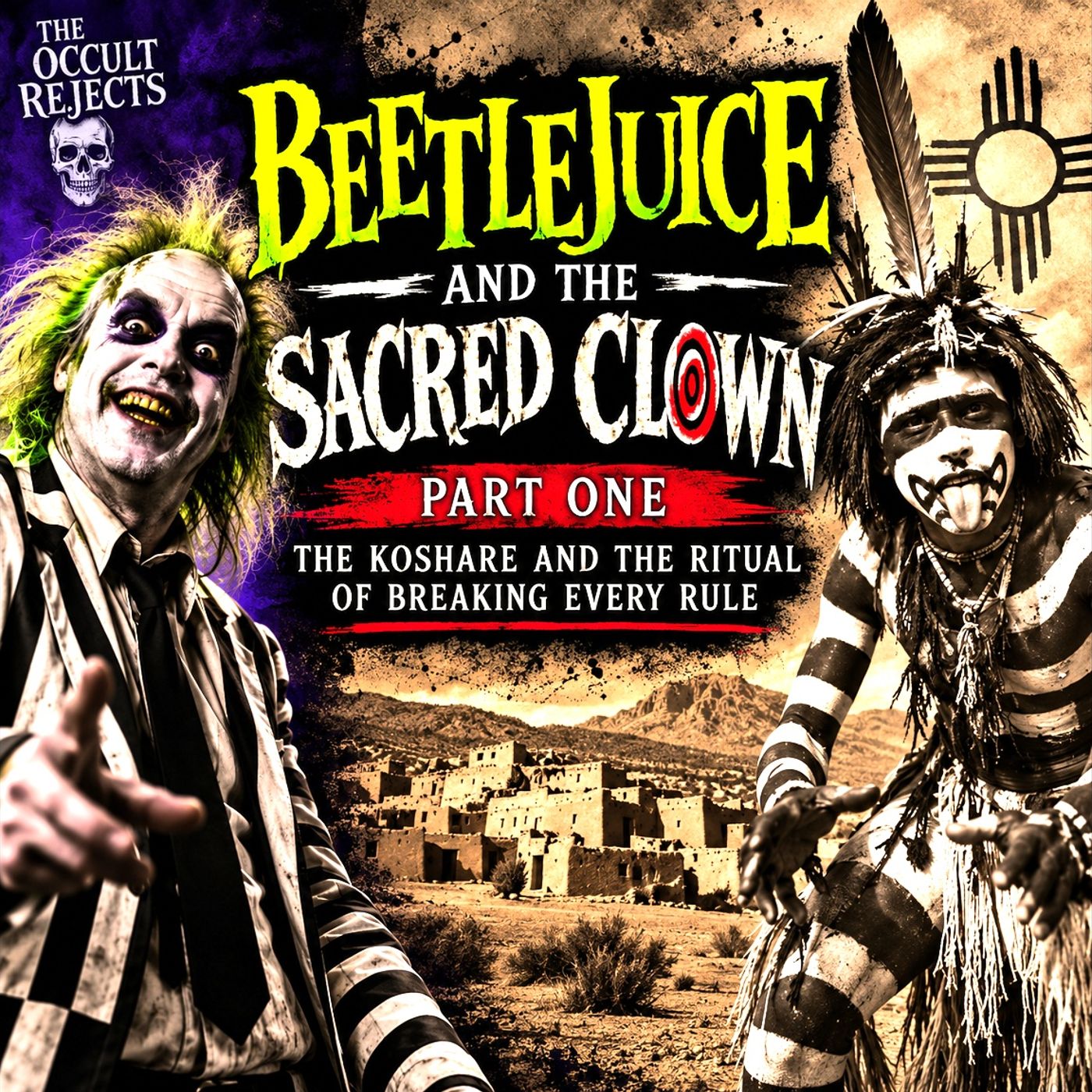
Beetlejuice and The Sacred Clown Part 1: The Koshare and The Ritual of Breaking Every Rule
Links For The Occult Rejects
https://linktr.ee/theoccultrejects
Occult Research Institute
https://www.occultresearchinstitute.org/
Substack
https://substack.com/@theoccultrejects?r=7auau0&utm_campaign=profile&utm_medium=profile-page
Cash App
https://cash.app/$theoccultrejects
Venmo
@TheOccultRejects
Patreon
https://www.patreon.com/TheOccultRejects
BIBLIOGRAPHY
Beals, Ralph L. Preliminary Report on the Ethnography of the Southwest. Berkeley, CA: U.S. Department of the Interior, National Park Service, Field Division of Education, 1935. This is one of the major historical comparative sources behind the sections on Pueblo ceremonial organization, clown societies, katsina dances, agriculture, rain ceremonialism, medicine societies, and policing functions.
Benedict, Ruth. Tales of the Cochiti Indians. Bureau of American Ethnology Bulletin 98. Washington, DC: U.S. Government Printing Office, 1931. This is the primary historical source for the Cochiti narratives we used, particularly “The Recovery of the Koshare” and the material concerning the recovery of the katsinas.
Howard, Courtney. “[Interview] Costume Designer Colleen Atwood Fashions Character Into Clothing in Beetlejuice Beetlejuice.” Fresh Fiction, September 19, 2024. Interview with Colleen Atwood discussing Aggie Guerard Rodgers’ work on the original film and Atwood’s statement that the original Beetlejuice appearance derived from a Tim Burton sketch centered on the striped suit.
Mathiowetz, Michael D. “The Keepers of Tradition: Clown Societies in the Casas Grandes and Puebloan Worlds.” KIVA: Journal of Southwestern Anthropology and History 91, no. 2 (2025): 147–179. https://doi.org/10.1080/00231940.2025.2461803. Particularly important for understanding Pueblo clown societies as institutions associated with governance, katsina ceremonialism, medicine societies, and the agricultural cycle, rather than merely as comic performers.
Parsons, Elsie Clews. Taos Pueblo. General Series in Anthropology 2. Menasha, WI: George Banta Publishing Company, 1936. Used as part of the historical ethnographic background concerning community sanctions, ridicule, Pueblo social organization, and ceremonial clowning.
Parsons, Elsie Clews, and Ralph L. Beals. “The Sacred Clowns of the Pueblo and Mayo-Yaqui Indians.” American Anthropologist 36, no. 4 (1934): 491–514. https://doi.org/10.1525/aa.1934.36.4.02a00020. One of the foundational comparative studies of Pueblo ceremonial clown traditions and particularly useful for demonstrating that the various clown societies should not be collapsed into one supposedly universal Native American figure.
Roediger, Virginia More. Ceremonial Costumes of the Pueblo Indians: Their Evolution, Fabrication, and Significance in the Prayer Drama. Berkeley: University of California Press, 1941; reprinted 1991. The principal historical source used for the detailed descriptions of black-and-white body striping, hair arrangements, cornhusk elements, clown behavior, mimicry, village gossip, and ceremonial appearance.
White, Leslie A. The Pueblo of Sia, New Mexico. Bureau of American Ethnology Bulletin 184. Washington, DC: U.S. Government Printing Office, 1962. Particularly important for the Sia/Zia material concerning Koshairi and Kwairina, ceremonial societies, katsina dances, corn-dance responsibilities, contrary behavior, doorkeepers, clowning, and disciplinary authority.
Wenger, Tisa. We Have a Religion: The 1920s Pueblo Indian Dance Controversy and American Religious Freedom. Chapel Hill: University of North Carolina Press, 2009. This is the major modern scholarly source behind our discussion of missionary accusations, alleged obscenity, Charles Burke, federal regulation of Pueblo dances, religious suppression, and the political struggle over whether Pueblo ceremonies would be recognized as “religion” under American...
You May Also Like

Let the Bible Speak Radio
Dr. Alan Cairns

Shine FM
Touch Canada

Quazi Johir
Quazi Johir

Brant & Sherri Oddcast
Brant Hansen

The Bible For Busy People
Purposely

LifeBridge Church Podcast
LifeBridge Church Podcast

Politics By Faith w/Mike Slater
The First Digital Inc.

הרב אלון עטיה - הערוץ הרשמי
הרב אלון עטיה

Neville Goddard Explored
Neville Goddard

Daybreak Devotions and Nighttime Prayers
Crossmap
Let the Bible Speak Radio
Dr. Alan Cairns
Shine FM
Touch Canada
Quazi Johir
Quazi Johir
Brant & Sherri Oddcast
Brant Hansen
The Bible For Busy People
Purposely
LifeBridge Church Podcast
LifeBridge Church Podcast
Politics By Faith w/Mike Slater
The First Digital Inc.
הרב אלון עטיה - הערוץ הרשמי
הרב אלון עטיה
Neville Goddard Explored
Neville Goddard
Daybreak Devotions and Nighttime Prayers
Crossmap
Community discussion