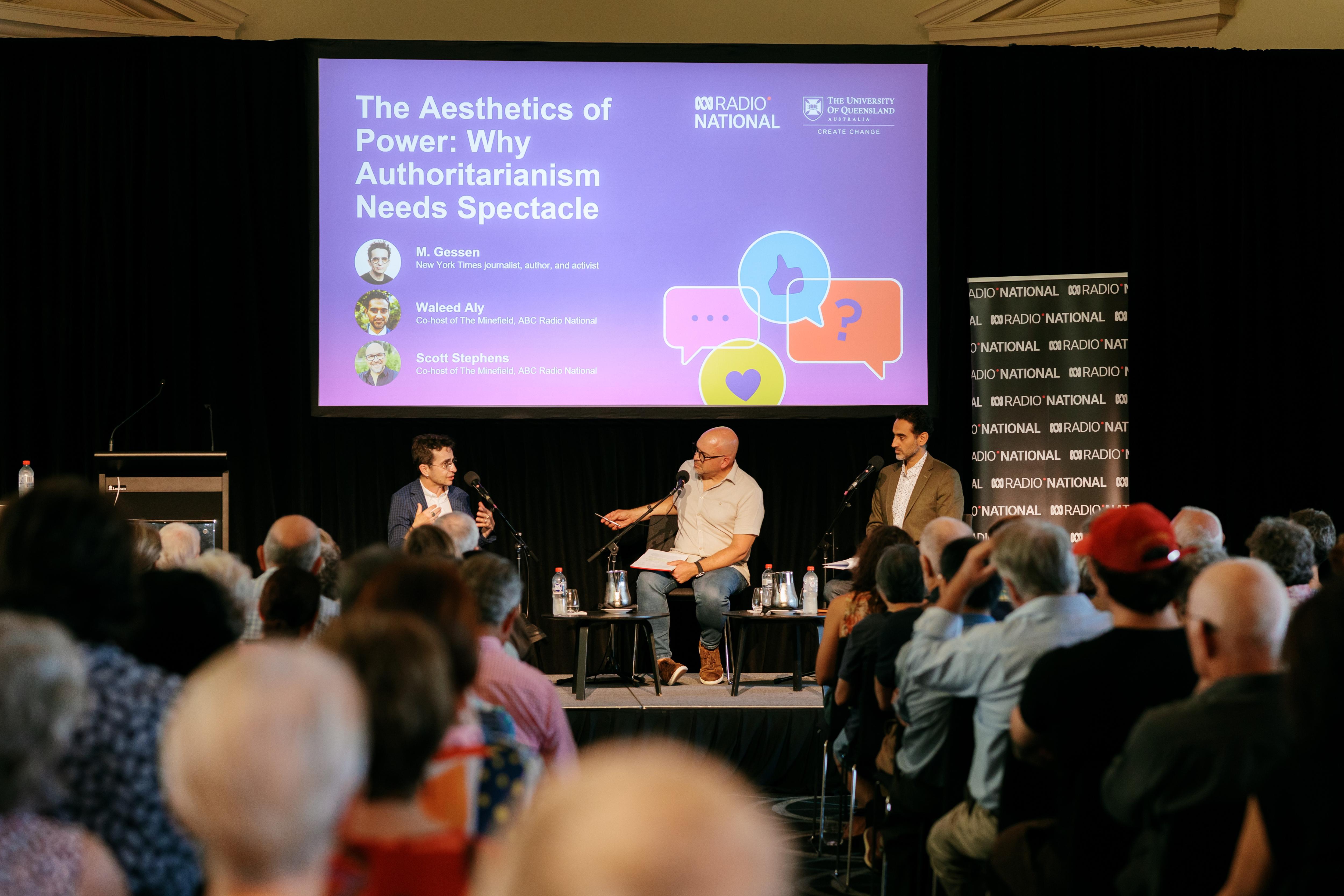
Why Autocracy Needs Spectacle — with M Gessen
One of the words we use to describe political authority gone wrong is “autocracy”: which is to say, the concentration of power in a unitary figure who then exercises that power without countervailing constraints and for its own the sake. To borrow an expression of St Augustine, autocracy is a form of political authority that curves in on itself.
Because most citizens have a clear sense that governance ought to be for something beyond political self-interest or naked self-enrichment, we rightly take a dim view of politicians who are unmoved by the interests and opinions of their constituents. But, of course, only tyrants are prepared to present themselves as wholly disinterested in the lives of those over whom they rule.
Autocrats don’t claim to be in it for themselves; they typically insist that they represent, serve and fight for “the people” — but “the people” politically defined as those who truly belong to the nation, those who build and contribute, those who are loyal and patriotic. In short, those who can be encompassed by the political pronouns “us”/“we”. Accordingly, autocrats also claim to be defending the nation and its interests against “they”/“them”, who have no part or place in the nation’s life and are therefore no voice in the conversation of politics.
What is corrupting about autocratic rule, then, is not simply that it is “corrupt” in the conventional sense of using the affordances of political office for private gain. Rather, it is the way autocracy throws off the basic constraints that define political authority in a representative democracy, and thereby betrays its character.
In democratic life, we are constantly being reminded of the contingency of political authority and its fundamental accountability. When autocratic power lays claim to the necessity of an unconstrainted mode of executive decision-making — most often in the face of some “emergency” which suspends the normal functioning of democratic scrutiny — it corrodes the conditions of democratic life, precisely because representative democracy reveals what political authority really is: contingent, correctable and inherently contestable.
As George Kateb writes in “The Moral Distinctiveness of Representative Democracy”: “political authority is suspect when undivided and thus untroubled by antithetical voices … when it moves too easily or takes shortcuts to accomplish its ends, or when it prevents appeals and second thoughts, or when it closes itself off in secrecy or unapproachability.”
It is no stretch, then, to say that autocracy is a politics of contempt. It is contemptuous of deliberation and mutual accountability; it is contemptuous of expertise and the constraints of precedent; it is contemptuous of any notion that the source of one’s legitimacy could be extrinsic to one’s own self. Which is why, ultimately, autocracy is a form of contempt f
You May Also Like

Worship & Wonder Daily Devotional
Westminster Presbyterian Church

Scrolls & Secrets
Scrolls & Secrets

Renascença - Pergunte ao Pe. Paulo Franco
Renascença

Darrers podcast - Ràdio Cubelles
Ràdio Cubelles

Darrers podcast - Ràdio Ciutat de Badalona
Ràdio Ciutat de Badalona

CHURCH on SermonAudio
Various Speakers

Church Unity: The Forgotten Treasure
Paul J. Bucknell
Unter Büchern mit Katrin Schumacher
Mitteldeutscher Rundfunk

Podcast Paris United
Paris United
Baptists on SermonAudio
Various Speakers
Worship & Wonder Daily Devotional
Westminster Presbyterian Church
Scrolls & Secrets
Scrolls & Secrets
Renascença - Pergunte ao Pe. Paulo Franco
Renascença
Darrers podcast - Ràdio Cubelles
Ràdio Cubelles
Darrers podcast - Ràdio Ciutat de Badalona
Ràdio Ciutat de Badalona
CHURCH on SermonAudio
Various Speakers
Church Unity: The Forgotten Treasure
Paul J. Bucknell
Unter Büchern mit Katrin Schumacher
Mitteldeutscher Rundfunk
Podcast Paris United
Paris United
Baptists on SermonAudio
Various Speakers
Community discussion