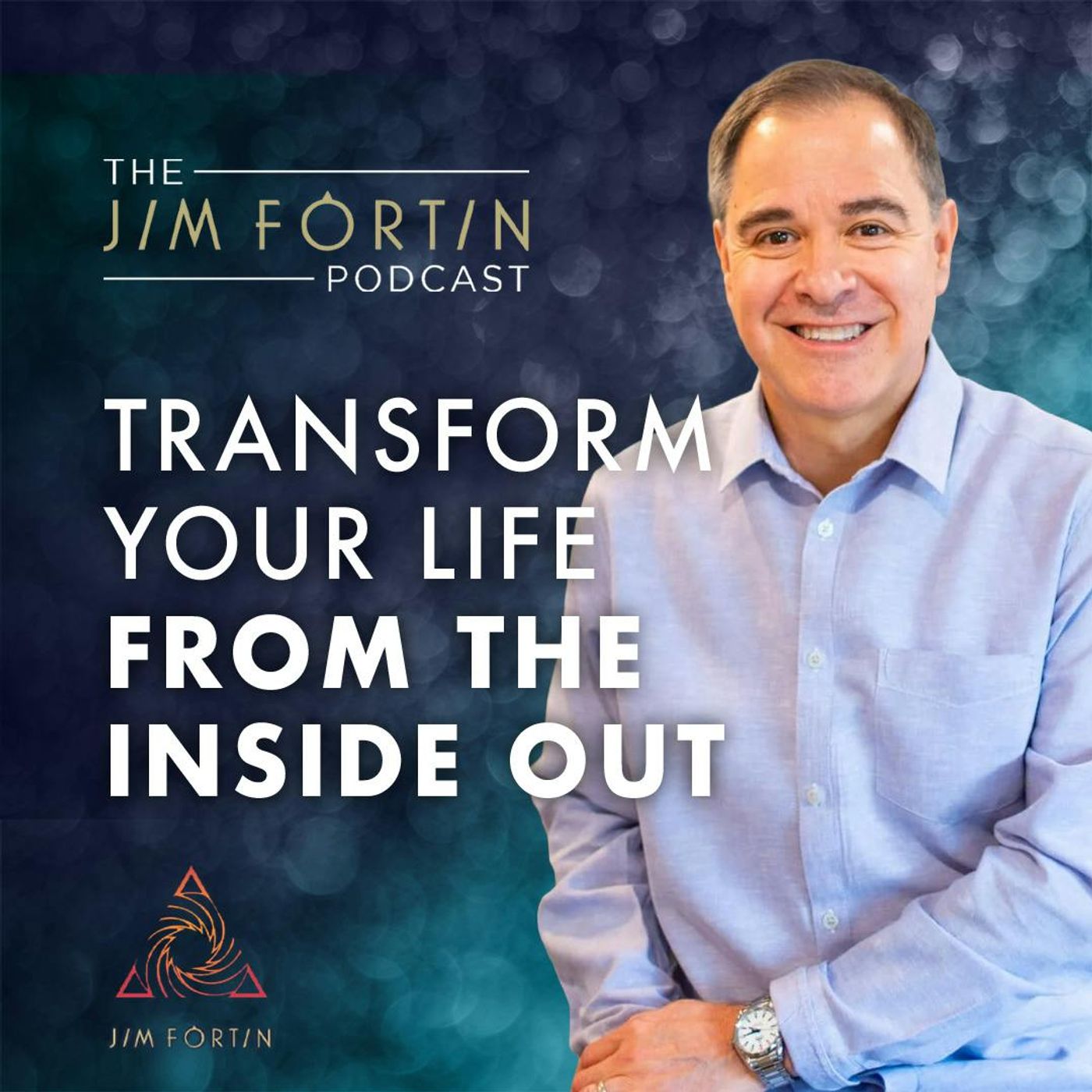
Ep 542: You Have Never Met Yourself: Exit The Lie
Your personality is unique, but what if I told you it wasn’t unintentional? The third installment of Jim Fortin’s series on exiting the human lie answers that exact question. In this episode, Jim takes on one of the most widely accepted beliefs about personality to prove that much of who we become isn’t up to us. He explains that everything around us, including family, culture, and society, molds and shapes our personalities. As Jim puts it, the person you call “me” was built by strangers. Even more compelling, he argues that a great deal of who you are today is simply what you have learned to be. He uses regional accents as an example, explaining that how we speak is directly linked to where we are in the world, just like the way we behave. There’s also the idea of the "old recording,” which Jim says comes from decades of inner training and how it comes into play when we judge ourselves. He shares the first-grade moment a teacher told him he was “just not good at math,” a label he carried until a sophomore geometry class proved otherwise. In this example, he shows why the inner critic is usually someone else’s voice and why decades of conditioning can’t fix present-day problems. Jim invites listeners to question their identity on a deeper level. He leaves them with a simple prompt asking them to get curious about who they are beneath the surface, beyond the conditioning, and under the layers of brainwashing, to meet who they really are. What You’ll Discover in This Episode: (02:49) Jim explains how the personality people call “me” was put together by others, many of whom are no longer alive. (09:10) The generational chain: Jim shows how beliefs about money, guilt, and scarcity get passed from great-grandmother to child, long after the original circumstances are gone. (15:30) Jim recalls the first-grade comment that shaped his identity for a decade, and what finally broke it. (23:13) Jim explains why people have only ever met their programming, and how mystics, shamans, and the Toltecs each named this false self. (27:12) Why the conditioning that created a problem can’t be used to escape it, and why the instructions are always on the outside of the box. (31:18) This week’s homework: Jim offers a simple practice. Every time the thought “I’m the kind of person who…” shows up, stop and ask, “Who taught me this?” Listen, apply, and enjoy! Transformational Takeaway Every “that’s just how I am” was handed over by someone else. The anxiety about money, the voice that says you’re not enough, the belief that life is hard: none of it started with you. You picked it up as a child the same way you picked up your accent, without knowing it was happening. That means it can be put down. The next time a limitation sounds like a fact about you, pause and ask who taught it to you. The one asking that question, the one who can see the programming, is the self you have never met. Let’s Connect: Instagram | Facebook | YouTube | LinkedIn LIKED THE EPISODE? If you’re the kind of person who likes to help others, then share this with your friends and family. If you have found value, they will too. Please leave a review on Apple Podcasts so we can reach more people. Listening on Spotify? Please leave a comment below. We would love to hear from you! With gratitude, Jim
You May Also Like

Motivational Speeches
Motivationly

Ethan Brings You the World
Ethan Boronski

Thrasherway Podcast
HLT

Bishop TD Jakes Sermons
Word Life

Shimon Davis
Shimon Davis

Healing TRAUMA
Kimberly's Hope LLC

Mejor Con Gaby Vargas
MVS Radio
Kabbalah Media | mp3 #kab_ita
Bnei Baruch Kabbalah Education and Research Institute, Бней Барух – Ассоциация "Каббала Ла-Ам"

Manifestation: Law of Attraction, LOA, Vibration, Affirmations, Meditation, Mindset
Manifestation: Law of Attraction, LOA, Vibration, Affirmations, Meditation, Mindset
Kabbalah Media | mp3 #kab_fre
Bnei Baruch Kabbalah Education and Research Institute, Бней Барух – Ассоциация "Каббала Ла-Ам"
Motivational Speeches
Motivationly
Ethan Brings You the World
Ethan Boronski
Thrasherway Podcast
HLT
Bishop TD Jakes Sermons
Word Life
Shimon Davis
Shimon Davis
Healing TRAUMA
Kimberly's Hope LLC
Mejor Con Gaby Vargas
MVS Radio
Kabbalah Media | mp3 #kab_ita
Bnei Baruch Kabbalah Education and Research Institute, Бней Барух – Ассоциация "Каббала Ла-Ам"
Manifestation: Law of Attraction, LOA, Vibration, Affirmations, Meditation, Mindset
Manifestation: Law of Attraction, LOA, Vibration, Affirmations, Meditation, Mindset
Kabbalah Media | mp3 #kab_fre
Bnei Baruch Kabbalah Education and Research Institute, Бней Барух – Ассоциация "Каббала Ла-Ам"
Community discussion