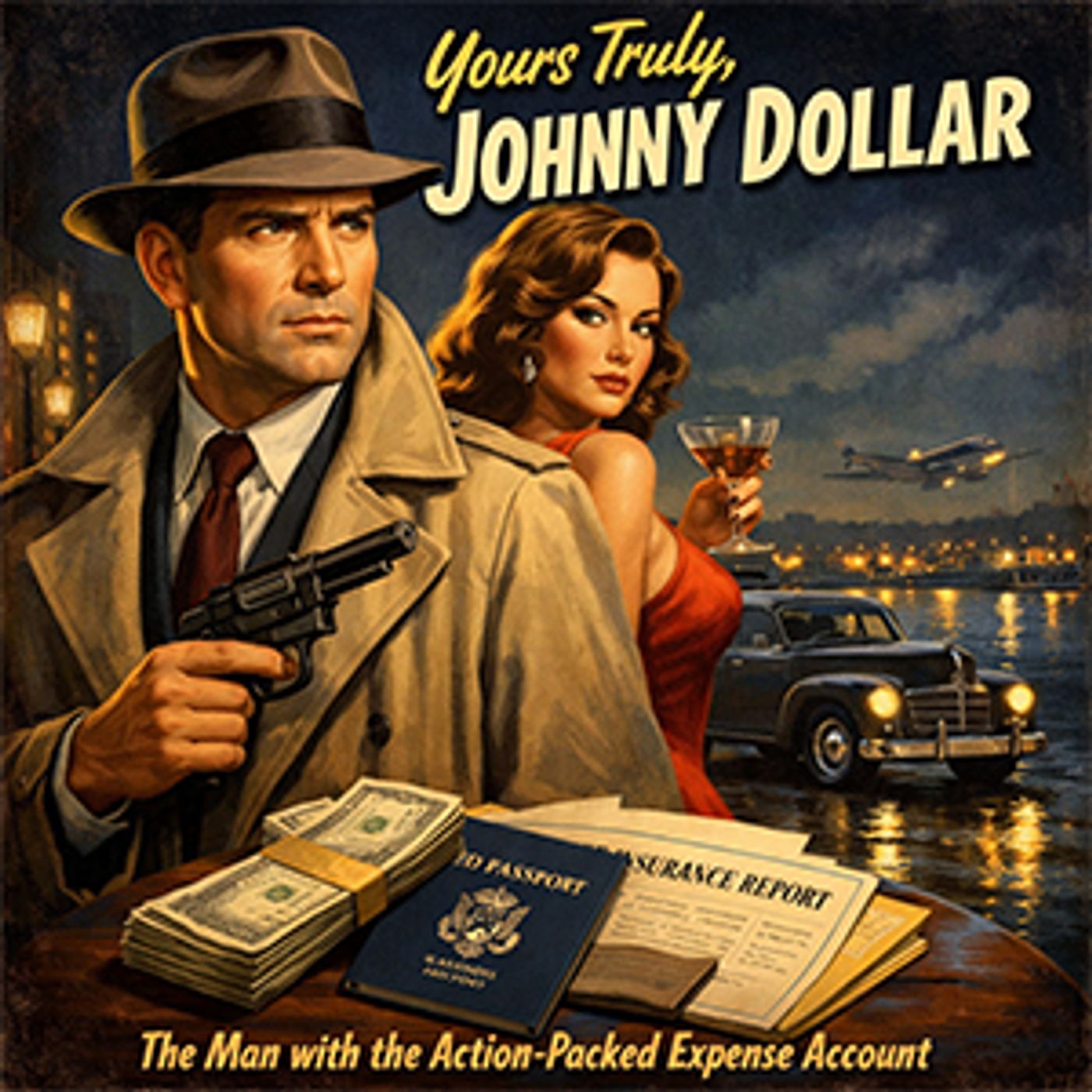
0:02 The End. 0:28 Welcome to the Great Detectives of Old Time Radio. From Boise, Idaho, this is your host, Adam Graham. In a moment, we're going to bring you this week's episode of Yours Truly, Johnny Dollar. But first, I want to encourage you, if 0:45 you're enjoying the podcast, please follow us using your favorite podcast software. And as you're making your travel plans, remember JohnnyDollarAir.com. JohnnyDollarAir.com is a Priceline affiliate link, so part of the purchase 0:59 price goes to support the great detectives of old-time radio at no additional cost to you. Remember, when making your travel plans, check JohnnyDollarAir.com first. Now, from October 18th, 1959, here is The Double Identity Matter. 1:20 Johnny Dollar. 1:21 Well, here I am. 1:22 I'm home. Huh? 1:24 Who, uh. 1:25 I said I'm home from my vacation. 1:27 Wow, great. Good for you. 1:29 So, when are you going to come over and ask me to marry you? 1:33 Oh, it's you. 1:34 Well. 1:35 I don't know. How about if I pop the question right now? 1:38 Well. 1:40 Will you, uh, will you marry me, uh, Paula? 1:44 You bet your life I. 1:46 Paula! 1:47 Who else? 1:48 Why, you two-timing... This is Betty, Betty Lewis. 1:51 Yeah, yeah, I know. 1:52 Come clean with me, Johnny. 1:53 Who's Paula? 1:54 Oh, now, does it make any difference? 1:55 Paula who, Johnny? Johnny? 1:58 Oh, Smith, Jones, Brown, you pick one. 2:00 You rascal, I could... You were kidding. 2:03 Me, weren't you? 2:04 Weren't you kidding me? 2:08 Oh, sure. 2:08 Honey, with this crazy business of mine getting slugged and shot at all the time, well, you know, as well as I do, it wouldn't be conducive to a happy married life. Not for either of us. 2:17 Yes, I know. But someday. 2:20 Yeah, someday. 2:21 Anyhow, I'm home again for my extended vacation, so. 2:24 So, how about dinner and a show and a big night all around? 2:26 I'd love it. 2:27 Say 7 o'clock? 2:28 Make it 6.30 and I'll have cocktails ready and waiting. 2:31 Right here at 11.30. 2:32 Ready, my love? It's a deal. 2:34 Good. 2:34 I'll see you in exactly, uh... Seven hours and 31 minutes. 2:39 On the nose. 2:39 Bye, honey. 2:41 Yeah. 2:43 Well, let's see now. Yeah, honey. 2:49 Huh? 2:49 Don't give me that honey stuff. This is Randy Singer. 2:52 Randy. How's the old New York Police Department these days? 2:55 Johnny, I gotta see you. 2:56 Okay, I'll run on down there first thing in the morning. 2:58 No. 3:00 Oh, well, now, look, Randy, I got a date tonight, an important one. 3:02 And I got to go out of town with the chief on a murder case. Leave me in a couple of hours. Maybe gone a week, maybe longer. So grab a train, will you? 3:10 Well, if I can be sure of getting back here by early this evening. 3:13 Back there in Hartford is where you should be, as quickly as possible. 3:15 Huh? 3:16 After I've talked to you. So if this. 3:18 Timetable I have means anything, you can grab a train. 3:21 In about 20 minutes. 3:22 Well, now, listen, Randy, I don't... I'll have the boys. 3:23 In the prowl car pick you up at Grand Central Station. 3:25 Listen, will you? 3:26 Now grab your hat and come on. 3:27 See you, Johnny. 3:28 Randy! 3:37 And now, act one of yours truly, Johnny Dollar. 3:54 Expense account submitted by Special Investigator Johnny Dollar. To the Universal Adjustment Bureau, Hartford, Connecticut. Attention, Mr. Pat McCracken. Following is an account of expenses incurred during my investigation of 4:04 the double identity matter. Pat, you have an assignment to this case, but it does concern some of the insurance companies that Universal Adjustment Bureau services. And if there's any question about reimbursing me for whatever charges I may run up, 4:19 I'll read on. Expense account item 1, 495. Taxi to the station and a train down to New York. As promised, Lieutenant Randy Singer had a prowl car waiting for me at Grand Central, and a few minutes later, I barged into his office in the Homicide Division of the 18th Precinct. 4:33 Okay, Conroy, okay. Just go tell the chief I'll be ready to leave by the time he is. Now, go ahead. 4:38 Yes, sir, Lieutenant. 4:40 Sit down, Johnny. Glad you could make it. 4:42 All right. 4:42 Tell me one thing, Randy. Is this an insurance matter? 4:45 It sure is, or rather, they are. They? Maybe you weren't called in on them, but, brother, you should have been. Here, look here. Fall 1956. John R.V. Brownfield. Lived in a small apartment over on the east side, but the old boy had a lot of money. 5:00 So what happened? Somebody knock him off? 5:02 His death was pronounced a suicide, overdose of sleeping pills. 5:05 Happens all the time. 5:06 Does it? An insurance company that paid off was Eastern Casualty and Trust. 5:10 Oh? 5:11 How much? 5:12 41,000. 5:13 Beneficiary? 5:13 His wife. 5:14 They'd only been married to her a couple of months. 5:17 And after she collected, well, she just sort of dropped out of sight. Ask me, a lot of those companies of yours pay off too fast. 5:24 Now, what do you mean by that? 5:25 Listen, September 1957. Franklin P. Ogborn died the same way. 5:30 Insurance paid to his widow was $ 30, 000. Tri-mutual insurance company. 5:34 Well, now, Randy, the mere fact that he also died from an overdose... Listen, will you? 5:38 August 1958. Peter William Gerhardt. Same thing. His widow collected $ 50, 000. 5:45 Are you trying to say you don't think they were suicides, Randy? 5:49 I'd bet my bottom dollar... Why? Now, here's the last one, middle of last month. William Earl Chadwick. $ 25, 000 for the widow. 5:57 I said, why? 5:59 Johnny, in every case, the marriage was only a few weeks old. 6:02 A good-looking young girl and a wealthy old man. Also, circumstances of death were exactly the same. 6:08 Exactly. 6:09 You investigate them all yourself? 6:11 No, they all occurred in different precincts. 6:13 So until I started digging through these files, until I realized that all these men had been married, and for only a short time, mind you, had all been married to the same girl. 6:22 What? 6:23 Yes, sir. 6:23 You're sure of that? 6:25 She used a different name every time, and we have no pictures of her, but, Johnny, according to the description by all the people who'd seen her, well, Johnny, it's one and the same gal. 6:34 Okay, Randy, as long as there was insurance paid by some of the companies I work for. 6:38 Right. 6:39 Now, so far, I've been running this down alone on my own hook until I could really spot her. So what happens when I finally do locate this dame? 6:46 All right, what happens? 6:47 She turns up outside my bailiwick. Also, I suddenly got to go out of town for a week, maybe longer. 6:53 But you, being right there. 6:55 Yeah, right where? 6:56 Hartford. That's where I've traced her to. 6:58 Oh, you know her name? 6:59 Sure do. So I'm handing it over to you, Johnny. 7:02 You've done me a lot of favors over the years, so, well, maybe you can collect yourself a nice commission. 7:06 What is her name, Randy? 7:07 She lives at 11325 East Maple Drive. 7:11 11325. 7:11 That's right, and. 7:12 She goes by the name of Lewis. 7:13 What? 7:13 Yep, Betty Lewis. What's the matter, Johnny? 7:28 Act II of yours truly, Johnny Dollar, in a moment. 7:31 The art of photography dates back more than a century, but for its first few decades, it entailed a cumbersome process in which the photographer was not only an artist, who knew something about lenses and picture composition, but was 7:45 also somewhat of a chemist. Photographs were made on wet glass plates, treated with a chemical surfacing just before the picture was shot, and then developed almost immediately afterwards. During the Civil War, Matthew Brady took his camera and a 8:01 wagon loaded with chemical equipment to the front lines and took thousands of pictures that were shocking in realism, many of which you may have seen in history books. His assistants later used the same method and equipment to take 8:14 pictures of the Union Pacific Railroad being stretched over the plains to the west, the first photos of the Grand Canyon, and other pictures which awakened America to the great possibilities of photography and In the 1870s, a bookkeeper in a 8:31 bank at Rochester, New York, became interested in photography first as a hobby, then as a business opportunity. When he traveled to locations where pictures were taken, he had to take with him, as expressed in his own words, a camera about the size of a soapbox, a tripod strong 8:50 enough to support a bungalow, a big plate holder, a dark tent, and a tub of chemicals, plus a heavy. 8:57 Load of glass plates. 8:59 While in his early 20s, he began experimenting to find a simpler process for taking pictures. The man whose name has become world famous in photography was George Eastman. In 1879, he was issued his first patent on a process for 9:15 making photographs on dry gelatin plates, chemically coated. He sold the invention for $ 2, 500, which gave him the capital to start his factory. Eastman continued his research with chemists whom he hired, and five years later came up with an 9:30 invention that was to revolutionize photography and eventually to make motion pictures possible. His invention was flexible photographic film, which could be rolled on a spool and carried inside a camera. 9:45 He then invented a simple. 9:46 Foolproof camera known as a brownie, which made it possible for anyone to take snapshots. Within a few years, he was a millionaire, but before he died, he gave away $ 100 million. 9:58 Some of it anonymously. 10:01 His name will endure in American history and in the minds of camera enthusiasts all over the world. The story of George Eastman is another illustration of the philosophy of American inventors. 10:14 Somehow there must be a way. Let's find it. 10:18 And now, act two of yours truly, Johnny Dollar and the Double Identity Matter. I went over the files on the so-called suicides word for word. 10:31 I read and re-read the descriptions of the widows. They all were the same. No question about it, the same girl had been married to each of the four victims, had been married to each of them only a very short time. Then after death from an apparent overdose of 10:44 sleeping pills, she had collected the insurance and quietly dropped out of sight. But Lieutenant Randy Singer, NYPD, had tracked her down and traced her to Hartford. And according to him, according to the description, she was Betty Lewis of 11325 10:58 East Maple Drive. Betty Lewis. The girl I knew and palled around with. The girl I had a date with that very night. The one girl in the world I almost took seriously. 11:09 What is it, Johnny? You know her? You know this girl? I, uh. 11:13 Yeah. 11:15 That is, I think I've seen her there in Hartford, right? 11:18 Good, then go back there. Get next to her, Johnny. 11:20 Trip her up. Make her spill the beans about these murders. 11:24 Murders? 11:25 Well, don't you agree she must have fed those old codgers all those sleeping pills just to collect their insurance? 11:29 Kind of looks that way, doesn't it? 11:31 What's the matter with you, Johnny? It's as plain as the nose on your face. And boy, how those descriptions of her all tie together. 11:37 Yeah. 11:38 Height, weight, build, complexion, eyes, everything. Of course, she dyed her hair differently a couple of times. A lot. When she married her last victim, she was a redhead. What'd you say she... She's a blonde? She's a blonde now? 11:49 Randy. 11:50 Yeah? 11:52 How'd you get on to her? 11:53 That's a long story. 11:55 Johnny, but somewhere along the line, I got suspicious about those sleeping pills. 11:59 They were all the same. A special prescription. Are you listening to me, Johnny? 12:03 Yeah, I'm listening. 12:04 Well, then I found out that not one of those old men had been given a prescription for them. So to make a long story short, I finally ran down a kid working in a drugstore who'd been getting them to her. 12:13 I see. 12:14 But instead of nabbing him, that would have spread the alarm, you see? 12:17 Johnny, I got real lucky In the trash barrel where the kid lives, I found some letters for her. All written within the last month. Telling him to start making some more of the stuff for her. In other words, Johnny, as soon as she can trick some other guy into 12:29 wedding bells, somebody up there in Hartford. 12:32 But if you can grab her first, pin those four murders on her. Huh? Hey, Lieutenant. Yeah, Conroy, what do you want? That newspaper reporter that was here to see you... Ah, what newspaper reporter? I told him you was tied up with Johnny Dollar on that suicide run. You what? Well, 12:46 I seen them files there on your... Conroy, you dope. 12:48 When the chief and I get back from this trip, I'm... Oh. 12:50 That's another thing, Lieutenant. Huh? The chief said if you don't want to start pounding a beat again... Well, you see, he's been waiting out front for you for about five minutes. Conroy, you crazy? Why didn't you say so? Tell him I'm coming. 13:02 I'm coming right away. 13:03 Yes, sir. 13:03 I'll take it. 13:04 Johnny... Will you take it from here? Will you run her down? 13:08 Sure, Randy. 13:09 Attaboy. I gotta go now. The chief's waiting for me. 13:12 And, baby, you ought to be able to wangle a big fat commission out of those insurance companies. 13:17 Yeah. 13:19 Sure. 13:26 Expense account item two, a couple of bucks for a couple of drinks at the nearest bar. Oh, why kid about it? This thing had hit me like a 38 slug. 13:32 Fetty. 13:35 Betty Lewis. Married four times to four old men, and only to kill them off to collect their insurance? Impossible. 13:45 And yet I'd seen those files myself. I'd seen the description that tallied perfectly, except perhaps for the color of her hair, and that's so easy to change these days. 13:53 Even the address, 11-325 East Maple. But Randy was wrong. 13:58 He must be wrong. He had to be wrong. Why, I'd known Betty as well as I'd known any girl in the world. Known her for So what if it was for only a few months? Then the newsboy who came into the bar and the headlines on the scandal 14:10 sheet he weighed in front of my face. Insurance dick to investigate string of suicides. 14:14 Oh, great. 14:15 Now the cat was out of the bag. Item three, two bucks for another drink, a double. Then finally item four, $ 3. 95, taxi and the train back to Hartford. I was late for my date with Betty, nearly two hours late. But instead of going on out to her place, I went 14:32 straight to my own apartment house. Still not quite sure of what to do or even what to think. Things didn't stay that way for long. The front door of my apartment was ajar. Inside, the lights were all on. 14:43 My desk in the far corner of the living room had been rifled thoroughly. Papers all over the place. Then I saw the shadow of someone coming out of the bedroom. 14:52 I pulled out my gun and. 14:54 What? 14:54 Johnny? 14:55 Betty. 14:56 Well. 14:59 Hi, Johnny. 15:00 Johnny? 15:04 Act III of yours truly, Johnny Dollar, in a moment. 15:08 Who administers the oath of office to the President of the United States? And for that matter, what is the oath of office? You may not know the answer to the first question. You should know the answer to the second. 15:21 Because before a man can become president, he must pledge himself to do two things. First, he must pledge that he will in fact perform the duties of the president. 15:31 And second, that he will perform them in accordance with our constitutions. This pledge is called the oath of office. 15:37 It is very short and reads as follows. I do solemnly swear or affirm that I will faithfully execute the office of President of the United States and will to the best of my ability preserve, protect, and defend the Constitution of the United States. That is the oath of office. 15:57 The President takes it. But who administers it? The answer is that the Constitution does not say. Washington was sworn in by an official of New York City. Calvin Coolidge took the oath of office before his own father in 16:11 the family homestead in Vermont. Frequently, it's administered by the Chief Justice of the Supreme Court. But the important point is not who administers the oath, but that the president, before he becomes president, shall swear to preserve, protect, and 16:28 defend the Constitution. Because it is the Constitution which ensures that your country and mine shall be our country unto God. 16:39 And now, act three of yours truly, Johnny Dollar. 16:45 Hi, Johnny. 16:45 Freddie. 16:47 Freddie, what are you... I mean, what are you doing here? 16:51 Hey, don't I even get a kiss after being away for a solid month? 16:54 Freddie, tell me. 16:56 And don't you think I'm the one who's entitled to ask questions? After all, honey, you stood me up. Or did you completely forget about our date for this evening? 17:03 Listen, would you? 17:05 Much as I hate to admit it, I guess maybe you were right, darling. 17:08 Yeah? About what? 17:09 No decent kind of a married life, that sort of thing. 17:12 You were out on some case, I suppose. 17:15 Yeah. 17:15 But you know something? I'm just not going to give up on you, Johnny Dollar. 17:20 One of these days. 17:21 Yeah, yeah, Betty, now listen. 17:23 Well, what is it, Johnny? What's the matter? 17:26 How. 17:27 how did you get in here, Betty? 17:29 Well, when you didn't come for me, as you promised, and when you didn't answer the telephone, well, I was afraid something terrible might have happened to you, so I drove on over here to see you. The door was wide open, so I just came on in. I started 17:41 looking around for you in the den in the bedroom, and then that's when you came in. 17:45 Betty, your vacation. 17:47 Well, it's about time you asked me about that. I missed you while I was away, honey. A whole long one. 17:53 I mean, where did you go? 17:55 You didn't get all those pretty postcards I sent you from the Poconos and Atlantic City and New York. 18:01 New York. How long in New York? 18:03 Oh, a couple of days going and a couple of days coming back. 18:06 That's all? 18:06 Of course it is. Johnny, what's the matter with you? 18:11 Your hair, Betty. 18:14 What? 18:15 What color was it before? 18:17 Well, I like that. 18:19 What color? Tell me. 18:20 You mean to say you think I dye or bleach it or something? You know very well that I... Johnny, what's come over you? 18:27 My desk there. 18:27 Well, yes, I wondered about that, darling. I hope you're not always that sloppy, leaving things scattered around that way. 18:33 All right, Betty, listen. 18:34 And do you always leave that window to the fire escape open when you go out? To say nothing of leaving the front. 18:40 Door open, too. 18:43 Hey, Betty, look. Look, it's been jimmied open. 18:46 See? 18:46 See the marks here? 18:49 Well. 18:50 Yeah, see, look. Here, where it was pried open. 18:53 See there? 18:54 What, it's... Just like my mailbox. 18:56 Sure, sure. 18:57 You seem almost happy about it. 18:58 Well, maybe I am. 18:59 Or did you think maybe I had... Only you know darn well I can't even use a can opener properly. Now, listen, Johnny, will you please tell me what this is all about? 19:08 Why are you acting so strangely? 19:10 Betty Lewis. 19:12 Listen, darling, has all this big mystery anything to do with that newspaper headline I saw? Some kind of a suicide case? 19:19 You don't know anything about that. 19:21 So that's why you were so late and... Johnny, does it have anything to do with your window being forced open, your desk being rifled this way? 19:28 Yeah, yeah, I think so. And maybe you're coming here. 19:30 Maybe you scared away whoever it was that... Wait a minute. 19:33 What? 19:34 Wait a minute. Did you say that your mailbox out at your little house, did you say that thing had been forced open too? 19:40 While I was away. I don't know whether anything was taken because I don't usually get much mail, but the tiny lock on it was broken. 19:46 You came back yesterday. 19:47 Late last night. And then today, well, you see... the mail's always delivered during the day while I'm at the office. 19:52 What time, Betty? 19:53 Oh, I don't know. Ten, eleven o'clock in the morning, I think. 19:57 So what happened today? 19:58 Well, you know that rain, that drizzle we had this morning? 20:00 Yeah, go on. 20:00 Well, I got back from the office and went out to see if there was any mail. Now, you love mysteries, Johnny, so maybe you can solve this. 20:06 Go on, Betty, go on. 20:07 All right. Well, there in the mud around the mailbox were the marks from those big clodhoppers the mailman always wears. 20:14 Well. 20:14 And right on top of them were some other footprints. 20:17 High heels, Johnny. 20:19 Of course. 20:20 The shoes must have been almost exactly the same size as mine. So, do you suppose maybe somebody else, some woman, has been using my mailbox and my address while I was away? 20:29 You bet I do. 20:30 Betty Lewis. 20:31 What? 20:31 Ten or eleven o'clock, you said. 20:33 Oh, you mean the mailman? 20:34 That's exactly what I mean. Now, listen. I want a key to your house. 20:37 Oh. 20:38 Will you marry me? 20:39 I'm serious, Betty, and tomorrow morning you go to the office as usual. 20:42 Don't you mean if I feel up to it after we finish celebrating my homecoming tonight? 20:46 That party's going to be tomorrow night. 20:47 Tomorrow? 20:48 Because I have a sneaking suspicion that by then we're going to have something to really celebrate. 20:52 Oh, like what, dear? 20:53 The solution of four murders. 20:55 Oh, Johnny. 20:59 Shortly after Betty left for the office the next morning, I established myself in a little house on East Maple Drive. 21:05 I parked myself behind the filmy curtains at one of the front windows. 21:07 Then I waited. 21:09 At 10.31, the mailman walked up. In addition to a couple of letters, he left a small package in the mailbox. 21:15 It didn't take much to guess what was in it. 21:18 I waited some more. 21:20 An hour. 21:21 An hour and a half. Did whoever that package was intended for, and I was sure it wasn't Betty, did they know the mailbox was being watched? After all, they knew from the newspapers that I was on the case. 21:33 But unless they appeared to collect this package, I had no case. Then it suddenly occurred to me. The important thing was to be sure of having that package myself as evidence. So after making sure the street was clear both ways, I slipped out the front door and walked 21:47 casually out to the mailbox. 21:57 Uh-huh. 21:58 Miss Betty Lewis. 21:59 11-3-20. 22:00 Huh? 22:01 Just a minute there, you. 22:07 Ah, yes? 22:09 What do you think you're doing poking around my mailbox that way? 22:11 By golly, you do look like her. 22:15 What are you talking about? 22:16 The real Betty Lewis. 22:19 I'm Betty Lewis. Now, if you don't mind, that package you just took out of the mailbox. 22:23 Sorry, miss, whatever your name is, but I need it as part of the evidence. 22:26 Evidence? 22:27 Yeah. That'll pin the murders of four husbands on you. 22:31 That's right. 22:32 All right. 22:34 Give me that package. 22:35 Oh, put that thing down, lady. 22:36 I'll pull the trigger, Johnny, if you don't give me that package. Give it to me. 22:42 Okay. Whatever you say. 22:45 You dirty. 22:47 Maybe you're a lousy shot. 22:49 No. 22:49 No, you're hurting me. Oh. 22:52 Okay. 22:53 Now, back in your car. 22:54 Now, listen. Johnny, listen. 22:56 Get in. 22:57 Listen, Johnny, I'll make a deal with you. 22:58 And you're driving, lady. Right straight to police headquarters. 23:01 Oh. 23:07 Sure, there's a lot more to be done, only by the police, both in Hartford and down in New York. 23:12 But there's not much doubt about the outcome, especially since the kid who supplied the drugs broke down and said plenty. 23:17 The insurance companies? Well, the money she had left can be prorated among them, and that'll be that. My problem, of course, will be explaining things to Betty. But you know something? That may have its pleasant aspects, too. So 23:30 expense account total? Well, call it 20 bucks. Provided there's also a fee on this one. Yours truly. Johnny Dollar. 23:38 Johnny Dollar. 24:05 Yours truly, Johnny Dollar, starring Bob Bailey, originates in Hollywood and is written, produced, and directed by Jack Johnstone. Heard in our cast were Joan Banks, Lillian Biaffe, Herb Vigran, and G. Stanley Jones. Be sure to join us next week, 24:21 same time and station, for another exciting story of yours truly, Johnny Dollar. This is Dan Cumberley speaking. 24:36 Johnny Dollar has come to you through the worldwide facilities of the United States Armed Forces Radio and Television Service. 25:01 THE END. 25:17 THE END. 25:37 THE END. 26:21 Welcome back! Well, I have to say that as a hook, I really love That cliffhanger where Randy Singer reveals that the name of the person they're seeking is Betty Lewis. 26:38 I also have to say Conroy's inexplicable link to the press is probably one of the biggest examples of a character just doing something because... story needs it to happen, or at least the writer thinks the story needs it 26:54 to happen, rather than something that you could really believable think would happen. But it also does grow that sense of Johnny being famous in his world. All right, well, listener comments and feedback now. And we have a couple of comments from James on the little man who was 27:17 there matter. James writes, I love how Johnny referenced Gunsmoke. 27:23 I guess he was a fan. Yeah, I enjoyed that little in-joke. You don't hear those sort of things where detectives reference other radio programs when you get into the late 1950s, but you have one of the last remaining radio programs referencing the other, and I thought that was 27:48 a nice little moment. James also writes, I appreciate you properly educating the listener on the complexities involved with the 17th Amendment. Over the years, little clues like this make me think that you and I would be friends given 28:02 the opportunity. Well, James, I would like to think so. 28:05 I think people who can appreciate Things like the ability to explain the debate over the 17th Amendment would probably have a better chance than many others at forming a good friendship. Then we have a couple of emails on 28:26 some recently completed series. We start with Derek, who writes, When does a radio program use something as an inspiration or imitation, and when is it a rip-off? If the names were taken out of the, and this is the first Burton Trent episode, obviously I would think it was 28:44 Sherlock Holmes. What would you consider this one? Also, I can't believe this program doesn't have more episodes intact. They saved a ton on sound effects. Well, who knows what lurks under the Holmes of Brisbane, but regarding how I 29:02 would categorize Burton Trent... I think particularly when you're looking at the first episode, I would not think it was a ripoff of Sherlock Holmes. It's clearly got enough differences in terms of not having a character with which Trent 29:26 had a Watson sort of relationship. he's got a police foil who is operating as his sounding board. So I wouldn't consider that a ripoff, at least not of Holmes. 29:42 The first episode really does have a lot of similarity to so many of the rivals of Sherlock Holmes. When Holmes became so successful, you had so many different detectives created in a similar vein. Again, they're being careful not 30:07 to precisely copy Holmes, but it's clear they're drawing inspiration from him and setting things up so that he is this brilliant detective and he may or may not have assistance of various natures. But he's got this fine deductive mind. 30:28 And there are some pretty good detectives in that class of the rivals. People like Max Carrados, you know, stands out to me as one of my favorites. Then, of course, you have Gideon Fell. Even Poirot, if you go back to the first couple of books, particularly The Mysterious Affair 30:53 at Stiles, when Agatha Christie started writing him, it really did have a sort of Holmes with a Belgian accent sort of feel to it, with Dr. Hastings, you know, really playing this Dr. Watson role. Of course, she would 31:15 take Poirot in different directions, but that's how she started off. So, I think that Burton Trent in that first episode comes off as kind of a generic Sherlock Holmes rivals character who, you know, is created with a lot of potential and 31:34 then ends up going another direction. And in Poirot's case, it was definitely a much better direction because he became a more distinct detective and established his own legacy of mystery solving. Regarding the big story, Caleb writes, Hi Adam, 31:55 I hope you're doing well. Sad that the big story is over. Would have hoped they had more episodes, considering that the cigarette sponsorship means the master tobacco settlement kept scripts at least. Guess they didn't also have to keep 32:10 the original recordings. Thanks for playing it. Really enjoyed the different locales and especially hearing from the reporters from smaller towns and newspapers. Thanks for all you do, as always. Well, thanks, Caleb. Yeah, 32:22 in most cases, sponsors didn't tend to retain the episodes on file. The one big exception I'm aware of is with the Cavalcade of America, where much of the circulating programs comes from archives maintained by the DuPont Corporation. I 32:47 also wouldn't be terribly surprised if more episodes emerged. Now, one reason that I did the big story is that there initially appeared to be far fewer episodes out there available than there ended up being. I think that When 33:09 I looked at the series, it looked like around 30-some episodes, which was kind of at the high end of what we would play on a Tuesday program. It ended up being 48, which meant I probably should have played that one on a Monday. 33:26 But I. 33:27 I wouldn't be surprised if there were more just because the series seemed to be very popular with those who program the Armed Forces Radio and Television Services programming. So we could always revisit this one. Then we have a 33:45 comment from Jeffrey on the last episode. And he trapped for a killer with the reporter as bait. Was this following the real storyline? Did the police offer a non-officer a firearm? The liabilities they faced back then were a bit more lax. Well, people were not as litigious, but 34:10 as I discussed after the episode, the reporter in real life did not dress up as a woman and walk around town for a week. That part It was all invented. Well, now it's time to thank our Patreon supporter of the day, GBO, 34:32 Patreon supporter since December 2022, currently supporting the podcast at the Shamus level of $ 4 or more per month. Thanks so much for your support, GBO. And that will do it for today. If you're enjoying the podcast, please follow 34:48 us using your favorite podcast software, And be sure to rate and review the podcast wherever you download it from. 34:55 We'll be back next Friday with another episode of Yours Truly, Johnny Dollar. Join us back here Tuesday for Mystery Theater with Hearthstone of the Death Squad. But we will give way tomorrow to the great adventurers of old-time radio and counter-spyware. 35:17 And this is headquarters, Benny. How do you like it? 35:20 No clippers in the back, Mugsy. 35:21 Yeah, Mr. 35:22 Laredo, sure. 35:24 Well, I asked you kids how you liked it. It's okay, Miss Laredo. It's real okay. 35:28 Gee, your own barber chair and everything. Yeah. Hey, who's the silent kid? I am. That's Squirt. Maybe Squirt ain't impressed. 35:37 Sure he is. Ain't you, Squirt? Ain't you? 35:41 Yeah, sure. 35:43 So you all think a lot of slick Laredo's headquarters, huh? Well, you should. 35:46 A lot of business goes on in this office, big business. 35:50 I guess you kids thought I was the cops when I had you picked. 35:52 Up, huh? Yeah, you had me fooled, Mr. 35:56 Laredo. 35:56 Yeah, and scared? I ain't ever scared of nothing. Tough kid, huh? 36:03 I get along. 36:05 I like a kid who's got guts, just like I was when I was a greenhorn. How much did Joe give you for the tools, Benny? 36:12 Tools, Mr. 36:13 Laredo? 36:14 I don't know what you're getting at. 36:15 Smart mouth, too. Kid's okay, eh, Muggsy? 36:19 Yeah, boss, okay. 36:20 Now, look, Benny, I know you took the tools to the fence. Joe told me all about it. Tough about that railroad bull, huh? A little off the top, Muggsy. 36:28 Yeah, boss, sure. I had my eye on you and Jigger here for a long time. 36:32 Hey, Benny, he's been watching us. 36:33 Benny, how would you and Jigger and Squirt like to come in with me? 36:38 Come in with you, Mr. 36:39 Laredo? It's slick to you, Benny. 36:43 Well, uh, slick. 36:44 What's your proposition? Hey, Mugsy, how do you like this kid? 36:49 Pretty sharp, huh? Yeah, boss, sure. 36:52 The proposition, Benny, is drawing a count on 10% of all you take. No penny-ante stuff like freight yard hauls, either. 36:59 I set the deals up for you, and I protect you. 37:01 Gee, Benny, that sounds swell to me. 37:04 What do you think, Squirt? 37:05 Who asked you two characters for an opinion? 37:07 I hope you'll be with us then. In the meantime, send your comments to Box 13 at greatdetectives.net. Follow us on Twitter at Radio Detectives. Check us out on Instagram, instagram.com slash greatdetectives. From Boise, Idaho, this is your host, Adam Graham, signing off.








Community discussion