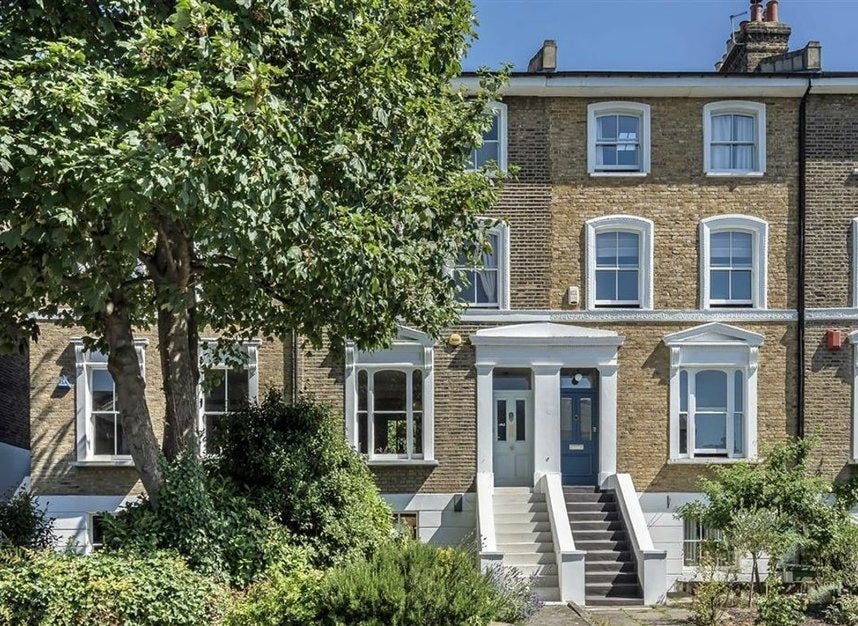
There is also now a video version of this article, if you prefer, here: I’ve been viewing houses this past fortnight, so I thought I’d share my anecdotal 2p on the state of the London property market. I’m looking in Brockley, SE4, which, if you don’t know it, used to be rough AF, but is now where all the cool kids are. The area has benefited from the various London rail line extensions – you can be in Shoreditch or Canary Wharf in 15 minutes; the Jubilee and Elizabeth lines are a similarly short step away – and that has attracted the slay crew to the area. The road links though are still horrendous though, made worse by 20mph speed limits and bus lane misallocation of essential road space. The drive to west London is interminable. Brockley has a good stock of beautiful detached, semi-detached and terraced Victorian houses. For example: With its proximity to Greenwich and the river docks, it was once a wealthy area, though, like most of south-east London, it got bombed to heck in the war. There are plenty of nice parks too. One of them, Hilly Fields, was modelled on Hampstead Heath, and there are many gorgeous houses in the roads running off it. Not quite Hampstead gorgeous, but getting there. Brockley also has the highest density of cemeteries in London, if you fancy dying any time soon, it’s highly convenient. It is, I gather, London’s most haunted area. It is only a bit stabby. Nothing like as bad as neighbouring Lewisham. (Maybe “only a bit stabby” will one day become part of estate agents’ jargon, perhaps to replace “vibrant”. I can’t believe how normalised stabbing now is that I’m talking like that.) The stabbiness is offset, however, by the plethora of nice restaurants, cafés, bars, craft ale breweries, the farmers’ market, mini-festivals, pilates studios et al. I understand, in Browns, the area boasts London’s best coffee and, in Babur, its best Indian restaurant. (Technically Babur is in Honor Oak, but, like England and many of its foreign sporting greats, we’ll claim it as our own.) I shot this vid from the steps up to the station. Brockley feels younger and more up-and-coming than the once-cool areas to the west like Queen’s Park, Kensal Rise, Clapham and so on, probably because of its easy access to east London. (A lot of people from Hackney move down here.) I moved here begrudgingly and skint in 2015 and have grown to really like it. But what about the housing market? I’ve known markets in which estate agents don’t give you the time of day, there are so many prospective buyers, but – perhaps because they know I am an unencumbered buyer – the agents are maybe not quite all over me, but certainly on my case: lots of emails, phone calls and the rest of it. That indicates it’s more of a buyers’ market. But, while I would describe the housing market here as slow, it is not dead. Stuff has been going under offer in the two weeks I’ve been looking, though rarely at asking. With the costs of moving – Stamp Duty is 10% above £925k, and 12% above £1.5m, plus an extra 5% if you own another property – buyers have got to really want to buy. Sellers, meanwhile, have to really want to sell, which often entails reducing their asking prices. Stuff which is unrealistically priced is staying on the market a long time. Look at this one (actually up the road in Honor Oak): This is a 5,000-square-foot property , not so nice inside, but with access to a 2-acre private garden behind with its own tennis court – quite something in London. From £2.5 million to £1.75 million and they still can’t shift it. (It needs a lot of money spending on it.) On the other hand, there don’t seem to be many forced sellers – people who can’t make their payments – and we won’t get any house price crash, long-awaited or not, until that is a reality. I imagine Brockley, as a young, trendy area, is busier than other parts of town, but that is my overall feel: slow, but not dead. I’ve looked at a few family houses. I can’t really comment on flats, but I gather there is an oversupply of 2-bed flats across London, and it is really hard to shift them. I’m not sure if this applies to Brockley or not. It doesn’t feel as expensive as it did around 2019–2022 (realised sales prices are a fraction lower, but there is obviously currency debasement to consider too), but nor does it feel super cheap. We’re a long way off where we were in, say, 2013, even though grander parts of London – Kensington and Chelsea, for example – are back at those 2013 levels. Where does the housing market go from here? It all depends on two things: interest rates and Stamp Duty. Britain’s zombie housing market, brought to you by Stamp Duty. If rates go lower, the market will not collapse. There won’t be the forced sellers. We’ll continue as we are: stagnant. If rates go higher, the market is in trouble. But get rid of Stamp Duty, and you’d have a flurry of activity across the country tomorrow. People aren’t moving because of the amount of dead money involved. Stamp Duty has im