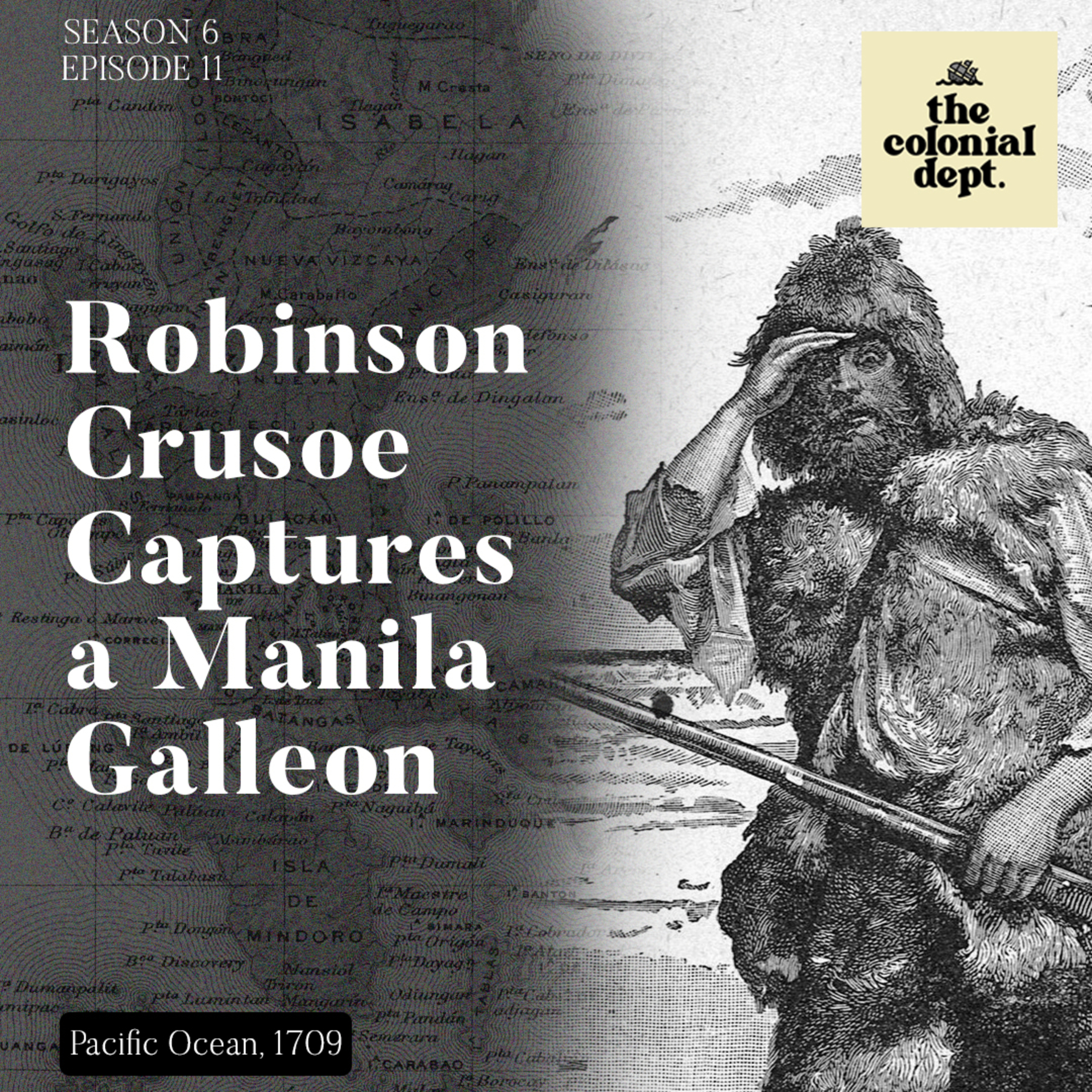
In 1719, a book appeared on London shelves—and became an instant bestseller. Its cover featured the now-iconic image of a man, trapped in a deserted island, dressed only in goat skins. Daniel Defoe, author of Robinson Crusoe , never confirmed nor denied that his massive hit was based on the life of Alexander Selkirk, a Scotsman marooned for years on a tropical island… but the parallels were undeniable. But before Selkirk made his way back to the Western world and became a celebrity, he was roped in by his rescuers for their deadly piratical mission: to hunt the greatest treasure ship of the high seas—the Manila galleon! Follow us on IG: @thecolonialdept Follow us on TikTok: @thecolonialdept Email us:
[email protected] References: Kamen, Henry (2004). Empire: How Spain Became a World Power, 1492-1763. Harper Perennial. Rogers, Woodes (1928). A Cruising Voyage Round the World. The Seafarer's Library. (Original work published 1731). Severin, Tim (2002). “Marooned: The Metamorphosis of Alexander Selkirk.” The American Scholar, 71 (3), pp. 73-82. https://www.jstor.org/stable/41213335 Ball, Phillip (1 May 2019). “The many afterlives of Robinson Crusoe.” The New Statesman. https://www.newstatesman.com/culture/2019/05/the-many-afterlives-of-robinson-crusoe McInelly, Brett C. (2003) “Expanding Empires, Expanding Selves: Colonialism, the Novel, and ‘Robinson Crusoe’.” Studies in the Novel, 35 (1), pp. 1-21. https://www.jstor.org/stable/29533546 Peterson, Andrew. “What Really Made the World Go Around?: Indio Contributions to the Acapulco-Manila Galleon Trade.” Explorations: A Graduate Student Journal of Southeast Asian Studies, 11 (1), pp. 1-18.