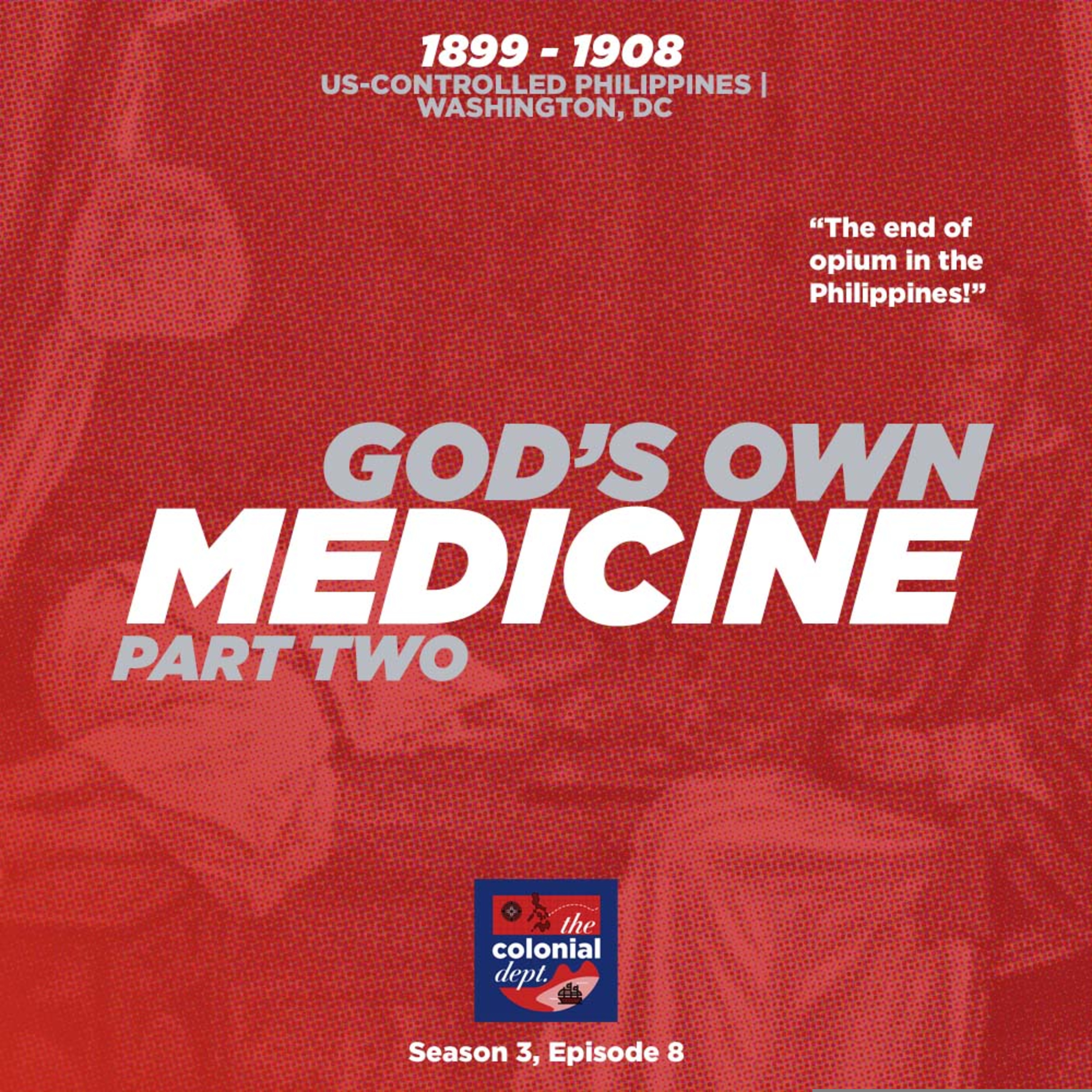
S3E8: God’s Own Medicine, Part Two
Caught in between religion and revolution, opium turned from a politically dicey government cash crop into an evil and illegal narcotic. And the minds behind the anti-opium campaign in the Philippines would arguably set the tone for anti-drug wars around the globe.
Follow us on IG: @thecolonialdept
Email us: [email protected]
References:
Bamero, Alma (2006). “Opium: The Evolution of Policies, the Tolerance of the Vice, and the Proliferation of Contraband Trade in the Philippines,1843-1908.” Social Science Diliman 3(1-2), 49-83.
Taft, William Howard (1903, July 13). [Letter from William H. Taft to Elihu Root]. https://www.theodorerooseveltcenter.org/Research/Digital-Library/Record?libID=o41275
Wertz, Daniel P. (2013). “Idealism, Imperialism, and Internationalism: Opium Politics in the Colonial Philippines, 1898-1925.” Modern Asian Studies, 47(2), 467-499.
Ginsberg, Philip (1970). “The Chinese in the Philippine Revolution.” Asian Studies: Journal of Critical Perspectives 8(1). https://www.asj.upd.edu.ph/mediabox/archive/ASJ-08-01-1970/ginsburg-chinese-philippine-revolution.pdf
Zarco, Ricardo M. (1995). “A Short History of Narcotic Drug Addiction in the Philippines, 1521-1959.” Philippine Sociological Review 43(1/4), 1-15.
Clip of “The Battle Hymn of the Republic” from the United States Army Band’s YouTube page.
You May Also Like

Le fil de l'histoire
France Inter
HISTORY This Week
The HISTORY® Channel | Back Pocket Studios

Einschlafen mit Geschichte
Schønlein Media
Explaining History
Nick Shepley

Stuff You Missed in History Class
iHeartPodcasts
Canadian History Ehx
Craig Baird
History As It Happens
Martin Di Caro
Willy Willy Harry Stee...
Charlie Higson

Christian History Almanac
1517 Podcasts

Everything Everywhere Daily
Gary Arndt
Le fil de l'histoire
France Inter
HISTORY This Week
The HISTORY® Channel | Back Pocket Studios
Einschlafen mit Geschichte
Schønlein Media
Explaining History
Nick Shepley
Stuff You Missed in History Class
iHeartPodcasts
Canadian History Ehx
Craig Baird
History As It Happens
Martin Di Caro
Willy Willy Harry Stee...
Charlie Higson
Christian History Almanac
1517 Podcasts
Everything Everywhere Daily
Gary Arndt
Community discussion