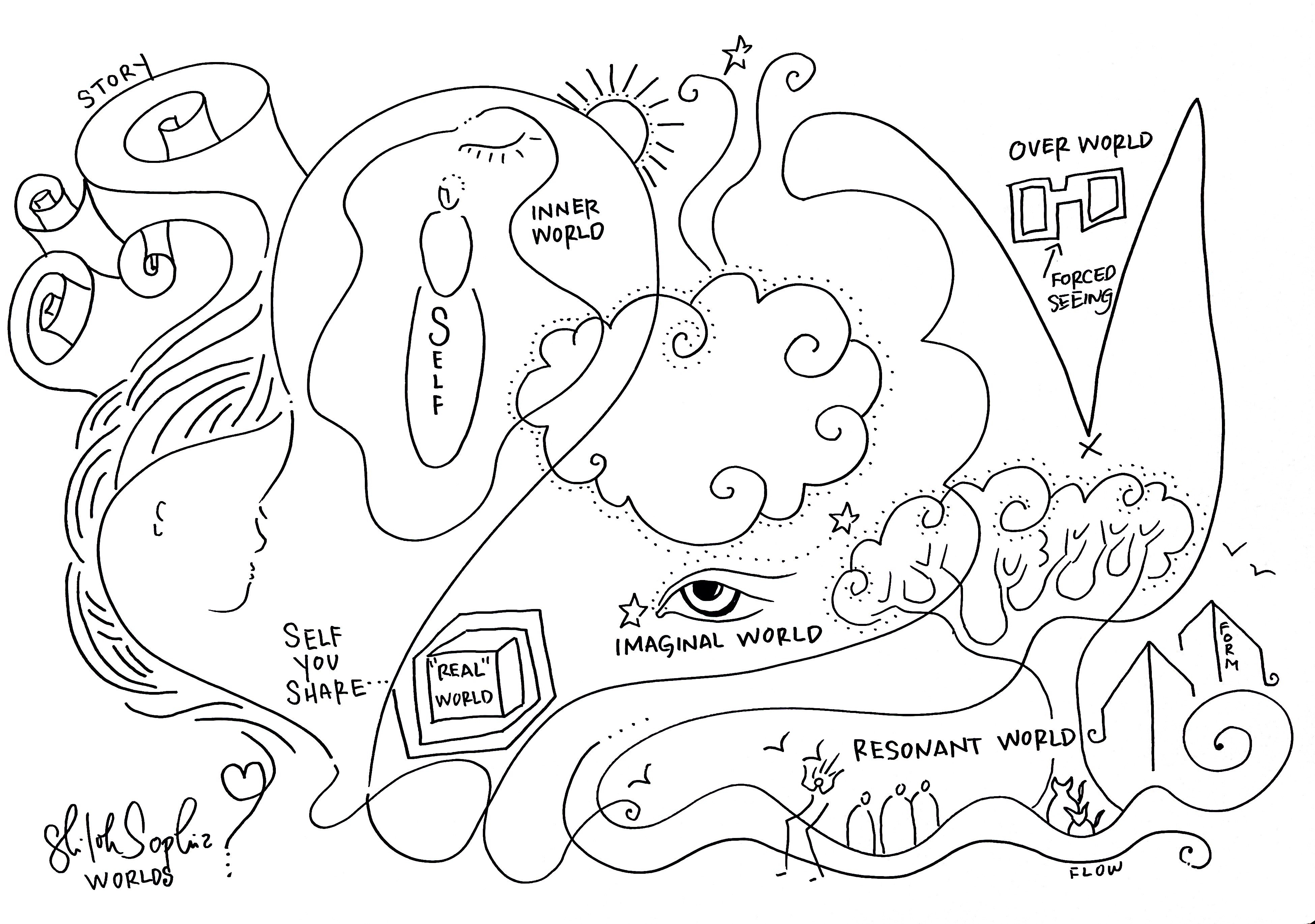
What worlds do you live in and how?
Here is the audio transcript if you wish to read with a cuppa instead ❤️
Dear Ones,
I wonder if you find yourself thinking about the different worlds that we seem to inhabit as a self, but largely unconsciously. It's almost like we become aware of worlds as we become adults because we've lost some connection to it somewhere between childhood and adulthood. We stopped seeing and dreaming in the way that we used to when we used to have imaginary friends and imaginary worlds.
I can't help but wonder if we wouldn't have a different world at large if children were truly taught to keep their imaginal world front and center as a way of thinking and being. We're not very old, eight to 12 depending on the culture that we're living in, sometimes even younger than that, before we start to create a disconnect, whether that's conscious by adults in our space, I think largely unconscious, or just in a desire to sit into being inside of a structure.
If we don't act like we're present and participating in culture, we sometimes are told we're daydreamers. We're told to stop making things up and stop pretending. We're told to grow up and use our adult voice. We're taught not to use our outside voice inside. But while all this is happening and has a relative level of logic to it, something else is being lost. We don't even know enough about it to talk about it.
Many people have to become adults and be able to afford education in order to start thinking about the imaginal world they left behind as a child. So many people we work with in our intentional creativity community can remember the moment they put down a crayon. That's how significant that moment is. If I ask them what was happening in that day, or even what they wearing or who was there, they often have this almost supernatural vision of themselves in that moment.
We're yet to determine why that image is so absolutely looming and huge in our lives. Why that moment would be so big that we would actually stop creating, sometimes until we're adult. I have different theories about why I think that moment is so significant.
One of them is that, until that moment, we are largely connected with our imaginal world, and move freely and easily between imagination and what others around us perceive as a kind of reality. When someone becomes critical of our creativity, which in many cases is an externalized version of our internal world, whether that's drawing, singing, dancing, playing, make-believe, when that in any way gets criticized, when it had been largely encouraged before, but nobody told us when we were going to stop being encouraged to be imaginative. There was no warning. We get surprised.
In that moment, something happens, a rupture, that it could take the rest of someone's life to repair, if we even know to do it. It's almost like we're caught in the act of somehow not being connected, somehow not being connected to the reality that the adults around us have been enforcing. It's a moment, it's a flash, it's a rupture, and we start to, in a way for many of us, become concerned about ourselves.
It could be a moment where self-trust is lessened and where we recognize a stark reality between what we think of as our imagination and what we are now crashing into as the reality in which everyone else is living and somehow we weren't. My mother, Karen, used to think of this moment as a time when many people would start to think they were just a little bit crazy and had to hide and pretend to behave in order to fit in.
Over days, months, or years of trying to fit in and not invite that imaginary friend to the lunch table anymore, because now there's real friends to behave and act normal with, we actually start to lose trust with that internal world. And then later, as we go on in education, we're criticized if we're not connected to our creativity and our imagination. We're criticized if we're too structured, too A type, too left brain. And so this tug of war between imagination and reality is set in place and barely ever do we actually talk about it in a way that can be understood and healed.
In the work of intentional creativity, the invitation is to reconnect to the imaginal world while still being connected with the resonant world. I call it resonant world because I don't want it to be an external world from our internal world. External inherent in the vocabulary actually indicates separateness.
If we could move from our inner world to our imaginal world and then into a resonant world, we would be able to navigate what we experience as internal and imaginal, and relate it and bring it into harmony with the resonance of those people, places, things, animals, energies, archetypes, creatures, symbols, and stories all around us. We would have a sense of place in the cycle of things and a sense of our own place. It would be resonant and we would seek for contextual resonance by choice, and our imagination would give us contextual relevance.
One of the things I have to watch myself with when I'm leading circle is when someone seems out of context. In my family's world, context is queen. It means you are conscious of being appropriate to the context. And when someone isn't appropriate to the context, to me, it interferes with the resonance, and I want to smooth it over and stop it. That's my first response. What my mom would call a knee jerk response. It's the first response.
The second response is, how is this important right now? How is this wild moment leading to something else? If someone's breaking out into a dance in the middle of a meditation, should I invite everyone to dance? If someone's making a lot of loud noises or opening a candy wrapper while I'm trying to say a prayer, should I suddenly start to make sounds and invite everybody to do the same? Should I ask the person to stop or should I impatiently wait?
When I lead circle, it's this interesting moment to notice all the sharp bits about myself, about how much I desire a level of coherence. But a resonant world wouldn't necessarily be that everything is the same and in harmony. It would actually mean that everything works in tandem and it's time together, and that there is a place for everything.
What I think I'm really reacting to is what I perceive as a lack of consciousness or a lack of willingness to participate in what I consider the energy that I'm weaving or that's present. That's where the overworld comes in. Dr. Clarissa Pinkola Estes, who wrote, Women Who Run with the Wolves would say that this is an over culture, a dominant power over kind of energy that exists at the level of paradigm. Pretty much all of us participate in it, even those of us who lead circle.
For me, when I notice that overworld coming in or have a desire to control for the sake of myself and everyone in the room, because I think it's best for everyone, for there to be coherence, I have to just stop and ask myself, what is the wild one in the room trying to show us? In almost all indigenous cultures, there's a wild one.
There's an emu in the indigenous aboriginal culture. There's the coyote in Native American culture. The trickster exists in so many forms all around the world, and I admit it's one of the places I have trouble. We have quite a few tricksters in our community. You know who you are. And I sometimes am challenged by the context, but that's part of the role of the trickster to shake things up. And what if a resonant field is woven all together with the tricksters?
And what if those of us who are pretending toward consciousness could recognize the trickster as part of the resonance? The trickster, FYI, for your information, is usually one of the highest intelligent beings in the circle because they're actually paying attention to everything that's happening. And for there to be a true resonance, there has to be a true diversity, and tricksters act ou
You May Also Like

Le Cours de l'histoire
France Culture
Podcast Patapoe
0d0a

خوانشهای گنجور

Mahlakung
Thobela FM
Hort Culture
Plant People
London Writers' Salon
Parul Bavishi, Matthew Trinetti

La voce del poeta
Lorenzo Pieri

ALEX
SUNNY
True Detective Stories from the Archives of the Pinkertons
Cleveland Moffett

Daily Short Stories - Ghost and Horror Stories
Sol Good Network
Le Cours de l'histoire
France Culture
Podcast Patapoe
0d0a
خوانشهای گنجور
Mahlakung
Thobela FM
Hort Culture
Plant People
London Writers' Salon
Parul Bavishi, Matthew Trinetti
La voce del poeta
Lorenzo Pieri
ALEX
SUNNY
True Detective Stories from the Archives of the Pinkertons
Cleveland Moffett
Daily Short Stories - Ghost and Horror Stories
Sol Good Network
Community discussion