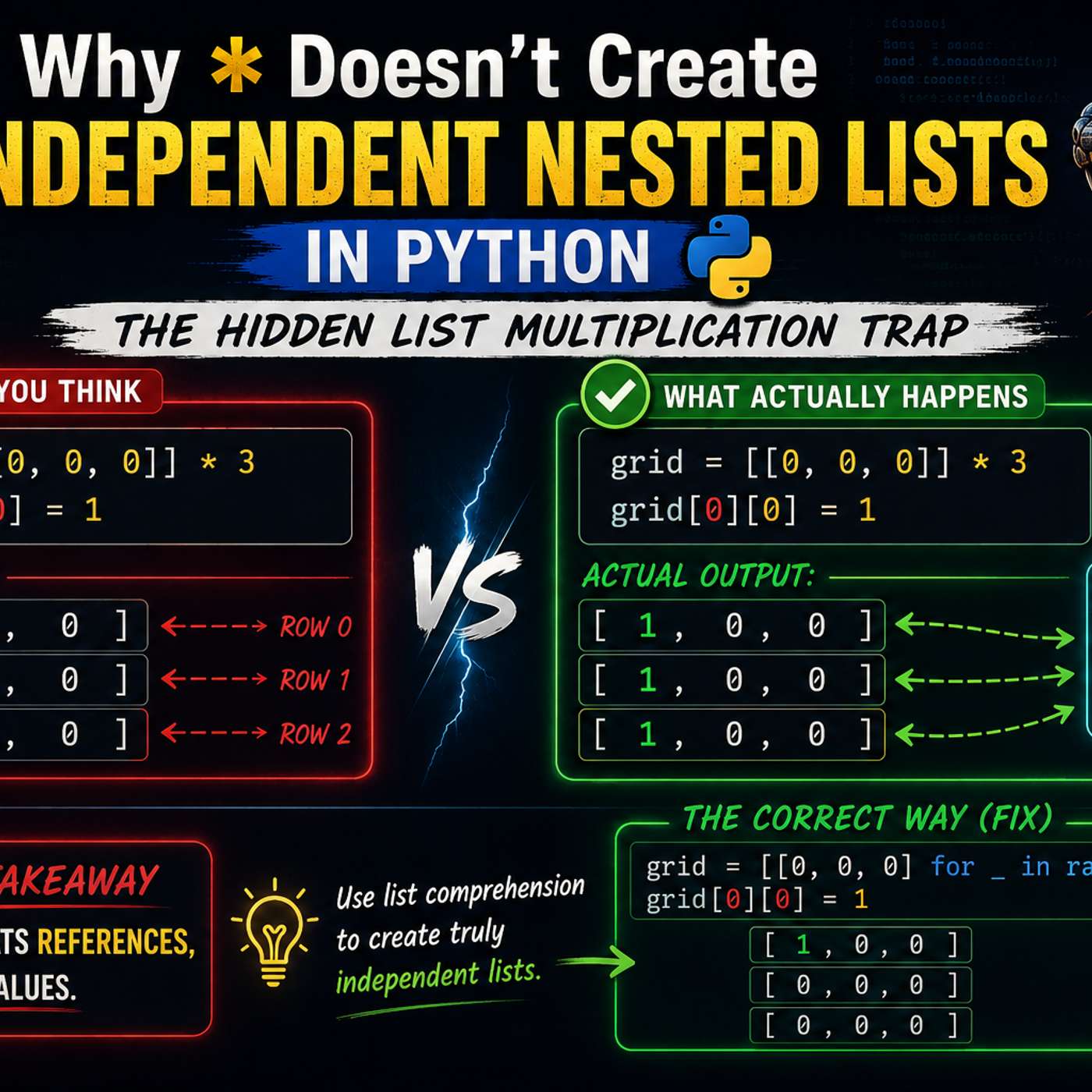
Why * Doesn't Create Independent Nested Lists in Python (The Hidden List Multiplication Trap)
This story was originally published on HackerNoon at: https://hackernoon.com/why-doesnt-create-independent-nested-lists-in-python-the-hidden-list-multiplication-trap.
Learn why [[0,0,0]] * 3 in Python secretly shares one list across all rows, and how to build truly independent nested lists the right way.
Check more stories related to programming at: https://hackernoon.com/c/programming. You can also check exclusive content about #python, #python-programming, #python-lists, #python-shared-references, #python-mutable-objects, #python-list-comprehension, #mutable-list-bug-in-python, #hackernoon-top-story, and more.
This story was written by: @sohelalam79. Learn more about this writer by checking @sohelalam79's about page, and for more stories, please visit hackernoon.com.
[x] * n does not create n independent copies of x. It creates one object and repeats a reference to that same object n times. For immutable elements like numbers or strings, this is harmless because any "change" actually rebinds the slot to a new object. For mutable elements like lists or dicts, every slot points to the exact same object, so mutating one slot mutates all of them. The fix is to use a list comprehension — [x for _ in range(n)] — which creates a genuinely new object on each iteration. Key takeaway: * repeats references, not values.
You May Also Like

Semiconductor Insiders
SemiWiki

No Tiene Nombre
elbruno

Artificial Intelligence Masterclass
AI Masterclass

The Vergecast
The Verge

EasyApple
EasyPodcast

Radio Miraya
Radio Miraya

Eye On A.I.
Craig S. Smith

Nodesignal - Deine Bitcoin-Frequenz
Die Nodesignal Crew

Jack Hopkins
Jack Hopkins

Mark Tilbury
Mark Tilbury Fan
Semiconductor Insiders
SemiWiki
No Tiene Nombre
elbruno
Artificial Intelligence Masterclass
AI Masterclass
The Vergecast
The Verge
EasyApple
EasyPodcast
Radio Miraya
Radio Miraya
Eye On A.I.
Craig S. Smith
Nodesignal - Deine Bitcoin-Frequenz
Die Nodesignal Crew
Jack Hopkins
Jack Hopkins
Mark Tilbury
Mark Tilbury Fan
Community discussion