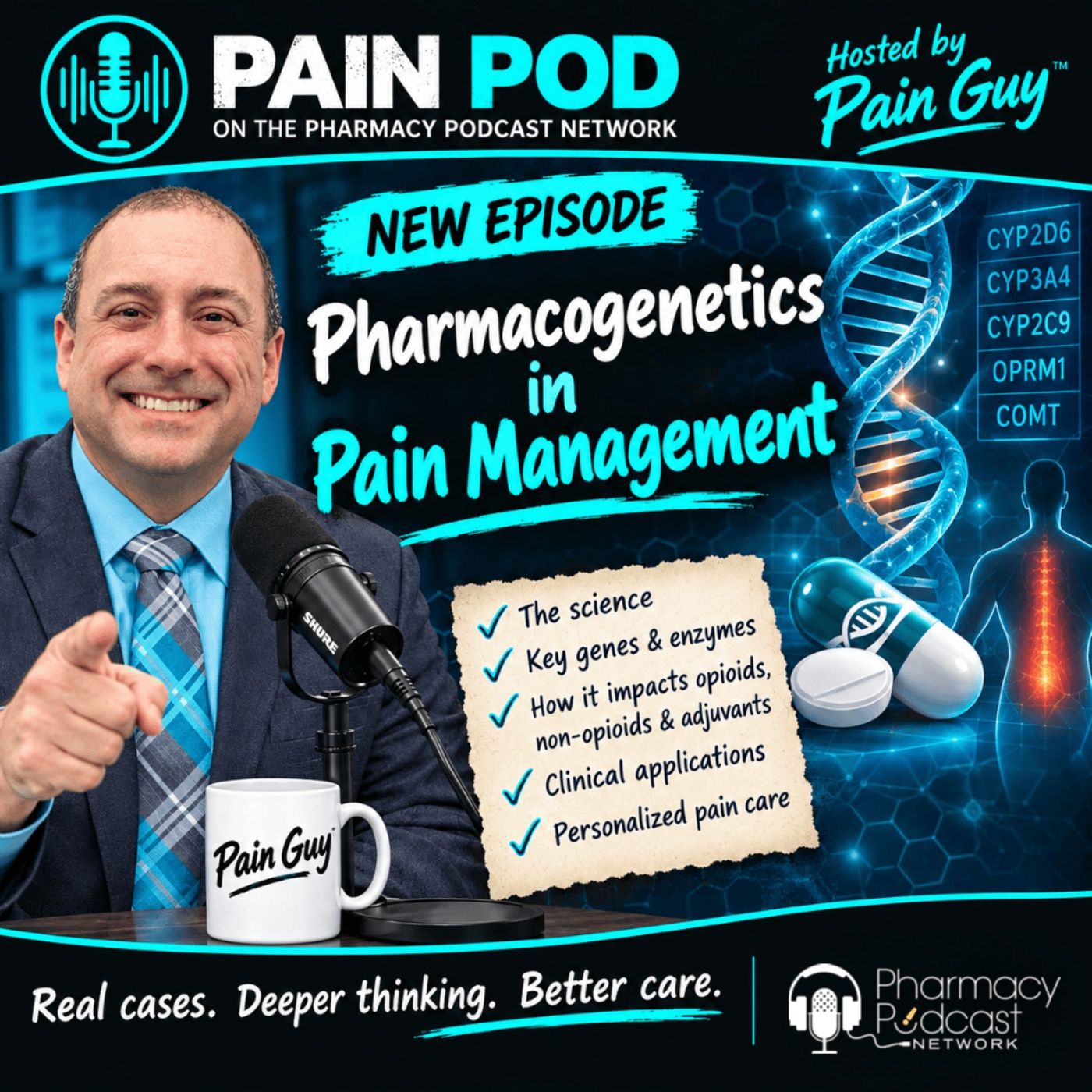
0:05 You are listening to the global network of podcasters dedicated to the pharmacy profession. Welcome to the Pharmacy Podcast Network. 0:34 Welcome to The Pain Pod, the podcast for all things pain management, hosted by the pain guy, Dr. 0:43 Mark Groffoli. 0:48 We'll be collaborating with numerous pain management experts, talking about substance usage disorders, the latest treatment modalities, and most important, focusing on the pain of our patients as leading providers of pain care. And now here's our host, a man 1:08 wanted in all 50 states, a suburban city like mountain man. 1:14 Without the beard. 1:16 From the hills of West Virginia and certified in weapons. 1:21 Of mass destruction response. 1:24 It's Dr. Mark Garofali. Welcome back, everyone, to The Pain Pod. 1:36 I'm your host here, Mark Paingeiger-Rofli, of course, and excited to have you back here, especially for this what we'll call follow-up episode. So today, we're going to be going over pain management pharmacogenetics. Now, if you haven't listened to 1:50 the previous episode of The Pain Pod, where we went over the codeine controversy Check it out. Highly recommend. Five stars, right? 2:00 Just like a good hotel. You could certainly, if you haven't listened to it already, you can feel free to keep listening to this episode and then check that one out. 2:08 But if you've already listened to that one, this is going to give, well, the complete picture of where we go forward for helping our patients in pain. And by the way, for our patients in pain listening out there, lots of little nuggets here for you and everyone alike. 2:23 All right, so let's hop to here. If we're going to go over pharmacogenetics or PGX in pain management, certainly apropos for the pain pod, let's kind of cover some of the basics first, right? We certainly didn't go over this in our chat about the coding controversy for the 2:39 last couple of decades, but here we are today. So pharmacogenetics, that's the textbook, is a study of how a single gene variation basically impacts the body's response to one specific medication, okay? 2:56 Whereas its cousin from another here would be pharmacogenomics. That's really the study of how a patient's genome, the whole thing, can influence how they respond to medications overall, right? So it's really pharmacology meets genomics, the whole thing, like we 3:13 mapped it, right? Now, pharmacogenomics is kind of like pharmacogenetics, except that it typically involves a search for variations in multiple genes that end up affecting different variable drug responses or responses to medications overall. All in all, we're really 3:32 going to be concentrating on that pharmacogenetics for this conversation and really for anything within patient care for patients in pain. 3:41 All right. 3:41 So, What's our next steps? So let's go over some terminology and call it the basics. But hey, we all had freshman year, but it's probably been a while. So, you know, a gene, you know, not the Levi's or the whatever other ones, bad religion, good religion, you name it. 3:57 But the genes in our bodies, right? It's a specific region in our overall genome that codes for proteins, enzymes, you name it. Then we have the genotype. That's a set of alleles. Give it a hot second, folks. inherited at a specific location on a given gene. Okay, so 4:16 genotype on a gene. And then those alleles, that's a variation of the same gene inherited from each parent. You could probably remember those boxes, whether you do the two by two or more, figuring out, you know, different colors of hair or the various other things we get from 4:33 our you know, conversational or general genetic testing overall. The thing that a lot of folks, you know, around the holidays spend about a hundred bucks on because they're always on sale then, you know, to find out all these 4:46 different characteristics and find our DNA relatives along the way. 4:49 But here we're really talking about the pharmacogenetics where it hits the pavement for our patients. And here, of course, our. 4:55 Patients in pain. 4:56 So what about these, when there's changes, when there's pharmacogenetic alterations, what changes, right? So that's basically pharmacogenetics or PGX. It's the study of the role of genetics in drug response. 5:10 So when we have changes in the gene, that's going to change some of those proteins and enzymes out there. 5:16 So we'll have You know, the DNA bases change, our good old ACGT, channeling that freshman year biology or whatever class, right? 5:26 And that sequence of those amino acid bases, aka the coding region, is going to generate various proteins. Those proteins, here's the drumroll, end up being, of course, drug receptors, drug metabolizing enzymes, and even we tend to not mention 5:42 as much, but drug transporters as well. So when we're talking about what changes, it's really the receptors, the enzymes, and the transporters. Then we jump into, okay, when we're looking at pharmacogenetic, say the enzyme metabolizers, okay, that's where 5:58 a lot of the meat and potatoes is for what would provoke action. when taking care of patients in pain based on their PGX profiles, right? A lot of times it's the enzyme metabolizers. You could have poor, intermediate, normal, 6:12 or extensive. That's a little tricky one. That's all one quote box, normal, extensive. So it's typical to be extensive, not necessarily intermediate, and then ultra rapid. So the bookends, the extremes are poor and ultra rapid. A lot of 6:28 us are right in between those with either intermediate or normal extensive. Now, when we take that information, it could go much more granular. If you all want to dive into that, we can, of course, but we're going to make this very patient care centric along the way. But 6:45 the different phenotypes, meaning that somebody, let's just pick, when it comes to pain management, it's usually CYP450, the hepatic liver enzyme, what's metabolizing or processing the medications in our body. 7:01 2D6 and 3A4 are the heavy hitters. You know, very much like, well, a lot of other places too, right? 7:09 I mean, 3A4, it's one of the top five. It kind of takes the lead along the way as well too. 7:13 But how much will it actually impact pain management? That's what we're here for today, right? So if you have things like CYP450, 2D6, normal metabolizer, intermediate, ultra-rapid, all of the gang, it basically means that they're going to have 7:27 a different diplotype will be noted on some of the actual reports, the PGX reports that patients receive or that we receive for our patients overall. You'll see usually some asterisks and some numbers. That's all well and good for 7:42 the nerdy scientist in us, but what we really need to know is what the heck does it mean for our patient's medication profile at all for the rest of healthcare? 7:50 The good thing is when we or patients receive their PGX reports, it's probably one of the best examples in healthcare where things are translated automatically. 8:04 Okay. 8:05 What I mean by that is it's, you know, think about like a PDMP, a prescription drug monitoring program. I know there's some fancy ones, basic things compared for the, you know, this decade or century anyway, but you know, some fancier ones with colors and numbers and all that 8:18 kind of stuff. But the bare bones reports are Excel spreadsheets. Okay. 8:23 Not too fancy. Whereas these typical PGX report, pretty much just about all of them I've seen actually, or have some features like color coding or You know, things like red for stopping this medication or talking about it more 8:36 or green being good to go, generally speaking, having words like actionable, you know, whittling it down medication by medication. 8:46 So that when a patient says, I'm utilizing, you know, medication one, two, and three, does my PGX profile affect these? 8:53 It's usually pretty straightforward, but then what to do with that information is where we come in, you know, as the healthcare professionals for explaining things a little bit further than just the red light green light right so when 9:07 we're talking about you know clinical practice when it comes to pgx that's where you know we take all that information you think about it like a hot five minutes ago we were talking about things like dna from freshman year college for everybody and really even 10th grade uh 9:21 biology in high school but um now we're going to take this to the next level This conversation goes to, well, where do the recommendations for action come from, particularly for our patients in pain and their medications, right? So there's 9:35 three general, dare I say, guidelines. But there's the Dutch Pharmacogenetics Working Group. 9:42 That's a mouthful. 9:43 DPWG rolls off the tongue. 9:45 Just say it even once. 9:46 Then we have the FDA Table of Pharmacogenomic Biomarkers in Drug Labeling. That's more than a mouthful. And then finally, we have, it's generally referred to as the gold standard, the clinical pharmacogenetics index. Implementation Consortium, CPIC, or roll with me, CPIC. Okay, 10:06 we're going to hear a lot about CPIC in this conversation today and really anytime you're reviewing or making recommendations for patient care based on PGX. CPIC is pretty much where it's at. In fact, you could actually go to 10:19 their website to look through things. It's cpicpgx.org. I'll have it in the show notes as well, but you can rewind that if you want. But it's CPIC, because we already went over CPIC, pgxpharmacogenetics.org. That'll get you where you need to go. And you're going to see lots of 10:40 guides on there. One of the things that's kind of like an Excel sheet again, but within the actual webpage, you could adjust the columns to look at things like based on the gene itself, well over 100 of them, and then based on the medication or they'll label it 10:56 as drug, where you can put them alphabetical, find them easier along the way. You could go by what guideline, you could go what's on the FDA labeling, so on and so forth. You could look up what are the actual recommended actions based on a patient's PGX profile for 11:14 their respective medications. Kind of cool. So there's different, when you go through that, the CPIC guidelines, whether you're using the chart or the overall guideline, there's different actions that come up. The wording that they'll use, just so that 11:29 you're aware, would be recommended action or changes. I got a couple pain meds there like allopurinol for gout. One of the DMARDs even, azathioprine, has very specific recommendations. 11:44 Along the way. 11:44 It doesn't mean this absolutely has to happen for every patient, but it's recommended. Then we have actionable things that come into play for things like even diazepam, SSRIs, multiple NSAIDs, dronabinol even. We're talking THC, the synthetic one, FDA approved. Codeine, tramadol, 12:04 so some opioids, TCAs, SNRIs, you name it along the way. 12:09 Those are actionable. What does that actually mean? That means that let's not proceed blindly. when initiating or even continuing or titrating medications for a given patient over time, PGX profiles can help. It's not an automatic, of course, but 12:26 they can help. And that's what we really. 12:28 Want to keep in mind here in the big picture. 12:30 You know, PGX is one of many things that comes up for either drug interactions or making us different. 12:37 You know, we have PGX, we have, you. 12:39 Know, sex, gender, age, Then also the pharmacological principles that could contribute to drug interactions or general concerns like we already went over metabolism, but things like QTC, the pharmacodynamic 12:51 things like QTC interval, thinking about the heart there, serotonergic effects, sedative effects, obviously, you name it, you know, in the big picture. Kind of already mentioned, let's hone in on that metabolism part because that seems to be the name 13:07 of the game here when we're talking about PGX, of course. 13:10 Keep in mind that there's phase one, two, and three metabolism for medications in our body. Essentially, medications typically will start as being lipophilic or less polar. And as they are metabolized, they'll typically become more polar, meaning hydrophilic, so 13:25 that we can pee them out. 13:27 You guessed it. 13:28 Or there's another option, right? But the vast majority of metabolism that's talked about as far as actionable change for patient care would be in phase one, the oxidation of the CYP450 hepatic or liver enzymes, like we talked about 13:42 minutes ago and on many episodes of The Pain Pot, right? 13:45 And that's, you know, CYP450 is a dominant feature there in that phase one oxidation. The top five I mentioned earlier, you know, for pain, you've got your top two CYP450s. 13:56 You have 3A4 and 2D6. 13:58 The rest of the gang that runs at the top five in general would be 1A2 and then 2C9 and 2C19. 14:03 That's getting some technical jargon there for us. But, you know, as clinicians, we tend to know those things. Where does it actually hit home, though? Right. So let's take those guidelines and just kind of talk and walk through, you know, 14:15 where is it hitting home for our patients in pain? 14:18 So let's see, I'll take a plan of attack. We'll talk about maybe some opioid information, NSAIDs, SNRIs, and TCAs, since I mentioned those earlier. Okay. Now, when it comes to opioids, alas, we don't need to be on the edge of the seat. We've been there before. You know, 14:33 it really comes up into play for, you know, actionable or recommended ideas when it comes to opioids would be the, you know, as far as prescription ones would be with codeine. 14:42 You guessed it. Remember the last episode, the codeine controversy and then tramadol. Both of those are metabolized by CYP452D6. 14:50 Tramadol is actually a pro drug. It's useless into our body, makes it helpful when it becomes. 14:55 The odesmethyltramadol, right? 14:58 It's just sounds like a, I don't even know, like a Saturday Night Lights skit when you say that name, at least with my tone. Odezmethyltramadol. 15:06 Good golly. 15:07 It's like in a play or something. Anyways, tramadol is a prodrug. So codeine is metabolized by 2D6 to morphine. 15:13 That could be a concern. Tramadol is metabolized by 2D6 to the active Odezmethyltramadol, the active metabolite, right? 15:20 M1 if you want to go there. 15:22 So those can be affected by changes in someone's PGX profile if their 2D6 metabolism is different. Now, when you look at some studies, I recall one that came to mind, actually, that just looked at the general population and looked at 15:36 different ethnicities identified by the authors to say, hey, where do we usually see these PGX metabolizer phenotype changes or noticeable differences? So when you look at 2D6... I'll include the study that I'm referring to in the show notes, 15:52 but looking at ultra-rapid, when the authors identified folks as being of Asian ethnicity, there was about a 9% to 21%, if I'm remembering correctly. So 1 in 10 to 1 in 5, give or take, percent chance of that given 16:10 population being an ultra-rapid metabolizer of 2D6. You know, that's something that can be actionable. We want to know that information. 16:20 Because if somebody's a 2D6 ultra-rapid metabolizer, we generally would say, the guidelines would say, CPEC, avoid codeine and avoid tramadol. 16:27 Because codeine, you would be metabolizing more morphine. That could be a concern for side effects, the whole list of them. 16:34 And tramadol would be, you know, the same kind of thing there of, you know, being over-activated as well to its active metabolite. So things to keep in mind. 16:42 In the big picture there. 16:44 Let's see, I mentioned NSAIDs. So the name of the game with NSAIDs is typically, metabolically anyway, CYP450-2C9. Half to a little bit over half of NSAIDs are metabolized by 2C9 in some way, shape, form, or fashion. Then we have our non-CYP ones that'll come into play. We'll get 17:07 into that here in a moment. But when you're thinking about 2C9, that same study I mentioned earlier, There's some population changes there when you're looking at the intermediate, you know, PGX profile for 2C9. 17:19 Metabolism, right? 17:20 Even those of white ethnicity, as identified by the study authors, about a third would be intermediate. So that's not a strong change action there, but, you know, big picture things to keep in mind. So if somebody has a concern, 17:35 you know, an identified concern for any CYP450, particularly 2C9, when it comes to NSAIDs, We can always consider our non-CYP450 metabolized NSAIDs. Things we're talking there like Etotolac, the 2Ks, Ketoprofen, Ketorolac, Oxyprosin. 17:52 Naproxen comes up particularly because it's OTC. It has minor 2C9 along with 1A2, but food for thought there. Solendac and Nabumetone are both pro-drugs, kind of like when we talked about tramadol where they're activated in the body. 18:09 But not in the 2C9 route. 18:10 See, you know, we got a bit, half dozen, Baker's half dozen there, options for the non-SIP 2C9 NSAIDs. 18:19 All right, let's see. 18:20 Let's go into our adjuvants. I mentioned SNRIs. So, you know, the gang, when you put them together, you have venlafaxine, duloxetine, and milnaceprine. 18:30 And then, of course, you have that. 18:31 Desvenlafaxine and levomilnaceprine, as far as those little changes there. 18:38 2D6 comes up in general for the venlafaxine agents and duloxetine. 18:44 1A2 comes up for duloxetine as well. And then 3A4 for levomonasoprine. So I know that was a lot, especially just to digest in the audio side of the world. 18:54 But there's metabolism and it can matter. Because when you're thinking about, again, honing in that one study for 2D6, where that comes into play for venlafaxine, desvenlafaxine, duloxetine, You're going to have those same population stats we chatted about 19:10 minutes ago when we were talking about prescription opioids. 19:13 That come into play, right? 19:15 So what's CPIC got to say as far as the guidelines? 19:19 So as far as the non-normal or extensive metabolizers, I think in the non-CYP452D6 SNRI, so that would be your monosopran or levomonasopran. Is that like saying, okay, somebody's been utilizing duloxetine for a decade. Oh, do we need to 19:35 change immediately? you know, pump the brakes there. It's just a conversation, particularly comparing with continued utilization, but definitely something to take into account when you have the data at initiation of medications. All right, so sticking to the adjuvants, 19:49 we also want to mention TCAs. They're like the best example when you're talking about medication metabolism, right? 19:56 M & M. 19:57 You have your tertiary amines and secondary amines. All that basically means is how many, essentially, going to pain guy anyway i'm sure our med cam folks would say would be losing their minds right now but um tertiary basically 20:10 having the three methyl groups on the nitrogen whereas the secondary is just going to have the two overall right so tertiaries are typically metabolized tcas to secondary so you go from you know think three to two tertiary to 20:25 secondary that's uh oftentimes going to be accomplished by 2c19 so there we have our target along the way i For instance, amitriptyline is metabolized to nortriptyline. That nor actually means loss of methyl. And then imipramine is metabolized to desimipramine. 20:42 That des actually means loss of methyl, generally speaking. So where does that come into play? Well, there's another step as well where 2D6 is going to take either the tertiaries and metabolize them elsewhere. Or we're going to take 20:57 the secondaries I talked about, like nortriptyline, desimipramine, and metabolize them further along the way elsewhere. you know, making more polar, get them out. 21:04 Of the body, right? 21:06 So 2C19 and 2D6 come into play for our tricyclic antidepressants, our TCAs, as adjuvants. 21:13 For pain management, or really anywhere along the way. 21:16 Those same population studies have some, you know, actionable, remarkable percentages when it comes to 2C19. 21:22 And of course, we already talked through 2D6 in the big picture. 21:26 So let's see, PIX-A. So You know, again, always think about the bookends, the extremes. So an ultra rapid metabolizer when you're talking about 2D6, you know, the general idea there as far as the recommendations, you know, therapeutically speaking 21:43 would be, you know, avoiding TCA utilization, you know, potential lack of efficacy along the way. If it's absolutely warranted, consider, you know, adjusting the dosage along the way. Conversely, in the other bookend, the other extreme would be poor metabolizers 22:02 for 2D6. That would be the recommendation of avoiding TCA utilization due to potential for side effects because you're going to have them building up overall, not being metabolized and getting out of the body overall. Now, we also mentioned 2C19. 22:18 Same thing, bookends, the extremes, you got your ultra-rapid metabolizers for 2C19. You'd want to consider an alternative there when it comes to TCA's poor metabolizers. The specific recommendation from CPIC would be to consider half the dose, so 50% 22:32 reduction of the starting dose, because again, you're going to have more of that initially and building up along the way. 22:40 All right, so I think we did a pretty good run-through of where PGX can come into play, particularly in the metabolic side, as far as pain management medications. Keep in mind, though, again, folks, that's not the whole picture. 22:52 We talked about there's PGX, sex, gender, age, all the Beyond metabolism, you have the pharmacodynamic things compared to PK, the QTC interval prolongation, serotonergic effects. I've got a lot of other things to keep in mind for every patient 23:06 in pain, not just PGX. In fact, PGX is part of the overall risk reduction strategy for best practices in pain management, but it is one thing along the way. Now, in the big picture there, I did want to mention, I think I'll wrap up with, you know, where do 23:24 we go with this? Like, do patients just get their own PGX testing and get their results or they bring them in or how does it go? Pretty much anything's an option. You know, things can be provided within clinics and practices along the way. or patients can get them 23:39 on their own a la carte. Definitely want to look into the different pricings, which change throughout the time like anything else in commerce. But the PGX services, there's pharmacists we have out there, spectacular pharmacists that are consulting and 23:54 concentrating primarily on PGX services. But again, it could be within clinics along the way as well, too. And it requires a little extra training and planning, obviously, along the way. 24:04 Folks are going to be even thinking about, you know, PGX lab selection, just like an individual patient or clinician would be choosing one. 24:10 Practices would as well. 24:12 I'll give a shout out actually to CPESN. It almost sounds like a sports channel, right? Are they 15 of them these days? 24:20 But it's not, right? 24:21 It's the you know cpesn for our independent pharmacies out there and beyond you know making the network across the country for you know cognitive services or services you know primarily beyond dispensing so there's novel pay structures actually available 24:36 within cpsn for our pharmacies out there where there's already labs and payers the pharmacies involved in cpsn along the way so that's a That's probably the quickest rundown of like, where does somebody begin with businesses or utilization of this? 24:51 And well, it all starts with some conversations, perhaps amongst us clinicians, where we go with this, how do we provide this or get this information for our patients and or patients in and of themselves, right? If one thing I believe in this podcast, this episode with who should 25:08 I get my own PGX done? Well, I mean, there's never really going to be a hard no, but there's a maybe yes, right? And nobody wants to be a hypocrite here, too. We certainly want to have our information. 25:20 Cost becomes one of the first things that we consider, just like when we go to a mechanic for our vehicles and just like when folks go to a pharmacy for their medicines. Cost is a thing, folks, right? So we got to keep that in mind along the way. 25:33 All right. 25:34 Just want to hope that everybody got a little bit more than the surface here in our chat, our episode here on the PainPod, reviewing pain management, pharmacogenetics, PGX, right? 25:45 PainPGX here on the PainPod. If you haven't listened to the Coding Controversy episode, please check it out. 25:52 I think you'll find it even. 25:54 More appealing now that you've heard this episode along the way. 25:57 And I hope this has been a good follow-up overall and could be a resource for folks going forward. PainPod Nation, though, as always, I thank you for your time. And I really hope that this could actually impact at least one here or there. I hope within three months, a year, 26:13 I get some stories from folks, whether it's on LinkedIn or painguy.us. 26:17 You can message me on both of the. 26:19 Like, hey, I took that information from that episode and I helped this one patient or maybe 20 of them. 26:24 But hopefully it can impact and help folks along the way. 26:28 So I thank you for your time, folks, as always. 26:30 And PainPod Nation, I wish you a great day every day. 26:34 If you'd like to join Mark on the PainPod, send us an email to publisher at pharmacypodcast.com. And make sure to share the show and subscribe on your favorite podcast directory. 26:47 Thanks for listening.










Community discussion