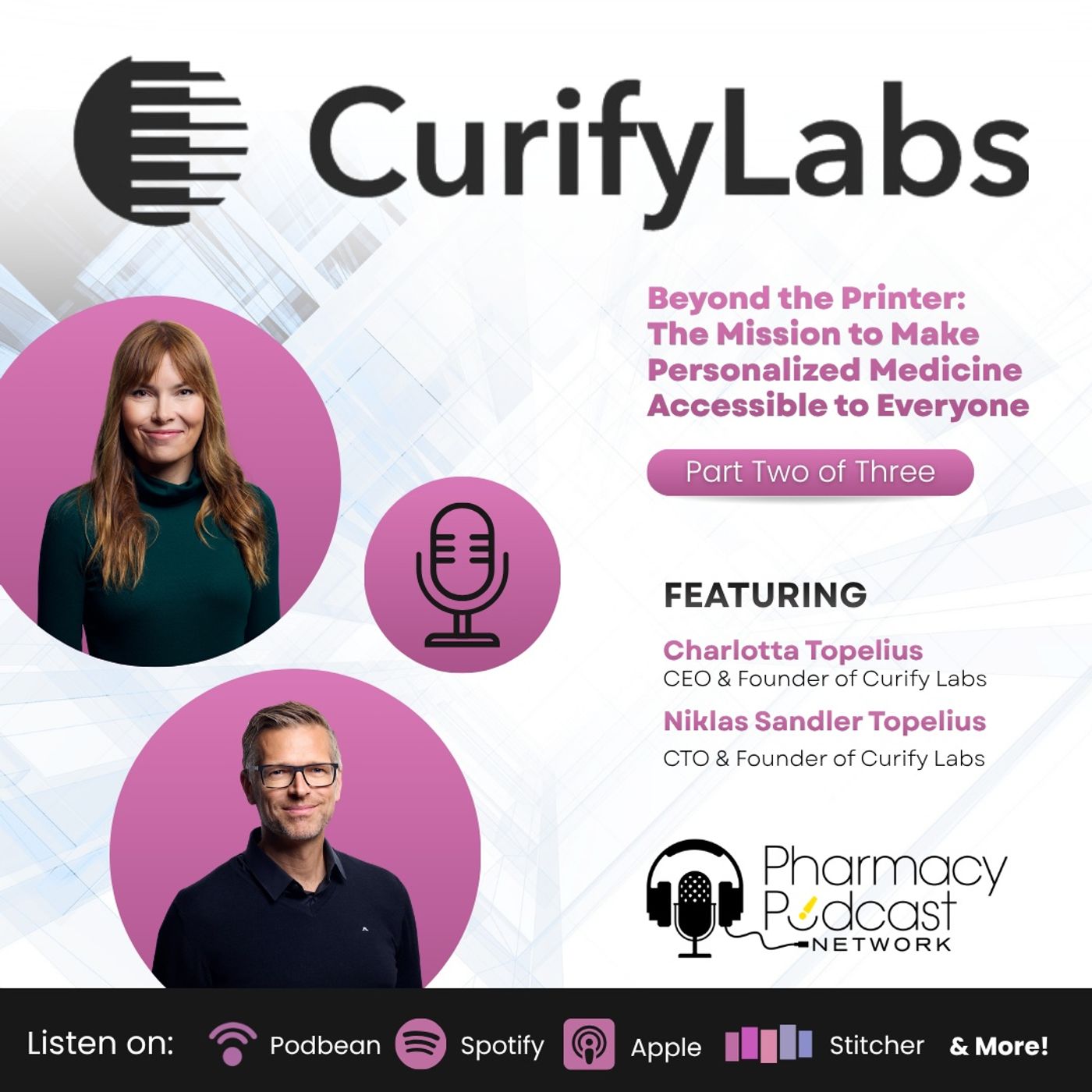
0:00 $ 5. 0:00 13 billion. 0:05 That's the market size of the United States compounding market as of 2023. We don't actually have updated statistics for anything else because there's so many different facets of what that means. 0:21 18,988. 0:21 That's how many independent community pharmacies are throughout the United States. 0:26 48% of you. are involved in compounding. 0:31 What's going on with the other 52% of missing out on an opportunity to really build your business with a specific medication management opportunity that's being demanded by the public and by the community? My name is Todd Ury, and 0:47 I'm bringing you a special three-part series brought to us by Curify Labs, which is a technology company that I am so impressed with. 0:56 I can't wait to dig into this more. 0:59 You're going to hear a three-part series, like I said, based on Curify Labs. 1:04 And today is the mission. We'll be right back. 1:13 You are listening to the Global Network of Podcasters dedicated to the pharmacy profession. 1:18 Welcome to the Pharmacy Podcast Network. Hey, welcome. 1:44 My name is Todd Urey with the Pharmacy Podcast Network. 1:46 I have two guests here today leading Curify Labs. If you haven't heard of Curify Labs, take a look. Go to curifylabs.com. I have been waiting for this interview, Charlotte and Nicholas. 2:01 Introduce yourself. Charlotte, you get to go first. 2:04 Thank you so much. It's a pleasure to be here. 2:07 We're really excited and greetings from Florida, where it's sunny and nice. This is where we have our second home nowadays. 2:16 So yeah, I'm Charlotta CEO, co-founder, crazy repeat founder. This is the third company that I've founded, but this is definitely the love of my life. So truly amazing story we have going on with Niklas. We started in Europe, did amazing there and in 2025, launched here in the 2:36 US as well. And it's been just a dream come true. 2:39 I have built companies before I said, and they have been focusing on things that people don't really need. You know, things that are not really, really relevant, but nice to have things. And this is why it feels so important and rewarding to work with Curify Labs and our team 3:01 and our customers and building something that makes a difference. 3:05 And even better to build it together with my husband. 3:10 Yes. Great to be here on the show, Todd. I'm Niklas. 3:16 I'm actually a pharmacist, but I'm kind of the tech guy in the company. So I have worked in the industry for soon 25 years, 10 years of that as a professor in pharmaceutics, actually. So during that time, we looked into... How can 3D printing be used in personalized medicine? 3:39 And how can we kind of evolve compounding and small scale manufacturing in a different way? And that was a 10 year period. And 2021, we put our heads together, right? 3:57 And yeah, here we are. 3:59 I guess six years later, we're really, really seeing traction on the market, both in Europe and and the U.S., so it's a pleasure to speak about this. 4:10 I'm excited to get you on. 4:11 We've been talking with several members of your team now for about six months. When I learned about Curify Labs, I knew there was a need. We have a special relationship with the Alliance of Pharmacy Compounding. They're members of 4:26 the Pharmacy Podcast Network, and they bring us a lot of data about the opportunities before pharmacies that are out there. 4:33 I also think it's very special that you're building this together as a husband-wife team. There are so many pharmacy owners throughout the country that their pharmacies are everything to them. 4:46 That means their communities are being served by them. They're a husband and wife team. They have kids that are third, fourth generation pharmacists or technicians. So this home delivery idea and mission that you're on really parallels nicely with our 5:05 independent community pharmacies throughout the country. So I want to talk to you right out of the gate about the origin story and the inspiration. What did you see happening in traditional compounding that inspired Curify Labs? 5:20 Maybe I can start actually, because things go back quite a bit because my mother actually was a compounding pharmacist. 5:27 So I grew up seeing that. 5:30 She mainly worked in the hospital, but I saw, you know, what it was already back in the 70s when I was born. So I think, I guess, I got some kind of a spark from there and, you know, then became a pharmacist myself. 5:47 So maybe that sort of, that strange... thing. 5:52 That nothing has happened in compounding in I don't know if it's if it's hundreds of years or thousands of years it's pretty much the same tradition that's been there for a long time and because being like a little bit of a tech nerd myself and I worked a 6:09 lot with industrial pharmaceutical processes during my career and I thought that you know something needs to be done to support these pharmacies and pharmacists to kind of elevate the level of technology that's out there and can be developed for the purpose. 6:31 And pharmacists are also so talented, hardworking people and in a way a bit hidden if you compare to many other players or stakeholders in the healthcare system. We really want to empower pharmacists to work at the top of their license, if you will. 6:48 So really do what they have been trained to do. 6:51 And if you think about compounding, it's a very manual process, operator dependent and a lot of manual repetitive tasks. So allowing pharmacists to have fun at work and do the fun part of being a pharmacist is also what's really driving us forward. 7:08 Charlotte, it's special that you're a serial entrepreneur, that you've done this several other times where you're building things. But that was very special, what you said about building something that is needed versus something that might not be needed. 7:22 And this impacts millions of people who are needing specialized services, who need a compound that is very specific to their needs with oversight from their physician and pharmacists. 7:35 So what were some of those earlier. 7:37 Challenges in turning an idea into technology that pharmacies could actually use? 7:45 Well, we started working directly with customers because it's one thing to validate something in a lab or in the academic setting, but to really get it right, you need to be out there on the field with several pharmacies 7:58 in several countries with different regulations and build it right from the beginning. so many things we thought were a specific way turned out to be different when we actually went out and tested. 8:12 And we did it and still do very fast. 8:16 So we wanted to fail fast, build something, get it out there, get the feedback and then test and do it again. And that's been just so powerful and sometimes really also like embarrassing or also putting you down like, oh, How did we think this would actually work? Whereas now 8:34 looking back, of course, this is how it should be. 8:37 And the technology never stands still. Innovation always goes forward. 8:44 So what we have today will be something different again in a few months and in a year or two. 8:49 So I know Niklas and our R & D team, they are never sleeping. They are just always looking for the next cool thing to innovate around innovation. And that's just fantastic to be able to do it with customers who also actually are our investors. So we have many 9:08 compounding pharmacies who have invested in Curify Labs and who want to build this as, you know, something from pharmacists to pharmacists. 9:16 Nicholas, Curify Labs talks about making personalized medications available for everyone. 9:23 What does that actually mean to you? 9:26 Yeah, maybe it's like Why we want to say that is obviously, as we all know, the standard drugs are not suitable for everyone, and that's why compounding pharmacies exist. 9:39 But there's also even more room. 9:41 I don't think compounding pharmacies are able to serve even all that need that's out there, because there's, for instance, just to give an example, the accuracy of a dose needs to be even more customized in an optimal setting. 10:03 So we want to broaden that sort of personalization topic a little bit. And we've started to talk about ultra-personalized medicine, actually, because we want to, you know, there's the precision and the accuracy. And then on top of that, there's the inclusion. improved, 10:18 increased quality of these medicines. So I think it's sort of, we want to broaden that sort of personalization aspect of it. 10:29 So when I think of the expansion, I gave some statistics at the very opening of this episode, there is a significant growth opportunity for independent community pharmacies to get into non-sterile compounding. And there are what, 52% out there 10:45 that are not in it yet out of those 18,000 plus that are out there. What do you say to them right now, Charlotta, when they're listening to this podcast or they're on the fence of doing something? Should I really help them and encourage them to really look into 11:01 the difference that Curify Labs makes? 11:05 That's a great point, actually. 11:08 And we hear that many pharmacies get into compounding because that's the absolute best way to survive nowadays. 11:16 It's not easy to be a. 11:17 Pharmacist or own a pharmacy. And obviously it's about knowing your numbers. And it might be that it's not so easy when you're a pharmacist to have time to really look into the business and the P & L and the details there. So what we want to do is 11:35 help our customers be more efficient in be even nine times faster, be more productive and use that saved time to. 11:46 Get more prescriptions. 11:48 So go out there, speak with prescribers, let them know the amazing things that you are capable of doing, all the innovative dosage forms that they can cater for with our technology. And when you start with something as our technology, 12:03 it also is much easier than going from the ancient way of actually doing everything by hand. So this is a great way to kind of get it right and get it automated from the beginning, instead of having to first build something and then, you know, take out the 12:19 manual steps. So we have many customers who didn't do compounding before, who wanted to start and saw a great opportunity in this. And we obviously also help them with with the marketing and the prescriber collaborations, which is so 12:34 crucial for surviving for compounding pharmacies today. 12:37 Yeah, I guess those are the main points and what we typically say, and that's kind of what it is. 12:46 We've standardized the way compounded medications are done, and that's what it makes so easy. So if you use our technology or the platform, you... the pharmacy in Georgia will make it exactly the same way as a pharmacy in Nevada or in Germany, you know, hospital pharmacy. So it's 13:10 the same recipe and same way of doing things because things are automated. 13:15 So that's kind of makes life easier. 13:20 It makes the training easy because, you know, it's also, you know, across the board, it's going to be the same. 13:29 And the staff shortage seems to be a big problem all over the world with talented pharmacists. So we see that this is a great way to increase the throughput, keep your current team size, make them even happier, pay them even a bit more because you have the money 13:48 because you're growing your business with this technology and future-proof your compounding. make sure that whatever happens in the regulations, you're ready. And we started from Europe, I said. And one big thing we had to work with in the 14:06 beginning was to get the German regulators on board. And wow, that was hard work. You know, Germany, they are really, they know their rules and regulations. And we had to build our technology to be compliant with everything that's out there. 14:23 And now this also means that we have a, absolute highest standard of technology on the market. So whoever implements it today here in US can also trust that what we have built will stay accurate, will be top-notch even in the future. So for instance, we have implemented ISO 14:43 13485 quality management system. So even though this isn't a medical device, we already have that in place. We have SOC 2 for the software parts. So all the really high demands that hospitals are requiring from a vendor is in place with our technology. 15:00 We're really proud of that. 15:01 And for listeners, just understand this is a system. This isn't just a printer of some kind. It's a well-thought-out, precise technology and system that's ready to deliver these non-sterile compounds to our independent community pharmacies. which includes validated compounding 15:22 instructions and formulation data, the mixing, the automated dispensing, the weight monitoring, the digital batch documentation. I want you to explain to the listeners how this became more of an ecosystem rather than just a standalone device. 15:41 Yeah, that's a very good point. 15:42 I guess we did start off with the 3D printing part because that was kind of new and unique and we needed. 15:48 To get that right. 15:49 But as Charlotta was telling earlier, we worked with customers from day one and we had a lot of pilots and we got gathered feedback and it was evident from the start that it's not enough. 16:01 You need to cover the entire workflow. And that's why we. 16:08 Built a platform on or an ecosystem around it. So, so all of these elements that you just mentioned are in there and they are evolving as we speak. So there will, there are new features in the software. There are new formulations coming every day. There is, uh, we, 16:24 we support many types of molds and holders so that pharmacies can do different types of dosage forms and those are evolving all the time. 16:33 So it's a, it's a kind of innovation that just. 16:37 Uh, lives and grows but yeah we needed that I mean because otherwise you don't serve you don't serve you know a compounding pharmacy with only a printer. 16:51 Yeah you don't solve the problem so 3D printing alone as we say it doesn't solve the problem and now we see some players coming with a nice and shiny 3D printer and like oh this is a great technology just buy this 3D printer when We know that actually 17:05 just that one device will not solve the problem. It will create a huge headache for someone who is not having time to call support every day somewhere in Spain or something like that. So yeah, it is a complete ecosystem and you need all the parts to discuss together 17:23 because when they do, that's the only way you can actually control the quality when you handle the whole process from beginning to end. And this is, we are the only one who can actually do that. and really proud of it. And that's why also we have many regulators 17:38 in different countries who are only supporting our technology. 17:43 Let's talk about the validation. 17:45 I've talked to several of your clients throughout different pharmacy conferences that I've gone to. We had one on an opening episode that really described the accuracy of each of the compounds being the same even after extensive measurement. So 18:05 how do validated formulations and standardized processes help to remove some of the variability in the guesswork, which is historically associated with compounding? 18:17 Yeah, great question. 18:18 So that's kind of the core of everything, right? Because you really take away that, yeah, you take away the variability, right? 18:27 Because we have proven in our lab with extensive studies that when you perform or make a formulation in a certain way have a let's say a five minute mixing time you we have validated the printing parameters they are fixed and then you get that stability data supporting that 18:53 validated process so so it's it's that process that has been validated that the pharmacy can just take. And it's, you know, it's a plug and play approach, right? So you don't need to put a lot of effort into how will I make this compound because it's in the 19:13 library already, right? 19:15 We have a huge lab in Helsinki. We just expanded it and several pharmacists, PhDs, obviously, and they are doing all the hard work together with our hardware and our software team. And this is also part of our magic sauce is that we have a pharma hardware and software 19:32 team that do this together because the solution is a vision of these three technologies and of course, quality in the center of everything. 19:41 So when we think about personalized medicine, where this is heading, we know that peptides are expanding. We know that, um, hormone replacement therapy is expanding it's it's in more demand now than ever before there's lots of opportunity to reach 19:59 out to a community and let them know that now a pharmacy has this kind of technology to be available So how do you decide which dosage forms and formulations or capabilities Curify Labs develops next? 20:15 Want to start or should I? 20:17 I'm guessing we're going to say the same thing. Ask our customers and listen to them. And that's what we do. 20:24 So obviously people who have our technology will be peptide ready as ready as you can be, obviously. 20:32 So this is something we're working hard on. 20:35 And yeah, we see a lot of HRT being done with our technology, ED, pain management, obesity, the big things that are here in US. 20:47 But the bottom line is like you said, we get customer feedback. 20:54 What do they want? Where are the gaps? We take that in. 20:58 We prioritize and then we start working on the formulations. 21:02 Then we launch them into the library and they, they will be available for everyone using the ecosystem. 21:09 So that's kind of our approach. 21:11 And then I just want to mention that if there's something, if not, something is not in our library, the customers are able to do them themselves as well. So they can create formulations. We have, it's called Curify Labs, create 21:26 software functionality so they can, really in simple steps also create something that isn't in there. 21:36 So that's one addition. Exactly. 21:38 And this is something that took us. 21:39 First, we didn't want to launch it because we thought that there's a risk if people start doing their own cooking in the kitchen. But we realized quite fast that, hey, actually, this is something that compounding pharmacies are used to do. 21:53 They want to. 21:53 Feel that they are free and they can take whatever formulation or whatever API and just get creative. So we had to support it and they don't want to wait for us to, you know, do something in Europe. They want to do it right now, like directly fix it 22:08 in the system. And this is what we have made possible. 22:10 And we can really see that that's so valuable to our customers today and what they also use a lot. 22:17 So allowing them to be creative, but in a very quality or in a quality controlled way. 22:24 Mm-hmm. 22:27 You're working very closely with pharmacists in your research and development and ongoing. Talk to me about that. That's a different kind of approach. Rather than just building something and being a wonderful technology platform, you're taking a time out 22:41 and deciding to make steps based on the pharmacist's feedback. 22:46 So talk to us about that. 22:49 Yeah, I guess we mentioned a little bit, but I mean, that's in the core of how we do. And that's why we've also invested a lot in our customer success people who actually go on site when we install. They're going to spend three days on site to really make 23:03 sure that people know how to use the technology and that we cater the needs first, the initial needs that they have. We make sure that they can make those formulas that they want to start off with, but then 23:16 also collect that information. you know, information that, oh, what's missing? 23:22 What do you want to do next? How can we support? 23:24 So I think that's kind of the approach. 23:27 And we have so many friends already because we have also personally, me and Niklas, been traveling around customer sites, spending time to really understand how pharmacists think And it's been really valuable. And I think it's also that they 23:46 want to have this network of getting to know other people. 23:51 From around the world, actually. 23:52 So we arrange a conference in Helsinki every summer, Curify Labs Midsummer Summit. And we invite our customers there to discuss, to learn, to share knowledge. And it's just beautiful to see how they stay connected. You know, we have Jana from Tartu University. 24:10 She was flying over to St. 24:11 Jude. 24:13 Um, here in us to, to visit them and, you know, so friendships are being born and it feels maybe also less lonely to be a compounding pharmacist when you have, uh, have new friends that you can call and, and, um, yeah, get support from. So we're trying to also enable that. 24:29 Yeah. 24:31 Networking. 24:33 Charles, you mentioned at the beginning of our conversation about constantly looking out for what might be coming next. And we see the trends that are happening in non-sterile compounding. 24:46 Are there. 24:48 Other APIs, other connections, other expansion using artificial intelligence? What's coming from the Curify Labs team that you can share without giving away super secrets? 25:02 Oh, I wish I could tell you everything because we have such cool things. 25:06 Coming out. 25:07 And we actually had our R & D team here in US, six people traveling around a few weeks back. 25:14 And out of that trip came an amazing idea that we will launch at some point. 25:21 And I can't tell you more about it, but it's... 25:26 Don't say A if you don't say B. 25:28 Well, no, definitely. 25:29 So the peptide thing is something we're working highly with. 25:34 and the whole concept that Niklas mentioned around ultra-personalized medicine. 25:40 So if you think about the really big, big boys in this industry that do millions per day, one can argue that that really isn't personalized, because if you do millions per day, it maybe isn't so personalized. 25:55 And why is that? 25:56 Well, it's of course because it hasn't been possible to really do ultra-personalized medicines, but um, with our technology, it actually is possible. And this is what we think will grow. 26:06 And this combined with all the data about how people are different on the market, how people also are interested in understanding themselves and what they need to, to feel better. 26:18 I think that's going to really grow and, and, um, compounding isn't going anywhere. 26:23 It's needed. 26:24 So, so we just want to make it easier and better and safer so that everyone who is in need of, uh, this type of therapy gets the same quality as a. 26:37 Registered drug. 26:38 Yeah I think really that sort of that combining I mean looking into the future combining that pharmacogenomics diagnostics information and then the accurate like the accurate dosing the ultra personalization and then being able to provide that to private compounders, that's, 27:00 you know, it's going to, you know, we want to make sure that they. 27:03 Are on top of the game, right? 27:05 And then really have that technology to support the trends that are coming. 27:10 So it's exciting. 27:11 It really is. The market is going to expand to $ 7. 2 billion by 2030, and that's compounding. And that just what you said, Charlotte, this is going nowhere but up. This is expanding and clients are going to learn more and more. 27:29 Patients are going to learn more about what this means for them and their health. And customization is going to become key. And when you have pharmacists who nerd out and really start getting into this whole system, they're going 27:42 to be able to build an ecosystem around their community and informing them. And I like what you said, Nicholas, about the pharmacogenomics and being able to test a patient being able to, to consult with a physician, um, give, uh, demystify that data and then put them on to a 27:59 compounding medication that can help them live better and feel better and extend the extension of life, the extension of vitality. 28:08 I mean, that's, that's what is in demand today. It's not just, this isn't about, you know, Hey, I have the flu or I need an antibiotic or, um, you know, my, my physician put me on a statin or something and this is much more positive. This is much more about 28:24 just living better and being able to do more in life, through life with this technology platform. That's what makes me excited about this. 28:34 Exactly. Well said. 28:38 All right. 28:38 Well, in closing, I just want to ask one question. 28:42 This will be for Charlotte. If someone remembers only one thing about Curify Labs after this conversation, what would you want it to be? 28:49 Well, it would be and given that we're speaking with compounding pharmacies here, that Curify Labs can enable them to be even up to nine times faster, giving their team the possibility to be much more effective and productive with 29:06 better quality, allowing innovative dosage forms and treatments for patients who need it. So we'd be happy to discuss and see how we can help these pharmacies to grow. I love it. 29:22 Well, we have more Curify Labs coming to the Pharmacy Podcast Network. Listeners, please take a look. Go to CurifyLabs.com. 29:32 It's going to be in the show notes. I want you to reach out to one of the team members, ask for a demo, have them sit down, do a personalized demo. And the sales team, the marketing team are just as personalized in their services that they're delivering to 29:47 the compounding pharmacies and the independent community pharmacies who might not be into compounding yet. 29:53 I've seen it firsthand. 29:55 I've heard the testimonies from the pharmacy owners that are out there. You guys take extreme pride in your customer base and in your client base, and you're treating them the way that our pharmacies are treating their patients. 30:10 So I'm very impressed with you guys. 30:12 Thank you, Todd. 30:13 Yeah. 30:13 Thank you. 30:14 You were listening to the Pharmacy Podcast Network special series brought to us by Curify Labs. making all the difference in the future of independent community pharmacy and non-sterile compounding. 30:24 Once again, go take a look, CurifyLabs.com.







Community discussion