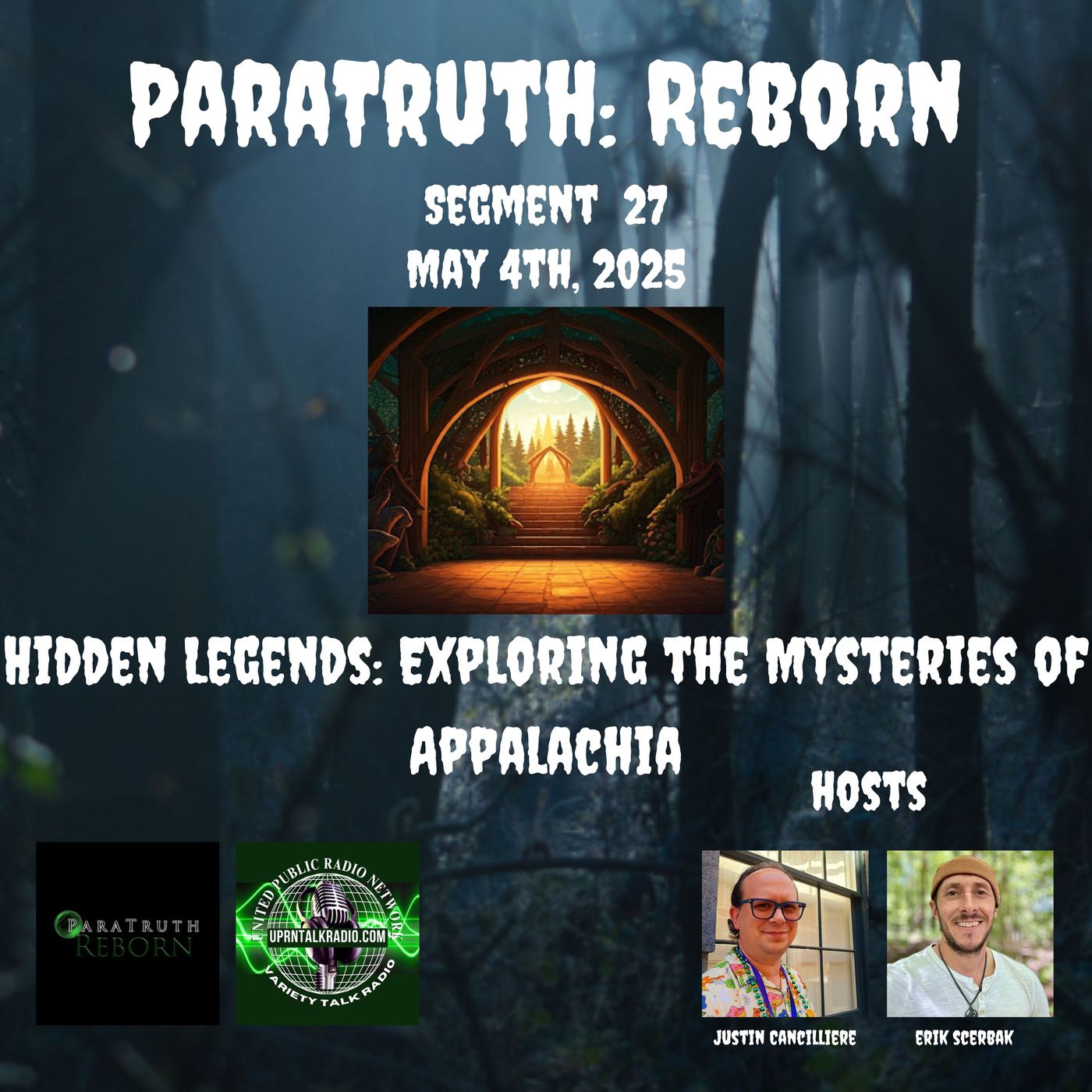
0:03 Welcome. Well, well do Para Truth Truth, what's up? And welcome to a new episode of Paratruth Radio. I'm sorry Paratruth. 0:35 You boring. Wow, that hasn't happened in a while, so we look I did. This is his a pre recorded show on when I was seven point seven FM, New Orleans, and you're not in public Radio network. 0:48 My name is Eric and I'm justin And I was mistaken last week when I said we were going to have a guest this week. It's actually next week where we're gonna be having Rich step on and we'll get into that at the end of the show. But I 1:03 wanted to correct that now, so nobody's expecting a guest. 1:07 And now we just lost a bunch of listeners. Oh no, 1:12 So today we're going to talk about one of the probably the most infamous areas in the United States, and that is the Appalachian Mountains, which is home to a rich tapestry of folklore passed down through generations and generations. 1:29 This particular episode delves into the myths and legends and stories that have shaped the region's identity and continue to captivate the imagination of thousands of people around the world. Now, the Appalation Mountains is actually the oldest mountain range in 1:47 the US. In fact, some believe, according to archaeology anyway, that the Appalation Mountains are actually as big, if not even bigger than the Rocky Mountains. That one point, but over the course of thousands and thousands of years, the 2:05 Appalachian Mountains have crumbled and slowly degraded and became smaller. 2:12 If you've ever went, like driven through the Appalation Mountains, you probably used to the very smoky aspect to much of the northern part of it north to like mid uh. 2:25 I guess I would say mid United States to the north, because like the southern portion of the of the of the appellation isn't all that smoky. But when you're driving through the Appalation Mountains, there tends to be a lot of humidity between them, and a lot of thunderstorms tend 2:42 to prop up pretty regularly, so it tends to create this fog that kind of sits between the mountains within the valleys, and it just creates this kind of spooky atmosphere, especially when you start to consider all of the various 2:57 stories that have evolved from the Appellations now. The Appalachian region boasts a unique cultural identity shaped by its history, its geography, and the blending of Native American, European and African American traditions. And its identity is characterized by strong 3:20 family ties, a connection to the land, and a diverse array of cultural expressions, including traditional music, crafts, food ways, and even folklore itself. In fact, Appalachia is one of those places that is so unique in its identification that 3:42 there are a number of groups on Facebook and just throughout social media dedicated to the Apple Let me also say Appalachia as some will say, I'm from the Northeast, so it's Appalachia. But there are a number of groups dedicated to this region and the various stories that exist 4:05 within them, primarily the stories of like ghosts and cryptids in particular, not to mention the number of urban legends that tend to exist as well. 4:16 And it's amazing how urban legends kind of melds into the cryptid as well, because I mean, if you think about it, that the mothman legend could be an urban legend, like where we're from, Ohio, the melon heads of Ohio is an urban legend, but they could also be viewed 4:40 as cryptives as well. 4:42 Well, one hundred percent. So one thing regarding Appolition history is the oral traditions, which are very crucial to understanding its history and its culture. Now they serve as the primary means of transmitting knowledge, beliefs, and values across generations, 5:04 shaping the region's identity and worldview. Again, a lot of people know about the Appalachian Mountain Range from all over the world, and people flock to it on the regular to just enjoy the atmosphere of what is the mountain Range, 5:20 but also for those spooky, spooky stories that exist within them as well throughout history. Now, this includes the stated earlier some storytelling, music, and folklore which preserved the history, shared experience experiences, and reflected the unique character of an 5:43 Appalachian life. Now, storytelling is one of the primary ways or examples in which the Appalachian Mountains have really grown in their identity overall amongst so many people. In fact, you can ask any individual who lives anywhere near them, 6:01 whether they're in West Virginia, Virginia, North Carolina, southern Ohio, you name it. Anyone you encounter in those areas who live in those states, they probably have some sort of story, either a first hand witness account or the secondhand witness 6:17 account of something spooky happening, or just a story that was passed down from more generation to the next. And there are a number of different bookstores also throughout the Mountain Range that you can go and actually pick up 6:31 basically folklore stories based on the Mountain Range, especially within the area soles Virginia or if you're in Virginia, you know these places actually have books dedicated to those states about all the folklore within the mountains. 6:46 And if I remember right, we had somebody on who we had met at Scarefest that had a collection of those stories, and of course I didn't have the book ready to share that. But on the regional show of the show Para Truth Radio, there is an episode where 7:03 we talked to somebody about the different legends that he had jotted down in his book. 7:14 Now, when it comes to storytelling, and especially appleach and storytelling, it includes a lot of ballads and folk tales conveyed, often conveyed tales of love, of hardship, triumph and capturing the echoes of time and mind you again, this particular 7:33 range is a treasure trove of history within itself. It was a mountain range that helped or that was there really with the establishment of the United States. It was very, very unique and important to the natives early on before 7:49 American history. There is just again a lot of history that reinforces the actual folklore that exists for this particular area of the States. And music is another thing that we've talked a little bit about, and with the Appalachian 8:09 music in particular, we're talking about folk music with its storytelling elements and unique instruments. It reflects the region's history and cultural influences. And then of course there's the folklore 8:20 itself with its supernatural beings, moral lessons, and trickster like characters, which gain reinforces the cultural values and offers insight into the collective experiences of the Apalachian peoples. So when it comes to folklore and the appellation history, it's very crucial. 8:45 The folklor itself is very crucial in preserving the Appalachian ancestral knowledge and values by transmitting cultural traditions, stories and customs through oral traditions and shared experiences, and it serves as a way to communities, I'm sorry, it serves as 9:02 a way for communities to pass down beliefs, morals, and a sense of identity, reinforcing a connection to the past and shaping the present. And again, if you ever go on to any of these Appalachian groups, you will find a granding number of people who are so dedicated to 9:18 the mythology that exists within the Appalachian Mountains and the number of people that come together to talk about these things. 9:24 It is very unique element within the United States in particular. 9:30 Yeah, I mean, growing up, I think both of us always was either hearing stories or I mean we've used to tell stories back in the day. And you know, telling stories around the campfire originated well before people came here from the East, but I think in the Appalachia 9:58 region that kind of reinforced, says those fire campfire stories, because it was the way that they would tell this this history and this folklore to everybody else. 10:11 Right well, and not to mention like, you know, you you have to consider why the folklore exists in the first place. And you know, in most cases, or in some cases, I should say, there is as we've said on the show, I'm sure plenty of times there tends 10:27 to be a hint of truth at least in every folklore, uh folkloric story. But there aren't in some cases folklore legends, et cetera, that are simply just made up, uh a manager to imaginative or they took on kind of a life there of themselves. Where you know, it begins as 10:50 one idea, one story, then kind of like this game of telephone, the story is added better, is more and more added to the story, more elements, more things that make it scarier. Uh. One thing about the mountain range here is a lot of it isn't explored. It's you know, 11:06 it's much like any mountain range for that matter. It's just it's very densely forested. There are creatures, noises, things like that that you don't always encounter in the cities or the surrounding areas of the mountains even and so 11:22 there are things that are very unique to this mountain range, and it naturally inspires a kind of mythology and a horror esque belief system behind them. And I've spent so many years driving through the Appelachia Mountains. I lived in 11:36 Virginia for three years. I lived in Georgia for two and a half years. I lived at you know, I grew up in Cleveland, so my family was here, So I was constantly driving back and forth from Virginia to Ohio, to Georgia, back to Ohio and again, like I was, 11:50 I was living in the valley of the Blue Ridge Mountains when I was in Virginia, so I was able to soak up all kinds of stories regarding rubberries, incidents or belief systems around that area. But yeah, you know, again, this is like, I feel like these stories are some 12:07 of the unique ones. Not to I don't want to mind that there are so many various stories throughout the country, throughout the world, but there is something vastly unique to the Appalachian Mountains that I think draws people. And I 12:21 think that in and of itself is kind of mysterious to me. 12:27 Well, and I mean you have to look at you know, Like you mentioned earlier, the rich blend of Native American, Celtic, European African American folklore that influenced all of that area. 12:42 Shaped by the unique environment and history of the region. 12:47 Native American traditions, particularly those of the Cherokee and the Shawnee, contributed to the Appalachian folklore through mythology, plant lore and spiritual beliefs. Celtic influences largely from Scotch Irish immigrants, and 13:06 that even comes out this way to North Dakota too, because there were a lot of Irish that were working on the railroads back then, so they migrated this way as well. 13:17 But the. 13:19 Folklore tradition isn't as dense here because it's not as populated here as it is closer to the East coast. 13:28 So I mean, you've got the Native American and the scotch Irish and the Germans here, but German folklore it's a little bit different. They kept kind of secretive, kind of like na American folklore, it's kind of secretive, kept to the chess type of deal. But the Scotch Irish 13:46 brought storytelling, ballads and musical traditions. European folk tales and superstitions, particularly those from England and Germany, also played a significant role in shaping Appalachian folklore or. 14:02 Something. 14:02 When I was doing this research for this and got our show notes ready, I picked out some of the best ones. I shouldn't even say the best ones, the most popular ones, but there's so many. But Eric, you can tell me if you've heard or not heard of these. 14:26 I think for the most part, we've both heard of these. 14:30 I've heard of them. I mean obviously I've already looked at the notes. So yeah, well, plenty well aware all of them. 14:38 Well, the only one that I was kind of unfamiliar with was the wampst cat. 14:42 So, okay, that's not what I would have guessed. I guess you were going to say, like the mountain lights. 14:47 Yeah, I was kind of familiar with those. So, but the big Foot in Sasquatch. I kept this one really brief because we've talked about the big in Sasquatch till I think both me and Eric are blue in the face and still don't have one hundred percent belief on 15:08 which side of the fence and on as far as if the Bigfoot is real or if it's a spiritual creature or what. But the Appalachian Mountains are a popular location Bigfoot sightings, with tales of this a play creature inhabiting the deep woods. You know, pretty much any forested 15:24 area is kind of where the Sasquatch or Bigfoot's stomping ground is. There will be those that say that Sasquatch and Bigfoot are actually two separate species of the same family. 15:38 Well, I actually you probably remember this, this story, but I actually thought I had encountered a bigfoot one time driving through West virgin I think it was west of virgin either Northern Virginia or southern West Virginia, while driving on the freeway. 15:52 I think you brought this up on Tim Saddano's fair site. 15:58 So you know, I was driving the freeway and it was like me, I guess like late afternoon, early evening, right, and at this point I think I was it was probably right around thirty one, maybe maybe a little under that, but my eyesight was already starting to go. So my 16:16 eyesight isn't the best anymore, but they like so I saw something at the corner of my eye I was as I was driving. It was a good distance in front of me, off to the side, on the brim of the road, and like my heart started racing because like in my mind it all clicked. I knew what 16:32 this thing was, uh, And I was darned for certain that this was a big foot. But of course, as I drove closer was able to focus. You know, my eyesight actually was like, oh hey, I think this is getting closer, we can now see what it is. It 16:46 ended up just being like a little pine tree, you know, a good several foot tall of pine tree. But the way that the shadows played tricks on you in there, like in that area, it's kind of crazy because you and I'm not saying that necessarily it's the shadows of 17:01 itself doing it. It might have just been my mind trying to make sense of what I was seeing. And of course, since I'm always so versed in our podcast, like my mind is always going to this paragormal aspect of stuff, right that what is this? What could this be? 17:16 I mean same here with as many quote unquote UFOs that I can see. 17:21 Right, But like you know, with that said, though, like whether the sun is up it means sky, you know, it's rising or setting whatever. 17:30 The mountains kind of play tricks on light refraction, especially when it's stormy weather there's a clouds or fog, so sometimes it'll you know, create a shadow and distort an image just slightly to make it look as if in 17:44 this case, it was like a bipedal creature walking. But again, as I've gotten close to it, I noticed it was just a tree, but it was for me, it was a step closer to a realization of a creature that may actually exist. But again, like as I said earlier 18:00 to this day, I can't I can't pinpoint whether or not I believe in the Bigfoot specifically. 18:05 Right, Yeah. Well, and there's so many different theories out there now, Yeah, it's hard to believe any of them. 18:15 Or is it a mixture of all of it? Yeah, it's weird. And that's part of the reason I think we got kind of burnt out with parature radio is everybody wants to throw these different theories out there, but nobody can pinpoint what the actual one is. All right. 18:32 So the wan. 18:33 Pescat this is a cryptid from uh Or that is described as a large cat like creature with a variety of physical characteristic characteristics, including those of a mountain lion or a cougar, so essentially a big black cat. Its 18:51 existence is largely linked to the Cherokee in Appalachian regions, with some believing it to be a guardians hear it or the embodiment of a cursed woman because there are tales of it walking on its hime legs. 19:09 Well, and there has been some belief over the years that this swampus cat was something of an exotic creature in this case, you know, like a black panther who was brought over to a certain area in the States early on and it somehow got out and survived for 19:25 a long time, or some sort of black cougar which is relatively rare, or black mountain lyon for that matter. 19:35 There are a lot of various ideas or beliefs behind what the wampus cat is, and I think the majority of people do believe it to be an actual animal, whether or not it's like a mistaken identity or just people don't know what it is. Maybe it's a creature 19:48 that we have not yet discovered officially because we've not been able to capture good photo or video evidence of it. 19:55 Although I will tell you if you look at the Wampus cat photos and videos, you will find good number of both trailcam photos, digital photos or phone photos from people. 20:04 And also there is a couple of interesting videos out as well on the wampuscat which is really intriguing and definitely does just look like a giant panther like creature, 20:16 and my like creature, I mean just looks like a black panther. 20:20 But yeah, so, well, look at how many cryptids there are that are basically creatures that we did know existed but were known to be extinct. 20:34 Well, yeah, has me an tiger right, one hundred percent? 20:37 And even to this day, you know, we we we just learned recently that there's yet another creature that was identified that was believed to be extinct and no longer is. 20:50 You know, the region that the region of the Appalachian Mountains is very dense with forest. There's a lot of springs, a lot of rivers that run through most cities and whatnot are pretty distant from each other, you know, so there's there's not a lot of space for us. Let 21:11 rephrase that, there is a whole lot of space for us to cover as human beings, whether by air or by foot or vehicle. By vehicle, you're only going through a certain portion of these mountains. By air, you're again kind of restricted to airspace that is legal airspace. And 21:29 by foot you can only go so far with the right parameters and the right you know, food sources and things like that enough to sustain you for a certain amount of time. But the simple fact is many of these creatures, like the bigfoot, and in this case, the 21:44 wampus cat. If the wampus cat is indeed just like a panther, sugar mountain lion, something like that, it's likely not going to sit around when it hears people coming towards it. It's instinct is going to be turned around and you know, run the way basically a hide. And 22:01 especially if there's only one or just a few of them, they're less likely to approach civilized areas. So again, trying to find these creatures is very difficult, and so a lot of it is just based on a little bit of luck, and that's it. So you know, again, the 22:17 videos in the photos that we do have online, though they're not always very clear, I think at least in terms of the wampus cat, we do decent evidence to support that it is indeed a cat of some sort. 22:34 Specifically what type of cat it is, that's just up in the air, right, all right. 22:43 The next one on my list is the Brown Mountain lights. 22:47 I'm a serious phenomenon often described as bright moving lights seen from various vantage points on and around Brown Mountain in North Carolina. These lights are a popular topic of discos and have been linked to various explanations including Cherokee legends, 23:04 ghost stories, and even UFO sightings, which if you guys don't know the Phoenix lights. This type of phenomenon is throughout the world, not just the Appalachia area. It's just these specific lights are specific to the Appalachian region. The 23:26 next one is the Bell Witch, which is a famous folk legend centered on a haunting that allegedly occurred in northwest Robertson County, Tennessee between eighteen seventeen and eighteen twenty one. 23:40 The story involves the Bell family, farmers along the Red River and a mysterious invisible spirit that terrorized them for several years. The spirit, known as the Bell Witch, was said to have the ability to speak, shape shift, and be in multiple locations at once. 24:00 This is another one that's like very high up on the mysterious factor and one that a lot of paranormal enthusiasts investigators are often interested in checking into. There are a couple of shows out on Travel Channel that have 24:16 shown investigations of the Bell Witch. Ghost Adventures is one of them. They did an episode on the Belwitch legend and they did an investigation in there and it was definitely pretty interesting, pretty creepy. But there is a ton of lore on the bell Witch, and it stems like, 24:32 I mean again, from eighteen seventeen to eighteen twenty one, and then you imagine all the years after that, how the story has changed and transformed over time. Again, It's like that telephone thing. So this is one of those things where it's hard to pinpoint what is truth and 24:47 what is fiction. But the bell Witch is nonetheless one of the scariest things within Appalatrian folklore, and one that many people do try those they are interested investigating. Many other will purposely try to remain from even talking much 25:04 about the Belwitch or looking into it, in fear of the entity somehow manifesting itself. 25:11 Correct me if I'm wrong, But was the blair Witch project based on the Belwitch? 25:17 I have no idea. 25:20 I know the Belwich story has been used in pop culture a lot, especially in movies. I want to say the blair Witch was based on that, but I can't remember all right. Last one for the cryptids or creatures is Mothman. Again, We've talked numerous times about the Mothman, 25:43 but if you guys don't know what the Mothman is it's the creature that was cited in Point Pleasant, West Virginia. 25:52 It's been cited numerous places. But it's a winged humanoid with glowing red red eyes, and a lot of times is a omen for bad things to happen. 26:04 Yeah, that one is. I will say. There is plenty of supporting evidence for the Mothman. This is something that not only was investigated by a number of enthusiasts and nowadays pro investigators, but also by the FBI and by 26:26 the police at the time. There are significantly interesting photo evidence of this creature. Whether or not it's true or they're fossifyed, I don't know, but I will tell you I had the opportunity. For those of you who haven't, and I'm sure somebody you listening have been here or 26:44 maybe even live in the region. But in Point Pleasant there is a little museum for the Mothman, and I'm sure a lot of you have seen the photos of the stand, the steel mothman, the statue, and. 27:03 I've seen the pictures of the way people putting the quarter in its butt crack. 27:07 Yeah, it's a weird thing. But you know, if you were to take a moment, like if you ever get an opportunity to go to Point Pleasant and visit the museum. 27:17 It is really cool. It's really interesting. It's it shares a lot of the original newspapers and articles that were published during the time of the Mothman sightings, as well as the individual cases that were opened up on the 27:31 Mothman and how the police department went about trying to investigate it, as well as like of course pop culture, pop culture references in which, you know, various movies or TV shows were inspired by the Mothman legend. And it is really really really kind of both cool, but also 27:50 on settling standing you know, either where the original bridge was or just to the outs, you know, just to the left right of the original bridges, thinking about what happened all those years ago and how many people lost their lives during this mysterious event in history. 28:11 Yeah, and this is one that I think I have always thought, is there's some truth to the moth Man, 28:25 I mean what it is. Yeah, you know, you can't really tell. And I mean there's people that even claim that extraterrestrial nature trying to warn us of bad things so that we can prevent them. 28:38 But people say that there was it was extraterrestrial in this case aliens. Someone see it was an angelic being that was there to try to warn people. Some say it was an alonic entity that was there to cause destruction. 28:51 There are so many different beliefs and ideas behind the moth Man and what it is or was, And of course there have been sightings after the original point pleasant incident, and there are occasionally still setting today. Supposedly, I've not 29:06 seen any significant evidence prove that today, but nonetheless there are plenty of stories that seem to suggest that it does happen to show up here and there. And we also see throughout the rest of the States and the 29:17 world that there have been incidents where this Mothman seemingly has shown up again prior to some pretty nasty disasters. 29:32 Now we've talked about these creatures and it is a part of Appalachian or Appalachian folklore, but their folklore permeates their daily life so much more, going into various traditions like food, music, there, storytelling like we mentioned, and even 29:52 community rituals. These traditions are deeply rooted in the region's natural environment and history, influencing everything from cultural I'm sorry, culinary practices to artistic expressions. I think the first and foremost the food and drink in that the Apple Latchin 30:13 region is like we've been talking about. The folklore and everything else in this region is so unique because it incorporates forged foods, homegrown produce, and even wild game. Corn beans and meat are staples with recipes passed down through generations. 30:35 I think as of late we as in me and my wife have been doing a lot of like Southern beans, especially the red beans and rice from New Orleans. I love that recipe. But you know, even core bread, biscuits, and gravy. Soul food basically is what comes up for 31:00 this and stews are common appalation dishes. Plant lore also influences food ways, with some plants traditionally used for medical purposes or considered good luck, much like in witchcraft music. 31:21 Their folklore or folk traditions permeates through their music, including old time music, bluegrass, and country. The banjo, fiddle, and guitar are key instruments often used to accompany traditional ballads and songs that tell stories of love, loss, and everyday life. 31:39 Appalation music also reflects the region's history and cultural influences. 31:43 With elements of Native American, African, and even European music traditions. 31:49 I will say this, I've never heard a song about the Mothman. 31:52 Or Bigfoot though now yet not yet. 32:00 You know, the story telling aspect, we've all already kind of covered all of that, but it all the folklore and all the past down traditions of oral storytelling is super important in the Appalachian area. And then community rituals, 32:23 which this one fascinated me because I'm not a huge I don't have a huge knowledge of that region for community rituals, but community gatherings and rituals are important parts of Appalachian culture, often centered around faith, family, and celebrations. 32:40 Church services, barn raisings, and festivals provide opportunities for people to come together, share stories, and celebrate their shared heritage. 32:50 These rituals help to strengthen community bonds and reinforce cultural values even to this day. 33:00 Well on top of that, another thing that is relatively popular in Appalachian culture and many cultures around the world for that matter, is the use of charms and amulets and spells, which are often used as apotropic bit the baka. 33:19 You know, I studied this word earlier today, because like I'm gonna, I know, I'm going to be the one to have to say this word for some reason, for some reason, I feel like I want to say this word. 33:26 You're tapping into the ether, buddy, dude. 33:28 Apotropaic practices, Yeah, say that three times fast, uh, basically meaning that they are intended to ward off evil and protect loved ones from harm. I'm sure many of our listeners probably have some sort of have been influenced in some way or another to kind of use ambulates or 33:49 charms or are very you know, if anything like us, we're listening to a paranorl podcast, you're likely superstitious to some extent. Many of our New Orleans listeners probably are vibe pretty well with this, i'd imagine. I know there 34:03 is quite a few here in Cleveland. Cleveland is a very superstitious. 34:06 City Ohio as a whole, I think. Because for sure, so you. 34:12 Know, wherever you're tuning in from, we would love to hear from you. What are some elements that that you tend to gravitate to you in terms of superstition, Like when it comes to production, especially, do you use terms, do you have an amulet? Do you have anything outside 34:31 your door, you know, here in Ohio there when I'm not working on film productions, I'm usually doing delivery services like grocery and whatnot. And I will tell you the amount of homes that have come across with a broom that is hanging above or on the side of a door, 34:45 or a home that has food dogs at the base of their stairs or protect it from negative energies and evil spirits is just wild to me. It's not something that I think a lot of people really consider. That's kind of a slaveh the hidden jam or aspect to 35:02 the Cleveland area that I think a lot of tourists don't know. And I've always kind of known that there has been a great superstition here in in this my particular city, and we even have I've shared this once upon a time, specific vampire bars that exist underground here 35:21 in Cleveland as well. So there is a lot of interesting, somewhat darker aspects to what is the quote unquote the land, not to mention the number of great hauntings and cemeteries that are supposedly haunted as well. Now, with that said, 35:38 these practices in the Appalachian culture are often you rooted in a unique blend of Christian beliefs folk magic, basically creating a system that provides meaning and empowerment and a challenging world. Right, So, amulets. I'm sure we all know, 35:55 most of us at least what an amulet is. It's typically worn around the now in a pocket or hung above a doorway, and ambulets are really believed to connect individuals to themselves, either to each other, to the elements, and even to the divine. Some will even use it 36:12 as a kind of a grounding nature. For me, for a long time, I was wearing a black obsidian wolf pendant or amulet. That's something that I really gravitated to. 36:23 It's kind of syncd with with like fire, you know. 36:29 It's basically my birth element, my birth stones and all that everything that has to do with what do you call it, my zodiac and whatnot. So I just seem to gravitate toward black obsidian. It's an element that is believed to absorb negative energy as opposed to redirect it. 36:49 It just absorbs it. So you often have to clean or cleanse black obsidian on the regular because it can if you believe it does what it's supposed to do. 37:01 Then it can't get a little filthy energy wise, so you have to That's something you have to consider with a lot of amulets. And the nice thing about ambulets though, is it often is dependent on the wearer or the person who's using it. So, however you decide you want 37:17 to manifest this amulet, whatever you want it to do. 37:20 Typically the idea is that you embed your belief system into the emirate itself, in this case empowering it. And there, of course are a number of different ways that you can do this, which I'm not gonna get too far deep into, but it's an easy Google search. There's so 37:38 many ways to do it, really. Yeah. Another one is whitch bottles. You know. These are bottles containing various objects like pins or needles, typically believe to deflect curses and evil. 37:53 You know a lot of people, unfortunately, who aren't really educated in the idea of the witch bottle. They come across them in old homes and they think that it was placed as a curse on the family, but it's actually the opposite. Most witch bottles are created to protect 38:07 the family, you know, and a lot of this comes from Southern roots. Voodoo, whodoo, West African cultural beliefs. So you know, this kind of stems from an old world and you may not know, but there have been a number of old homes, especially throughout the abolition in the South, 38:30 where there is like a mummified cat and rat or mouse embedded into a wall, which is kind of crazy, but there was a belief system that if you were to put a cat, hand of mouse into the walls, it was kind of this symbolic representation of any rodents, 38:50 any creatures from coming in. It was a preventive measure, you know, one of those my belief superstitions and this you know, you know, it's kind of gross to put a poor dead cat into your wall. You know, most people who do that typically eventually start to put dead 39:10 people in their walls, and those are called serial killers, and it is illegal in the United States. 39:14 And we just talked about that on the episode we did with the cat word. 39:20 Yeah. Another one, of course, is charms in this again kind of similar to amulets in a way, objects that crosses, horseshoes or other simpols are believed to have inherent protective powers. 39:35 One of the most popular by far is the crucifix, right. Uh, there are people both Christian and non Christian who wear the crucifix in simple belief that it is in itself a very powerful charm to protect a person from any 39:50 number of elements. And there are plenty of others, you know, charms too, you know, like the horseshoe is very popular for good luck, the what is the Italian horn? Who that was called? It was supposed to name too. 40:07 I think came, uh, yeah, I know what you're talking about. 40:14 That's supposed to represent fertility. But I mean even look at the evil eye. A lot of people believed that having an evil eye pendant was to curse somebody. It's actually to protect you against the evil evil eye from somebody else. 40:32 Absolutely. And then what are the last things that is often used, uh for some people anyway is spells. 40:39 Now. 40:39 Spells can be a little controversial for some individuals, but they're often recited or performed to invoke protection or world of evil, and sometimes even incorporate Christian elements, as we see in our some of our New Orlean voodoo practices 40:55 in which Christian elements are involved in some of the the of voodoo spells that are cast. But I will go a little bit on spells because I think spells kind of leaves this as an example of like a type of witchcraft. But I'm also going to add prayer 41:11 here too, because prayers are also not a I wouldn't say an extension or a a what do you call it. 41:26 I wouldn't consider a prayer a spell, but I think there are some people who might in some way, because some spells that are conducted are very much done so in a prayer type way, often reciting a certain verse and then trying to manifest that or believe in that, 41:43 which is kind of similar in some ways to prayer in which you're reseting a certain verse or believer or it's an idea that you are hoping that God will bring to you, or any other entity that you might be praying to. I guess you do you, but you know, well, be careful. 42:01 I think most people kind of incorporate that because it's a way to invoke your intent. Like a lot of people pray, but when they're doing that, they're praying for something specific and that has to do with intent, So I think that's where that kind of comes from. It's 42:24 a completely different reaction, I guess, but similar like you're saying, yeah, I. 42:38 Can feel myself losing my voice here. No, No, I am a little sick. I've been sick for a few days, so I'm trying to like fight through this. 42:45 All right. I can go through the last of those because we kind of have to wrap it up here shortly anyways. Folklore propoundly shapes a region's arts and craft traditions by serving as a rich source of inspiration, symbolism, 43:03 and cultural identity. It influences the themes, techniques, and materials used in artistic expressions, allowing communities to reflect their values, history, and beliefs through tangible and performative art. Folklore becomes a 43:18 way to preserve cultural heritage, convey narratives, and reinforce a sensitive a sense of belonging. You see this in any culture that uses folklore that it will be imbued in any type of art. Inspiration and symbolism. Folklore, with its stories, nests, 43:40 and legends, provides a wealth of symbolic imagery and narrative structures that artists draw upon. Artists may incorporate specific folk tale characters, motifs, or events into their work, giving it a unique cultural significance. Same can be said about stories. 44:03 Here comes one of my hell hounds. For example, a folk tale about a courageous heroine might inspire a sculpture or painting depicting a powerful female figure. It gives cultural identity and heritage to the region. Folklore acts as a 44:25 tangible link to communities, a communities pass, allowing artists to create works that reflect their ancestors, traditions, beliefs, and ways of life. Art and craft become a way to celebrate and preserve unique regional identities, fostering a sense of pride 44:43 and belonging within the community. For instance, a traditional weaving pattern might be adapted to create new textiles, carrying on the legacy of storytelling. In craftsmanship, techniques and materials, FOLKO often dictates the use of specific materials and techniques that 45:05 are associated with particular cultural practices. Such as, a folk belief about the medicinal properties of certain plants might influence the selection of materials for a particular craft. Similarity, a 45:25 traditional pottery technique might be passed down through generations, reflecting the expertise and knowledge accumulated over time. You kind of see that in pottery. In Native American traditions, performance and ritual. 45:44 Folklore can also shape performance in art rituals, where artistic expression is intertwined with storytelling, music, and dance. Again, you see this a lot in Native American culture, where they are dressing in their Native American garb. They dance to 46:07 to represent the different history historical events, and a folk dance may be performed during a harvest festival, combining artistic expression with a celebration of the community's agricultural traditions. These 46:31 performances often involve costumes, props, and musical instruments that are rooted in the region's folklore and cultural practices. Eric had mentioned, you know New Orleans because that's one of the areas that we are broadcast, and I believe, don't They in 46:49 New Orleans have a certain Day of the Dead tradition. 46:54 As far as I know, But I live in Cleveland. 46:57 No, no, no, If you're listening in New Orleans, yeah, let us know. Put it in the comments wherever you're at or on social media. Let us know. These performances already run over that evolving traditions. While folklore provides a 47:15 foundation for our test expression, it's not it's not static. Sorry, it evolves and adapts over time, reflecting changes in the community and the world. Artists may incorporate contemporary themes and influences into their work while still honoring their cultural groups, 47:38 and this dynamic interplay between folklore and art allows for preservation of traditions while fostering creative innovation. So what are some of your final thoughts about the appellation folklore or folklore in general. 47:58 I mean, well, folklore in general is just it's always intriguing when it's one of the things I study the most, you know, I find folk wore would be so interesting because again, I do believe that the majority of folklore that we have is based off of some sort of truth, right, 48:19 and so understanding the folklore helps us to better learn the truth, and that means backtracking and seeing where the folklore originated and why it originated, but then how it manifested throughout time, and that allows us to have some 48:36 sort of basis or understanding of something like the early Appalachin belief system, especially when it comes to the folklore, the urban legends and all the myths that surround it, and especially when we're thinking of like ghosts and these 48:51 cryptids that seem to exist within the Mountain Range. As for the Appalachians, I mean, I will tell you again, for someone who has spent many, many years within the Appalachian Mountains, either hiking through them or driving through them 49:07 day night, midday, whatever, there is some certain element to it. 49:13 It's almost as if the Appalachian Mountains have a spirit of their own. It's like they're a living, breathing entity. 49:22 And of course, I, at least to some extent, I believe this in general, just based on my Christian faith. 49:28 I believe God spirit hovers in everything and exists in everything. 49:32 But I think there's something else within the Mountain Range as well, almost like there is another sort of supernatural entity that helps influence a lot of these mynths. It is again, you know, you can sit in the middle bit and there's almost a heartbeat, and it's kind of 49:54 it's a calming but also a little kind of creepy. 49:58 You know, that's not something you get like you have to say, I do believe like anywhere you live there's probably a heartbeat to your city, you know. I think like you think New York City, you think something like Los Angeles. Even if we go away to your neck 50:16 of the woods, Bizmarck. You know, you can pinpoint the one thing that is often most regulated, and that's where the heartbeat exists. You know, whether that be traffic, whether that be the people, whether that be airlines, et cetera. 50:31 There's always something or maybe just the atmosphere and in itself. 50:35 And with that said, I do think the Appalachian Mountains do have its own heartbeat, and that is really kind of cool, really intriguing, and it's what constantly I think draws people to the Mountain Range as it makes it 50:47 a prime destination for people who are interested in exploring and a very old part of the Americas, but also those who are very interested in the folklore and the the ghost stories that are much, very much ingrained into its history. 51:08 Yeah, I feel that it folklore was originally started to kind of convey urgency and awareness of things that you can't explain. So I think that it's very important to continue on those traditions, even in this today and age where you can find information at the drop of a hat, 51:33 but definitely keep those vocal traditions alive because it's one of those things that you don't want to lose. That that's especially say, we had this huge catastrophic thing happen, and we no longer have the Internet or cell phones or any of this stuff. We have to pass that 51:55 information on somehow. I do want to encourage you all to tell us what you all think, because the information that we find is typically just researching the web and finding stuff. I mean, some of it we've experienced as well. 52:13 So tell us your thoughts, folklore, some of the cryptos we talked about. Whatever, put in the comments, email us, put it on social media. Whatever we would love to hear from y'all. I do have to make sure that we let you know that we will be on as 52:35 the airing of this episode. We will be on Third Eye Live Show on Wednesday, May seventh at a pm Eastern time. We will definitely get you guys a link as soon as we have it to get on and get into Brian Bon's chat and just interact with us. 52:57 And then we've got Richard Steup next week for the Horror Horrors of Fox, What does It Hollow Farms? And then the week of the There The following week, sorry is Chris Carter to talk about his book The Case for the Afterlife. So a lot of great guests coming 53:20 up a lot of great guests appearances by us on different shows, So if you're not, make sure you like, share, subscribe, follow, no matter whether you listen or on social media, we're on Blue Sky or on Instagram or on Facebook. We've 53:41 walked away from x and LinkedIn, but i might have to incorporate us back into those. I'm not sure yet. 53:49 Anything else you can think of? 53:53 No, okay. 53:55 Again, This was a peer record show on one of some point seven FM Orleans and United Public Radio Network. 54:02 Make sure you check out all the great shows we have on United Public Radio Network until next week, where you will find us, same time, same channel. My name is Justin Think 54:13 About Eric Pace




Community discussion