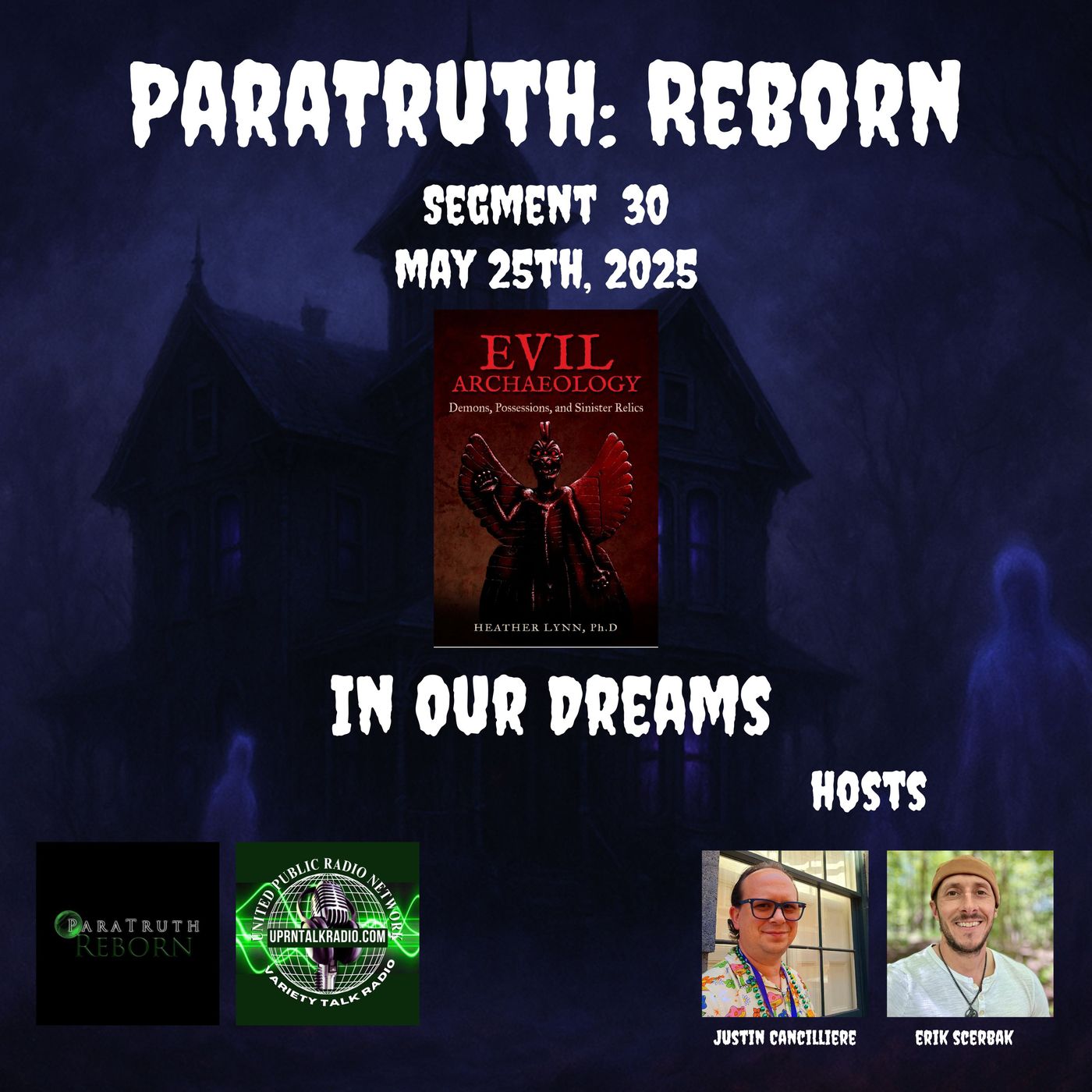
0:03 Welcome, Well, go well do para Truth. 0:32 What's going on? Paratruthers. Welcome to another episode of Paratruth Reborn. 0:38 My name is Justin and today we're playing a replay of our episode from Paratruth Radio entitled Evil Archaeology. This is a peer recorded show on one of seven point seven FM New Orleans and United Public Radio Network. We're gonna go to the show and we hope you enjoy. 0:58 Today we have a very special guest. Her name is doctor Heather Lynn. She is a historian, a renegade archaeologist, and defender of classical education. A professor of humanities by day and ardent truth seeker by night, Heather is on 1:12 a mission to uncover and share the lost wisdom of antiquity, challenging the accepted narrative found in our history books. Author of multiple books and articles on fringe topics ranging from 1:24 history to philosophy, Heather's research includes hidden history, ancient mysteries, mythology, be account, symbolism, paleo contact, and consciousness. 1:35 And without further ado, we're going to go to the line with doctor Heather Lynn. 1:39 Doctor Heather Lyn, Welcome to Paratruth Radio. How are you this evening. 1:44 I'm well, thank you so much for having me. 1:46 Thank you for joining us. We've been excited to talk to you. So I think I wrote that I really just want to get an idea here of what it was that really had you decide on evil archaeology for a book. You know, what was it that took you 2:07 on this journey and made you think, oh, this is gonna be a great book for people. 2:11 Uh? 2:11 And really, what kind of reader is this book geared toward? 2:16 Well, I guess my inspiration. I would like to say that it was something, you know, a little deeper than what it actually was. My inspiration was the movie The Exerci. 2:28 In the beginning scene from the book and movie, Uh, there's a scene from an archaeological excavation in Iraq and at the site, a priest archaeologist feels this strong wind blowing and it's foreshadowing the arrival of the demon Pazuzu 2:45 of Mesopotamia. And the demon statue featured on the cover of the book is actually, uh, the Pazuzu, which is the demon that possessed the character in the movie. And you know it's I was brought up Catholic and I was not really supposed to be watch that movie at 3:00 any point in time. And you know, I did see it, and it just it was there in my reference, and you know, life goes on, and I hadn't seen it for a while, and as an adult, I saw it and I picked up on that beginning sequence that I 3:14 hadn't connected before, you know, because of my line of work. 3:17 I found it a little interesting and I started to then ponder the relationship between demons of ancient Mesopotamia and the modern era. And I wondered if demons of the ancient world could still be with us today. It was sort of a you know, a passing thought. But it 3:32 wasn't long after seeing the movie then that I read a news story about a man in North Carolina who changed his name to Puzuzu so that he could honor that particular demon. And he went on, you know, he was actually discussed because he was a murderer and he 3:49 cannibalized his neighbors, and he was involved in these horrific crimes that he believed he was taking part in as a way to worship. And you know, while these Mesopotamian demons and this sort of thing, and I thought, so that's just you know, weird and interesting. And it was 4:09 interesting timing, of course, since it was fresh on my mind. 4:11 And I started thinking about that, and I thought, you know, clearly this individual is responsible for his own actions, but he claimed to be inspired by these demons to do these things. And I considered the Latin for inspiration, you know, 4:28 the inspirare meaning to breathe or blow into, and how it was originally used to describe when a supernatural being imparted an idea onto someone. And so I thought about this question of possession, and I wondered, well, what is 4:43 possession but an evil spiritual entity inhabiting a willing person and encouraging them to do evil things. And so I started toying with the idea, well, what is this fine line between something like inspiration something that would be possession? 4:58 And I wondered about, how do we view these sorts of activities now, and how did the ancients view this, because there have always been, you know, people who've done these horfect things and crimes and the idea of evil, and I just started wondering about that. So I don't 5:13 know that I had a particular demographic in mind when I wrote the book I just most of the time what I do when I write is just follow my own questions and ponderings and interests, and hopefully what I do is I present something that other people may find 5:28 as interesting as I do. I work on it as a as a journey of exploration, and I try in my work to present it as such. So I don't easily have a either an agenda or a point that I want to get across, you know. I just I look at things with the questions, and then I also 5:45 know where my expertise lie and where they don't. So with that that I listened to help for the input in some ways of people that might be you know better well burst in things like forism. So, for instance, I interviewed Bill Bean, an exorcist, on his views on 6:06 this sort of thing, you know. So I looked at it as more of an exploration into the origin of evil and the connection between how that was shaped in the past and involved and how it may be at played today. 6:21 Okay, all right, well here's a question for you. A lot of serial killers have used symbols, for example, not necessarily for power per se, but for the symbolism itself, like the pentagram. You know, Charlie manson The Nightstalker, several 6:46 others have used the symbolism zodiac used symbols as well a lot of times that we you know, we talk about demonic possession here on Paratruth, but we also talk about out how maybe us as humans giving these particular 7:06 things power over spiritual entities, actually doing these things can can have the same effect. What are your thoughts on that? 7:20 I think so, I think that that is, you know, probably one of the things that I explored in the book, in the research was the idea between the tangible actual reality of something like a demon versus what we put onto things, so such as like amulets or symbols, you know. 7:41 I tried to use an approach sometimes refer to as cognitive archaeology, so that I could look at the meanings, concept characteristics, and symbols and description of things to you know, not just look at assigning blame or you know, but 8:00 trying to have a more complex or nuanced look at these matters, but also at the same time not ruling out the question of, you know, the spiritual components. Could there actually be something more to this and is it something that when we're looking at symbols and as the 8:16 result language the concept of linguistics. Are we just limiting ourselves by the language we're using, or is it actually enhancing or is it completely complicating matters? And so in some ways it's like you could look at these issues 8:29 and think, well, we're using these different terms to describe this maybe demon or you know, an entity or you know, well, at the same time, the ancients might have been using that particular term to describe an illness, and so it 8:45 may sound like splitting hairs, but it in some ways it would seem like when you take Okham's razor and you just maybe look a little more closely and take some of that symbolism out, or you know, some of the maybe ornamental value of it, it becomes a little 9:03 more like we're all talking about the same thing, and we've all and when I say all, I mean through different cultures, even religions, on a different time period, that we are sharing this experience and whatever it may be, 9:18 whether it's the way someone's behaving differently or horrific acts that we can't understand that defy our comfort level of what we may feel is the natural order, however you want to frame it, there's something there that across languages 9:33 and experiences and beliefs that we just know, and we as people develop ways to describe these things, and we can call them demons, evil entities, some call them just angels in general, or spirits or you know, there's so many different ways to look at it. Gin or even 9:50 if they're not ablepomorphized, they could just be a symbol of an animal or as you said, a pentagram or something actually tangible. Either way, I think that there is a very simple, not not easy, but simple threads that can be kind of seen holding everything together. I think 10:13 that we're all on the same page about something and the language is what it is that maybe we need to you know, look more deeply into. So that's kind of what I found with symbols, because symbols are you know, a form of language as well. How much power do 10:28 we give those symbols And that's another question that considers, you know, words have a lot of meaning as do you know, amular for these sorts of things, even if it's just how we feel about them, those feelings can 10:41 turn into action that have very real physical consequences, you know, So that leaves us with a lot of different questions and things. So you know, people can talk all day about how many angels can fit on the you know, tip of a needle or or what have you. But 10:56 these are very real questions that have practical, you know, consequences that, oh, is something evil, what is evil? Does this match my religion or morality, et cetera eta. At the end of the day, while those are very important 11:08 theological discussions, we know evil when we see it, and you know, we have to sort of have these symbols, have these these terms so that we can function in the society as well. And that's what what I believe has happened since the beginning. Is if you look at 11:27 the ancient Mesopotamian you know, demonology a lot of primitive medicine, and so while they had all of these different names for demons, they had a lot of symptoms for the possessions and they were really diseases. But at the same 11:45 time they for anthropomorphized the disease. And for example, if you had cancer, they you need to have these symptoms, and instead of calling it cancer, they might have named it after Lamastu, you know, one of the demons. So yes, 11:59 the anthropomorphise but you know, what is that ors something there? 12:02 And I think you know, it's it's served a practical purpose because it's gotten us in, you know, so far in development to where we are today that they actually laid the groundwork for modern medicine. And so, you know, symbols are very important, and whether or not they can 12:17 by themselves have some sort of independent, imbued power, you know, it's hard to really say. I don't think I'm qualified answer that, but I will say that the what people put onto them, the meanings that they put onto that a very real and tangible consequences, and so it's very 12:36 important to even consider it things. 12:39 So with that said, like considering, we talk a lot about how there are various ways that people can accidentally open doors to the spiritual realm. And so with your conversations with like the Exorcists and the interviews, did you 12:52 find anything maybe they said anything regarding whether or not superstition really plays into many of the demonic possessions that they actually take call to or is it, I mean. 13:08 Well not necessarily. Yeah, that's something interesting because the idea of superstition, you know that that's a really interesting concept in and of itself, because it's easy to dismiss something of the superstition. But at the same time, where where 13:23 did we Where did we come up with these ideas. 13:25 It's almost like a maybe genetic memory or some sort of folk knowledge that tells the hmm, let's put on the brakes before we start doing these things. And so you know. But in terms of you know, my discussions with various exorcists, the idea of gabbling, that's a very 13:44 popular idea. Nobody that I spoke to when researching this book at all said that dabbling would be a good idea, and that includes psychologists. So if you're looking at it from the perspective of a religious point of view even 14:02 versus just maybe a more secular and psychological point of view, something with regard to to perstition or something like that. 14:11 Either way, if you are concerned about letting some sort of negativity in, that idea of dabbling is just really not recommended, at least not what I found that it's something that does open doorways, and if it doesn't, actually, 14:29 from the perspective of extorsist that I spoke to, they agreed that it can open spiritual or metaphysical doorways. By contrast, the psychologists that I spoke to both said that it can open doorways on a subconscious level, which to me, 14:46 you know, is very closely aligned with that metaphysical or spiritual component. So it just maybe again another idea of the linguistic difference, but kind of a leaf coming to the same conclusion that for whichever reason, however you may 15:00 have developed the methodology to reach that conclusion, is probably not a good idea to dabble because it can open doors and those doors are perhaps you know, subjective. However, somebody wants to describe that, whether again the spiritual doors 15:17 or if it's a subconscious doors, some would argue those are one and the same, and that would just be a you know, that question of splitting the mind, the idea of mind the mind body, and that maybe that's something we shouldn't do because they're connected and holistic way 15:32 that that subconscious and that consciousness, the spirituality component of it, they're actually more closely related. I mean, that's that's kind of where I would tend to follow the idea that yeah, there's the spiritual and then there's also something that's more psychological, 15:51 and that those things are actually not in conflict. And as much as it may seem like they are to somebody with a particular bias or the end, I see a lot of ways that they overlap, at least for you know, the practical outcome. And so at the end 16:06 of the day, if you're you know, somebody's concerned about bringing that negativity to them, whether they think it's in the form of an antipomorphized entity or if it's just something that maybe it is superstitious and they don't want 16:17 that to enter their psyche. However they reached that, I think it's probably helpful to at least not open those doors. 16:29 All right. Well, actually, as you were talking, I kind of had a question too. It was, you know, you mentioned earlier, and I read in the book about how 16:43 there were there were a lot of different cultures that would use different things to let out the the evil spirits, even though really they were they were kind of truly treating diseases as well. 17:00 Well. 17:02 How often the not were there deaths or even brain damage from these particular evil spirit letting out type practices. 17:20 Well, you know, I think there I don't know if I actually reference a particular number, because as you said, that is something cross culturally you'll find because of the different ways that people perform exorcism, So there would be actually quite a few. If you look at you know, 17:36 especially in foreign countries, you'll see a lot of people doing something with maybe folk medicine or things that maybe wouldn't be you know, something we would consider safe maybe in a more developed country. However it's it's it's not 17:53 even safe to consider it just because it's a developed nation. 17:57 Something that would be modern or content temporary that oh well, it'll happen without a flaw or you know, because we've actually seen in recent relatively recent years people in the United States dying from these activities and so bridges. In 18:16 ninety seven, there was a woman killed in California, and in New York about the same year, a five year old died after she was made to swallow a cocktail of ammonia vinegar and had her mouth sealed shut. I mean, she died from that. And this happened a lot in 18:37 the nineties. The seventeen year old was suffocated by her mother with a plastic bag because she was trying to chill the devil who she believed to be inside her. Now, arguably that wouldn't be a prescribed exorcism. That could be 18:53 just mother having these delusions and then unfortunately killing her child. 18:56 But then in two thousand and one there's a woman in New ze that was actually strangled by a priest during an exorcism. And the list goes on and on about all of these different activities that have taken place well meaning people in some cases, some cases not. But 19:13 it is something to consider that the idea of exorcisms. 19:17 They're very traumatic, they're very dangerous, they're not something to be taken lightly, and they're definitely it's not like they show in the movies. We'll just say that it's not even in the movies. It looks very traumatic, but I 19:31 mean again, they're very real, quiet consequences for things like this, and you know, people have died, they've died of dehydration, lack of oxygen, just the mental torment of it all, and definitely mental illness has played a part in some 19:45 of that. So there's been a case in the South Germany. 19:52 It was actually a pretty famous case to film for made about this girl's ordeal, The Exorcism of Emily Rose in two thousand and five, and a movie called Rereclion in two thousand and six, and this was a story from actually nineteen sixty eight. The girl was diagnosed with 20:09 epilepsy and was on medication, but it wasn't really helping her, and so by the seventies she ended up being admitted to the hospital for six months having tuberculosis, and she just became more depressed and had more issues, and in 20:24 medication still wasn't working, and so a neurologist found that her EEG was starting to show abnormality, and a week later she claimed to see a demon in a vision and she would start to pray, and then the prayer just became longer and more intense, and then she would 20:43 become really afraid and paranoid and in some cases delusional. 20:46 But this went on for a few years until she would just suffer countless seizures and continue to see what she described as demonic faces with horns, and she said she smell horrible sulfuric smells. It was just an ordeal. 21:01 And so by this point her father took her to a northern Italian town and told her, you know, she was going to be healed, and this was where she would see Mary. It had been a place of pilgrimage for people for many years. And while she was there, 21:20 she fell to the ground and said that her feet were on fire. They called the local priests for help, and they started to give her an impromptu exorcism. And at this point she started tearing off her clothes, urinating on the floor. She was eating whatever she could find, 21:39 and she like just grabbing handfuls of dirt, and she attacked the priest. And apparently the priests say that the demon who had taken possession of her called himself Judas, and so they kept trying to help her, and it took years, and you know, after the mid seventies, they 22:00 had these failed attempts to help her with these exorcisms and still with medication, and so the priest decided to try harder and go in for more intensive exorcism. And so the demons, including the Judas demons and then others 22:14 that called themselves Lucifer, Hitler, Nero, they started become increasingly violent. 22:19 And this girl had just gone through the ringer close to a decade, starting with the you know, the delusions or the you know, epileptic seizures and not all the way to this just violent flaming her head against the wall, not sleeping, not eating, and her knees actually broke after 22:37 she had been kneeling so many times to pray, and so by the time she ended up dying and it was a day after her this is mind blowing, but her sixty seven exorcism, and she had died from losing so much weight and going through all of this, and 22:57 so the cause of death was actually malnutrition and dehydration. 23:01 And at the time she died, she weighed only seventy pounds, and you can imagine a grown woman, you know, at this point weighing seventy pounds, and her parents and the two priests who were involved in this were actually convicted 23:18 of negligent homicide. And so as a result, you know, there's a lot of legends about her, and of course these movies that had been made, and so it can be a very dangerous thing. And so that it's hard to untack that because you could say, well, clearly she 23:34 had epilepsy and that was the cause of her illness. 23:37 She had, you know, the doctors failed her, her parents failed her, the priest failed her. These these entities, you know, was the words, was she suffering just from these delusions or at which point do you draw the line between 23:51 either you know, delusions or these are actual possessions of entities. 23:58 And either way, again, it's something to be taken very seriously because she tragically dies, and you would think that that would you know, have people maybe considering this a little more, looking into a little more, or regulating it 24:12 at the very least. But even though there are these clear dangers, the exorcisms have become more popular than ever. 24:21 They're on the rise in many countries, in Italy and in the Vatican and you know, in the Catholic you know practice that's become something that has been increasingly popular. 24:34 But then also in an evangelical movement. It's been something that's very popular in the United States, and I discussed that a little bit in the book as well, my experience, especially witnessing what would maybe be looked at as a 24:49 non traditional style exorcism if you consider the traditional one to be something recognizable in pop culture, like the you know, pries saying demon, what is your name? And this sort of thing. So, but the practice is becoming more and 25:04 more popular, and you know, with that, I guess that means there's going to be you know, a lot more potential for dangers and so and what's interesting too, are there there are some psychologists that are starting to incorporate 25:17 exorcism into their practices because they believe that there may be some you know, benefit to it if your client or patient is somebody who have these pre existing beliefs already or so, you know that it comes down to that symbolism again. You know, in my view that if 25:37 it works, if it's something that you can use to have them break through and have this understanding and maybe that can reach into the subconscious and heal them in some way. And that and then in that case, is that they're subconscious or is this their spirit? Is that 25:50 what that is? Or you know, it might seem just like semantics again or putting hairs, But this, to me was one of the important themes in the book is just trying to figure out what are we talking about when it comes to evil and demons, because it's so 26:06 easy to just imagine a demon as if they hooved read character with horns, and then not completely appreciate what we understand as humans to be a demonic entity. 26:22 Right, Yeah, that's really interesting. It's like, even as a psychologist, maybe someone who doesn't believe in the same religious beliefs that the person who they're talking with, you know, doing the exorcism. Maybe to the patient it's it's like a 26:38 drug that actually helps them, whereas to the psychologists it's a placebo something they don't necessarily believe, but still affects the mind. And that's still, you know, I think it's really interesting just in general. I didn't know that someone 26:51 were doing that these days. Now. You've mentioned a couple of demons just a little bit ago, and you mentioned number of demons throughout the book, but one that I would like to discuss, and I'm let me know if I mispronounced either of these names, but I'd like to 27:08 discuss as Modius for a moment now. According to your research, and this is actually just so everyone knows, this comes from the chapter called Summoning Demons that you talk about this. 27:19 But according to your research, who was an especially wretched demon that was perhaps enslaved by is it Ornius? Okay, saved by Ornias through the magic Ring of Solomon, which was given unto Solomon as a gift from God by 27:35 the archangel Michael. Now Solomon lent or Nias after capturing him he lent it to Ornias to capture other demons for the construction of Solomon's temple. Now, in the book, you had mentioned that the similarities between as Modius and 27:51 a Lucifer are actually remarkably similar. My question is, would you mind sharing some of the attributes shared between these two entities and also what ultimately separates them as two separate demons as opposed to possibly the same demon with two different names. 28:08 Wow, do you know? That is a really great question? 28:12 And well, so I would start by saying that they were two different demons in the interpretation and just the story. However, I believe that given their particular attributes, I really think that they were one and the same in a lot 28:37 of ways. And that's that's one of these cases where maybe it came through and had that religious syncretism where some of these things melded into one and then became the other, et cetera. I think that this is more about it being a Promethean figure. So I don't know 28:57 that they are two separate ones. Clearly they're they have two separate stories, but a lot of these stories have crossover. 29:03 A lot of these stories are very ancient, but then they are revived in the Renaissance, and then they're you know, expanded or changed many different authors and a written different versions, and then all these spreads of similarity between these types 29:16 of Promethean figures. And so while as Madius is well, he was considered the demon of occult wisdom and human technological advances, and he was considered also the successor to the Egyptian god of wisdom and learning Task, who both of them were linked to serious And so I mean, 29:41 it sounds like kind of strange maybe to your listeners that these demons could be connected to these Egyptian gods, but again it might be. It's one of these things that I discussed in the Book of Demonizing the process of demonizing, and so it's throughout a lot of these 30:01 ancient cultures they had these these gods or these entities. 30:07 They sometimes they didn't even separate the demons from the angel. 30:10 They would just consider them these spiritual entities. But either way, they they would take on these attributes and Chane's the way they looked or what have ei, their name depending on what culture they would be in, but their key 30:24 components would their personality would stay the same. So that's what lead me to believe that they were the same figure because of how they're portrayed in all of these different cultures. One for example, is that in Islamic tradition, 30:43 Asmodius was considered a gin, and it's the very same gin that cheated a Laddin out of the ring to secure the magic lamp. I mean, it's the very very common and popular, you know being. So it's like Asmodius was the case of these demons, and Musipero is considered 31:02 to be, you know, the king of these demons, and a lot of the different stories and so and again, with a Promethean figure to connect them to Prometheus, who I had the similar feature of being, say, an entity of wisdom or technological advances. And in a lot of ways, 31:22 I just I think that these are I don't want to dismiss them by saying, well, these are just names for the same thing, because they do contain very different and specific attributes and characteristics that link them to their 31:39 particular times and cultures. However, it is my belief that they are referencing the same spirit or entity, and that spirit or entity or even architect, if you will, is that of the trickster, the you know, Promethean figure and that sort of thing, and so that would be I think, 31:59 in our society be considered lucifer. So I do thinksmodius is lucifer and lucifer is emodium. 32:07 Okay, well, this particular chapter is actually just really fascinating to me. And so moving on to a page one under the subtopic of possession pandemic, you actually talk a little bit about how, according to some Muslim researchers, GIN 32:24 can be responsible for a number of psychological disorders. Now, it is in fact believed that a GIN doesn't need to fully possess a person, but can cause physical and emotional trauma by infiltrating the human brain, either directly or 32:37 through the bloodstream, in order to affect the hormones and neurotransmitters of a person. Now, this section is again really interesting to me, but what actually piqued my curiosity was a sentence that you wrote that said, some Muslim researchers 32:54 have suggested that the presence of GIN can be detected by MRI or magnetic resonance imaging. And so my question is, was there at all in any of your research any indication on how an MRI expose a gin or what a gin's presence with any human body may actually look like. 33:15 Yes, actually, this is something that I found to be so important I had to put it into the book, but also a little frustrating because it's it's not as developed as well it probably you know, I have limitations in my in my language and ability to translate. So 33:36 there's a lot more scientific research out there available that I unfortunately wasn't able to translate. So from what I my limited ability to get English versions of different research, I found that this is a legitimate study in the 33:54 Islamic world to track down GIN as a physical phenomenon. 33:59 And they've used different things like MRIs to try to find what it is that you know, could be responsible if they could detect it somehow, And so yes, they it's a little, at least in my opinion's a little unconvincing. 34:18 So they just look at these different activity areas that are you know, I guess illuminated in the mind that they've sort of linked to particular types of what they believe would be a possession. Again, it's something that I'm like, well, 34:36 maybe within a different contact that could be helpful. So I didn't see anything that was overwhelmingly convincing, which is why I think what I found to be even more interesting was the research that had to do with looking at the molecular explanation for demons at the post of 34:55 the MRI, because it continued the idea of a germ theory of demon ilogy that they were able to back up with mathematic models. And I thought that is really interesting because again instead of looking at you know, an MRI and any sort of scans are you know, clearly scientific, 35:14 but there's a little bit of subjectivity that can go into them by having to look at them or have your senses. But so I don't want to call it qualitative, but it's there's definitely a little bit of of user bias that could enter that. So when I saw that 35:29 what they were doing, in addition to the MRI is using mathematic models to not only identify the GIN, but to to predict their behavior within a certain level of accuracy, I thought, wait a minute, Now now it's getting quantitative. 35:50 Now it's getting a little on the harder edge of science. 35:52 I thought, what For one thing, I thought it was quite fascinating that there's actual finance, you know, research going into this at a university level. And of course some people have cited that part of the book as being 36:06 you know, objectionable because they say, well, it's pseudoscience and et cetera. But I, you know, if they're using the scientific method and that's the way they'd like to look into that, I have no problem with that. I don't 36:18 think that there's anything wrong with natural curiosity and also trying to use science to perhaps investigate issues of religion or theology. And so from my perspective, it was very exciting research. And so again they have that idea of 36:32 maybe germ theory of demonology that's very much similar to the ancient Mesopotamian approach to demonology. And so in this kind of explanation for demons, they think of it beyond just mental illness, but also related to the mental illness, 36:49 but that these gin or evil spirits are sort of responsible for things like epilepsy, autoimmune even cancer. And so according to some of the scientists in Morocco that are working on this research, these spirits are invisible to the 37:07 naked eye, but not like ghosts or something, but more like microbes. And they contend that the existence of these evil spiritual molecules exists beyond human perception, but that they they believe they're getting close to being able to pick 37:24 them up through ways like MRI or you know, advanced my crops, you know, microscopes, using using many different methods to try to find them. But in the meantime, if they thought, well, we're going to look at this molecular composition of these evil spirits and try to figure out 37:41 some of the key questions. And so interestingly, they they thought about the idea of demons sort of being linked to the darkness. And in all of the they old entailed, you know, demons don't like light. They they spook around corners or in you know, dark places, and so the 37:58 idea of that is that they're averse to light, which explains why they appear at night and they're in the dark. 38:05 And they believe that they have their own then physical laws or wife cycles, and that they can enter the bloodstream and rapidly multiply and and uh so they've sort of built this whole system around this by using faith, I would say, first as a guide and then using 38:24 the scientific method to try to test that or detect that. 38:27 And you know, but I thought it was so fascinating that they were able to You should look at the mathematic models and try to figure out and a claim are able to predict the movement of these demons and how they'll manifest in the in the physical body of somebody. 38:47 Now again it's it's hard to get It's definitely something to look at with a healthy level of skepticism. And you know, it's another maybe ethical question, or some people it should science dictate our beliefs or should our beliefs 39:03 dictate science? But which comes first? But I felt it was important to add into the book just simply because I think it's important to kind of get out of our own, you know, Western centric way of approaching science and explore what other people are doing and how they're 39:19 looking at it. It might, you know, help to expand our understanding of these things called gin or even demon So, but yeah, I think there's some exciting research on the horizon, and I would really really love to see sort of 39:34 a more inner disciplinary approach to looking at this. If anything, I think it would help expand ideas, you know, medicine. 39:43 Yeah, I absolutely agree, And like you know, I over the years, I've constantly said, how I think just science and religion really have to have a balanced marriage between the two because we're always getting this, you know, religion 39:56 says this, science as that, and we're always mutting heads. Lately, it seems like seeing something like this with the MRI and how we can detect possibly not demonic ansties through science while still claiming yeah, hey there's a possibility, but 40:13 maybe not. This is the evidence for both sides. It's just really an interesting thing and I think very very important for researchers, especially those within the paranormal field and the account so to really get on board with. 40:28 I agree. I think it's very important to start looking towards the scientific method or using scientific tools and quantitative methods to try to you know, separate the cream, so hopefully we'll have more of that. I don't think it's I think it's I think it's good. I don't think 40:48 that it is. This is my personal opinion, But I don't think that it is a challenging faith to use science to try to investigate the natural world into trying to do those things. I think that it can actually strengthen face and do a great service. And I'm just 41:05 one of those people I don't believe that there should be that just disregarding it as superstition. I think that in a lot of ways, religion and that maybe spiritual sense not necessarily organized, but just the idea of religion 41:20 in a human sense. It's actually the precursor to science. 41:26 It was the first way we tried to, you know, understand the world around us and the happenings. And we had philosophy and then science, and I just don't think that they belong to so separately. I think that it's important to use science to understand the things that we 41:43 don't understand. 41:46 Agreed. 41:48 I think we've found our muse eric for the paratruth radio in doctor Heather Lynn. So something you bring up in the book, and I think it's like really important that we do this. But I am kind of curious about your intentions about putting the Protections against Evil in 42:09 the book, because you had mentioned earlier about how uh psychologists are using exorcism as a way to treat patients. 42:17 Uh. 42:17 What what was your your original thought about putting that particular chapter in the book. 42:25 The chapter about then can you explain that. 42:32 One more time. 42:34 The deliver us from evil, may we no longer fear any evil, all those different ways that you can protect yourself from evil. 42:42 Yeah, well, I felt that was so important to add into the books because a lot of the book, if I if I'm discussing things like curial killing or you know, a lot of these horrific archaeological fines, and you know it, it seems, you know, a little could seem at least 43:01 a little disheartening, discouraging. And I really wanted to point out that drop a lot of my research and my interviews that this wasn't something to fear, that we didn't have reason to actually fear. And it's from what I've found to be the case with the interviews is that 43:19 fear is actually more dangerous than you know. If you're trying to not have an evil entity around you already kind of like negative influence, then the you definitely don't want to have feared, and so fear is something that 43:38 can create vulnerability. And again, it could be the argument that will that fear puts you into some sort of like metaphysical state of negativity and then that leaves the door open for something you know, otherworldly to enter your life. 43:54 Or it could also be that perspective of if you dwell on a negative place psychologically, you'll be more prone to go down those negative, dark roads. Either way, I thought it was very important to you know, balance and at least maybe end the book to a certain extent 44:11 with that advice of you know, not being afraid and looking at some of the ways that ancient people try to protect themselves in the past and how people are trying to protect themselves now and is there anything that we can glean from that or are they all just superstitions. 44:29 Is it just oh, you know, hold on to the amulets and that'll make you feel better, or know, is there anything like that? And I really have to say I'm really grateful to Bill Bean for his input into this. 44:40 He really got me to see his experience with exorcisms, you know. I talked to him for a very long time in many interviews, and it was fascinating to see how similar the experiences he had and has on a regular basis actually have been to some of the accounts 45:02 of ancient exorcists, except he didn't even necessarily know that. 45:07 So it was really interesting to see that there were these similarities. And the advice that he gave is something that while it may sound very basic, or very contemporary is something that is shared throughout many cultures yet again 45:23 and many different time periods, that if you want to invite positivity into your life, something good and deflect any sort of evil, there are a handful of things that somebody could or should do that can make them less likely to encounter those evil things that might be a 45:43 little dangerous. The idea could be dangerous to put out because it almost borders on that idea of the secret or you know what, the law of attraction, all of these sort of new age ideas, which can be dangerous because it also have a foot in the idea of 46:01 victim blaming, where you can have so much huberic that you think that you alone can deflect the evil or attract the positive, and so when things don't go that way, then it's easy to you know, point a finger of blame. 46:13 And so if not something you know, I'm trying to do, but it's something that I thought it needed to be said so that people could at least have a hope will view on what things they made be able to do to protect themselves, especially if they already felt that 46:26 they had been in having an encounter with a demon. 46:31 Because I had gotten a lot of emails from people who wanted to discuss this with me, and I've been on shows where people have caulled in and discussed that they are being tormented actively by demons, and so I thought that, you know, there are actually people out there 46:47 that may benefit from some of the advice that is again not necessarily coming from me. I don't have the credentials to tell people how to ward off evil spirit that it just basically, you know, an amalgamation of historical insights and the advice of other people and then maybe 47:09 a little commentsense thrown into that. So you know, I do have a section in there on how to protect yourself and against demons. And one one thing that I, you know, found to be interesting is the something as simple as cleaning your personal staith and your living environment. 47:27 You know, the things like that putting, putting things that you enjoy around you, things that are uplifting and spiritual. 47:33 And it may sound wishy washing and again little New A's or something, but I just see that to me, it just it's so true because when you start, when you look at maybe like some of my descriptions of the house and environments that the the murder from North Carolina. 47:55 Had he surrounded himself with occult symbols and you know, pictures of demons and a horrifically filthy environment. And at this point he was already in the throes of whatever had him, and so much so that he, you know, 48:11 surrounded himself with the dead bodies of his own neighbors. 48:14 So clearly we have this extreme example of the surroundings being a reflection of what was going on inside. And so you know, with both people who were religious in the thinking spiritual, and even psychologists or just old fashioned folk advice and all the way up to what then 48:32 I would consider to be self evident or just maybe common sense, but the idea that if you maintain order around you, that you're you know, building a spiritual protection and maybe not if you're concerned about evil entities, maybe 48:47 don't decorate your room with a bunch of you know, pentagrams and demonic images and you know, try to actively do what Bill Bean called living in warrior mode. And I thought that was a really good piece of advice. 49:01 That's it's really cool, and it's it makes me think of all the different like there's a window decals and T shirts that say, good vibes on them, and it's pretty much the same in a way. It's the same thing. 49:12 You know, I have that positive outlook on life, be thoughtful, uh, and just keep those good vibes around because negativity really does bring on negative things, whether that be a physical, emotional, spiritual. 49:27 So we just got to be aware of what we put around us, whether it be people or objects or anything. Uh, and just take on life head on and just be garbage in, garbage out the absolutely. 49:43 Well. 49:43 Unfortunately, this does bring us to the end of the show. 49:47 So doctor, I would like to give you a moment here to kind of tell everybody where they can find you, where they could pick up your book, and of course share any information you'd like to share. 49:57 Oh, you can find me on my website, which is doctor Heatherlin dot com. That's dr heatherlinn dot com. And my books are available at the all bookstores, They're on Amazon, and they're on audiobook as well. And I have a new book out right now called The Honor Naki Connection. 50:14 It's about human origins and the fate of humanity as well. 50:19 So uh yeah, and if you I'm also on social media Facebook, those types of things but just come to my website and you'll be able to learn more about me and my books. 50:29 All right, doctor Heather Lynn, thank you so much for being on Pearatruth Radio. 50:36 Thank you so much for having me. It's been a really, really great honor. I really love the show. 50:41 Thanks all right, folks, that was Heather Lynn, author of Evil Archaeology, Demons Possessions, and Sinister Relics. She has a couple more works out or in in the works to come out, so definitely looking forward to that. 51:03 We had just gotten off the line fine with Doc Demon's Possessions and to Minister Relics. If you have not read this book, I do recommend picking it up. It was a really interesting read, very fascinating, and I had a lot of fun with this this interview here today. 51:16 There's a lot of information in this book that I think we've talked a little bit about over the years, but we got to dive into some really interesting stuff, especially in how science and religion or faith can very night in the same topics, you know, and the same thing. 51:33 So m hm, yeah, So I've after reading through it and talked to her. I actually really loved the fact that she kind of has done what we've talked about for a long time, brought science and religion together to talk about these things. Not once did she ever claim 51:57 that she believed one way or the other into these different things, which I thought was a very academic way of looking at it. But at the same time, you know, we've talked about it several times, how science and religion have to have a coming back together because at one 52:18 point they were together and then they split because of some rumors started. 52:22 By broken soil. So all that happens at divorce. That's pretty much. 52:34 So what are what are some of the things that you took from this or what are some of your final thoughts about the interview in the book? 52:45 Yeah, so, I mean there was there's still had more questions that I would have been great to have asked, you know. Unfortunately we are on a time limit with this show, so that's a little disappointing. But like I said, there's a lot of things that are really just found 53:00 it interesting. And you know, there's a we talked about it a little bit, she got into it, but there was a chapter titled the most Horrific archaeolog Archaeological Finds, and that was another fascinating chapter, and she went into 53:18 basically different archaeological sites or archaeological finds that were really just actually about a Neolithic massacre, which was a huge, like massive bone pit that showed various bones of men and women, primarily women know and young children, which looked 53:43 like ritualistic murders or ritualistic sacrifices. But what was really interesting that she found were that some of these bones had markings as if the flesh was cut from the bone itself. I guess some of her colleagues believe that 54:01 it was just part of the sacrifice. She had actually thought that there's much more to it, and at this particular site, people would actually cannibalize the sacrifices afterwards. Now apparently, I think it, as far as I could tell, the 54:21 area in which this happened only lasted, like the village only lasted about fifty years. I think nobody really knows that they picked up and moved on, or if it just kind of crumbled. But it was one of those things that were just really creepy and interesting, and another 54:37 one that I actually kind of liked because you know how I am with the idea of witchcraft, and it just is something interesting to me by about the history of witchcraft. And there's this section called witch bottles and Smoked Cats. Don't know if you're not the most fun 54:53 read in regards to the smoked cats, But there is these witch bottles that people were finding that archaeologists are finding all over the world, even here in America, especially in the New England area, in which there were these 55:06 small bottles that contain things like urine and pins or needles, nail clippings, hair clippings, you know, various different things. And it was believed that if you had one of these bottles and put it into a wall or buried it underground, 55:23 it would protect you from any type of bewitch, maut or curses placed on you buy witches. And of course the urine. It was believed that by putting it down in the ground or wherever, you would cause the said witch to have extreme pain when urine going to that level. 55:41 You know, I don't know why, Oh well, let's make her hurt when she urine zora. But you know, I thought that was really interesting. And these can still be found today, especially in New England, but even throughout the country. 55:56 So I think there's this kind of horrible thought that somebody New England maybe living in a home that has one of these witch bottles embedded in their walls and they don't even know about it. Soaked cat thing, where again people were finding dead cats that almost lived, burnt 56:11 or smoked to kind of mummify them. And these cats were placed also into the walls or underground and very often were found with rodents either in their mouth or they would be kind of placed in a way whereas cat chase mouse type of ordeal. And it was believed 56:30 or is believed that this type of protection spell or talesman or awarding, whatever you want to call it, of protecting a person's home or property from rodents. So again another one those really interesting things, that sad thing, especially 56:50 for you know, I've got six cats in the house, so the think of one of them being smoked and put into walls just a little so little little SCTA, Yeah, what about you. 57:05 I think the biggest thing that I liked about it was the fact that not only did she and I had mentioned this during the interview, not only did she do these different evil things throughout the book Archaeology, she talked about stuff that we talked about last episode, which 57:23 was Talisman's Charms, those sort of things, But she also brought up the fact that there's protection as well, and you know the I thought it was actually really interesting when she brought up the fact that there are some 57:39 psychiatrists right now using an exorcism quote unquote extorcism to treat patients that are believing that they're possessed. You know, they're they're using that belief and using this method to cure them in a sense, or at least treat them. 58:00 So I thought that was like fascinating. I've never heard that before. So I definitely recommended the book because it is very packed full of knowledge and just the fact that she, like I said, is bringing together science and religion in a book that is about something that is 58:21 still taboo to this day. Even so, I thought it was a great a great book and a great interview. 58:28 So all right, folks, I hope you have enjoyed Evil Archaeology. 58:34 Make sure you like to share, subscribe wherever you are, and check out all the great shows that we have on United Public Radio Network. Again, this has been a pre record show for one oh seven one seven point seven FM New Orleans and United Public radio network until 58:50 next week where you'll find this same time, same channel. 58:53 We'll see you next time when


Community discussion