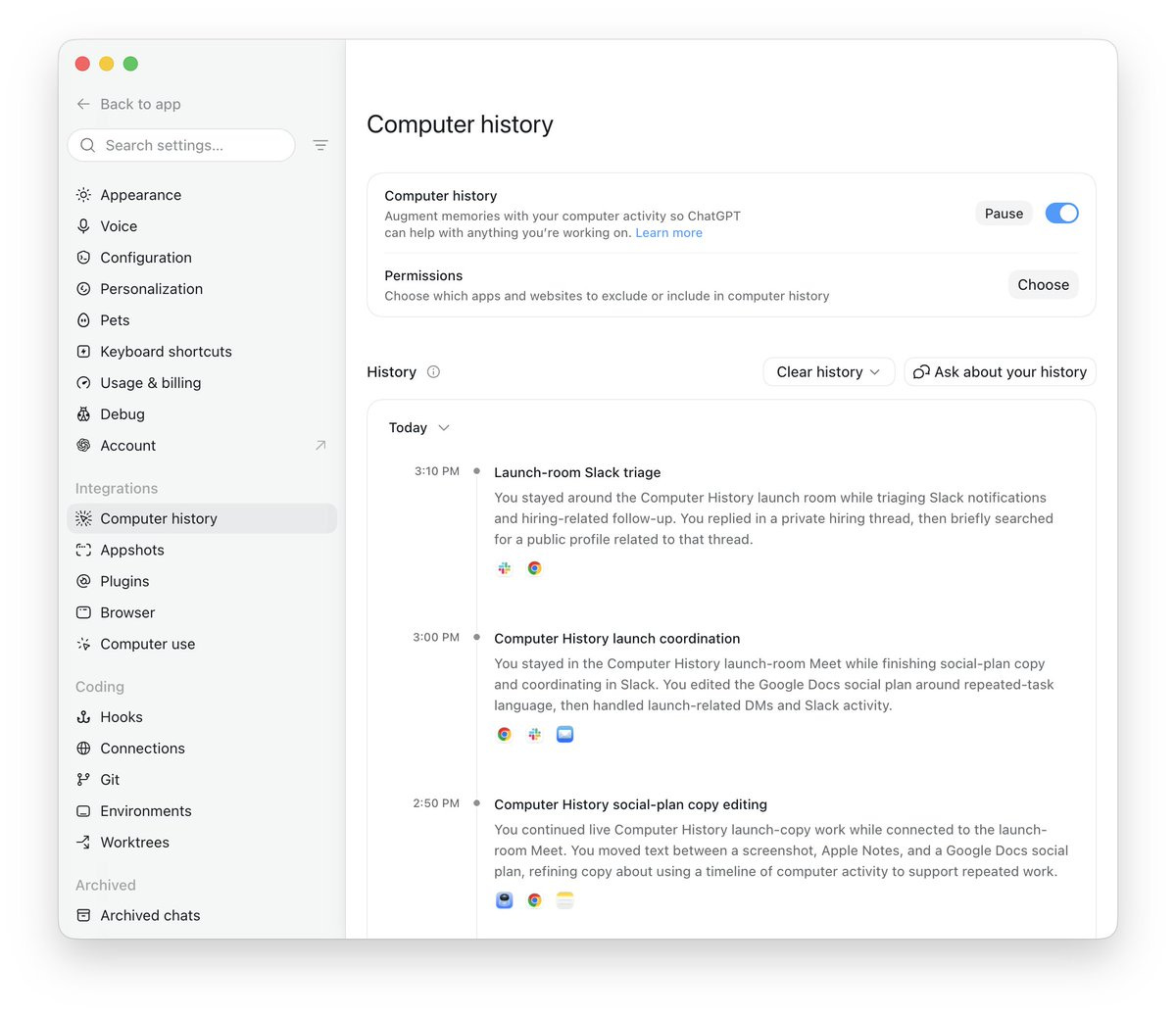
Why Dwarkesh is Wrong about Computer Use + How OpenAI shipped its Jev competitor in 1 Week
Three months ago Dwarkesh, who has been posting incredible blogs and episodes about RL, posted a framing question for his video essay on RLVR which upset a lot of Computer Use folks:
We are no strangers to learning in public and are no strangers to the stress of getting things wrong when you have a big platform. However, we were at Anthropic for the Computer Use launch, there for Claude Cowork with the first big podcast on it, organized the first Computer Use track at AIE presenting the state of the art, and were close to the OpenAI-Sky Software acquisition that now powers the complete domination of computer use that Codex enjoys today. This is why we’re excited to bring you today’s first guest, Ari Weinstein, cofounder of Sky and now leading all the amazing CUA progress that casuals might miss:
Ari explains why Computer Use is now “180 degrees different” from where it was months ago, how agents are learning to debug and recover from failures, why combining screenshots with accessibility data, the DOM, Playwright, and generated code changes the speed equation, and why the next frontier is making agents literally superhuman at using software.
OpenAI clones Jev
In the second half, Nikunj Handa from OpenAI’s API team breaks down the new developer stack: async tool calling, mid-turn steering, WebSockets, UltraFast inference, the Decisions API, prompt caching, pre-warming, compaction, and the Agents API. Given that we were the first Jev podcast, we particularly focus on the unusually fast sprint on the Decisions API:
And why it is just a Luna wrapper for now but the team is motivated and egoless enough to clone what they consider to be good patterns.
We discuss:
* Why OpenAI thinks Computer Use has changed dramatically in just the last few months
* Dots and what changes when every agent gets its own Linux computer
* Why Computer Use can now complete some tasks faster than the average human
* The path from human-level to “literally superhuman” computer use
* Why modern agents are much better at debugging and recovering from failure
* How screenshots, accessibility trees, the DOM, Playwright, and generated JavaScript work together
* App Shots and why they give models much richer context than ordinary screenshots
* Why Computer Use can close the loop between writing software and testing it
* Trust, permissions, and safety when agents can make payments and operate websites
* Async function calling and why models no longer need to stop reasoning while tools run
* Mid-turn steering, WebSockets, and the architecture behind more responsive agents
* UltraFast inference and how OpenAI is pushing frontier models toward much lower latency
* The rapid internal story behind the Decisions API
* Why Decisions API is more than structured outputs at low latency
* GPT Live, fast tool calling, and real-time computer control
* How OpenAI is already using Decisions API for support classification and internal workflows
* Longer prompt caching, cache pre-warming, and cache-aware applications
* Server-side compaction vs manual compaction for long-running agent threads
* What should live inside an Agents API versus a developer’s own harness
* OpenAI as an “AI cloud” and the search for higher-level primitives beyond raw model APIs
Ari Weinstein
* Product & Engineering, Computer Use at OpenAI
* X: https://x.com/AriX
* LinkedIn: https://www.linkedin.com/in/weinsteinari/
Nikunj Handa
* Product, API at OpenAI
* X: https://x.com/nikunjhanda
* LinkedIn: https://www.linkedin.com/in/nikunjhanda/
Timestamps
00:00:00 OpenAI DevDay: Dots, GPT-6.1, Agents API, and Decisions API
00:02:52 Dots and Personal Cloud Computers
00:04:59 Why Computer Use Is “180 Degrees Different”
00:06:04 From Sky to Self-Debugging Computer Use Agents
00:09:24 How Computer Use Sees and Operates Software
00:12:09 From Faster Than Humans to Superhuman Computer Use
00:16:03 Agents API: Trust, Permissions, and Safety
00:17:31 Computer Use for Coding, Testing, and QA
00:19:14 GPT-6 APIs, Async Tool Calling, and UltraFast Inference
00:23:21 The Rapid Story Behind Decisions API
00:25:32 What Decisions API Is and How It Works
00:30:24 What OpenAI Is Building With the New APIs
00:32:23 Prompt Caching, Pre-Warming, and API Performance
00:35:20 Context Compaction for Long-Running Agents
00:37:13 Memory, Higher-Level APIs, and the AI Cloud
Transcript
Introduction: OpenAI DevDay and the New Agent Stack
Vibhu [00:00:00]: Okay. We’re very excited to be here. Today is OpenAI DevDay. Special podcast
Swyx [00:00:08]: We’re the first podcast after your livestream.
Vibhu [00:00:10]: First podcast. We have Ari here, who leads the product and engineering team for Computer Use agents. Before we kick in and dive deep on Computer Use, you wanna give a quick recap? What was announced? What’s the quick slew of announcements you guys had today?
Ari Weinstein [00:00:24]: Yeah. yeah, it was a super exciting day. we just got out of the keynote. It was really sick. there were a bunch of Computer Use announcements that I think are worth thinking about. We have, Dots, which is the new, sort of personal assistant product, and, that has some really exciting Computer Use features. There’s GPT-6.1 Sol, which is this amazing new model, that I think is particularly great for Computer Use ‘cause of, sort of the cost and speed, advantages. I think, I think we shared that it’s, a fifth of the cost of Astra and a seventh of the cost if you’re looking at Computer Use specifically, which is really amazing. sorry, there were so many things. I’m trying to sort through it.
Swyx [00:01:02]: And the API.
Ari Weinstein [00:01:03]: Agents API, which now has Computer Use in it, which is really cool, ‘cause now developers
You May Also Like

Mark Tilbury
Mark Tilbury Fan

Lenny's Podcast: Product | Career | Growth
Lenny Rachitsky

CISO Insights: Voices in Cybersecurity
CISO Marketplace

a16z Show
Andreessen Horowitz

Jak Piggott
Jak Piggott
ChatGPT - Sol Good Shorts
Sol Good Network

Theo - t3․gg
Theo - t3․gg

ITSPmagazine
ITSPmagazine, Sean Martin, Marco Ciappelli

ゆるコンピュータ科学ラジオ
pedantic

User Friendly - The Podcast
User Friendly Productions
Mark Tilbury
Mark Tilbury Fan
Lenny's Podcast: Product | Career | Growth
Lenny Rachitsky
CISO Insights: Voices in Cybersecurity
CISO Marketplace
a16z Show
Andreessen Horowitz
Jak Piggott
Jak Piggott
ChatGPT - Sol Good Shorts
Sol Good Network
Theo - t3․gg
Theo - t3․gg
ITSPmagazine
ITSPmagazine, Sean Martin, Marco Ciappelli
ゆるコンピュータ科学ラジオ
pedantic
User Friendly - The Podcast
User Friendly Productions
Community discussion