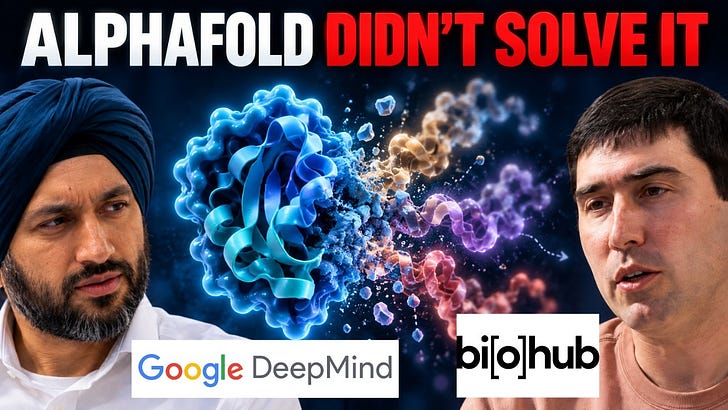
Why AlphaFold Didn't Solve Protein Folding — Pushmeet Kohli, Google DeepMind & Sal Candido, Biohub
From the Bitter Lesson of AI scaling to the unsolved mysteries of protein folding, Google DeepMind’s Pushmeet Kohli and Biohub’s Sal Candido are rethinking what it takes to build AI that truly understands biology. In this special panel moderated by Brandon Anderson, they explore why AlphaFold’s breakthrough was only the beginning, why scaling compute and data alone won’t solve biology, and how the next generation of AI models could transform our understanding of proteins, cells, and human disease.
We go deep on the future of AI-driven biology: finding scaling laws in biological data, the tradeoffs between scientific intuition and general-purpose architectures, why protein structure prediction is far from solved, and what it would take to build predictive models of living systems. Pushmeet reflects on the lessons behind AlphaFold, the limits of human interpretability, and whether future frontier models could understand other AI systems better than we can. Sal explains why protein language models may already contain scientific knowledge we haven’t unlocked, how biological modeling must move beyond individual proteins, and why achieving Biohub’s mission to cure all disease requires thinking in terms of 10x breakthroughs rather than incremental improvements.
We discuss:
* The Bitter Lesson for biology: why scaling compute and data isn’t enough
* Why finding the right scaling law matters more than blindly increasing model size
* How low-quality metagenomic data can improve protein language models
* Why AI researchers optimize for available data instead of the most important scientific problems
* Lessons from DeepMind on balancing modeling, data generation, and scientific expertise
* Why building a virtual cell requires fundamentally different datasets
* AlphaFold’s handcrafted architecture and the role of scientific intuition
* Why good data matters more than simply having more data
* Inductive biases, scaling laws, and the future of specialized AI architectures
* Why we aren’t in a post-Transformer world, but architectures are evolving
* Why AlphaFold didn’t actually solve all of protein folding
* Protein dynamics, disorder, and the limitations of static structure prediction
* How cryo-EM micrographs could unlock richer biological representations
* Moving from models of individual proteins to whole biological systems
* Feynman’s famous principle and why AI can now create things we don’t understand
* The hidden biological knowledge inside protein language models
* Why trustworthiness and uncertainty calibration matter more than full interpretability
* Whether frontier AI models could interpret other AI systems better than humans
* When AI could deliver 10x–100x acceleration in drug discovery
* Why curing all disease requires thinking about 10x breakthroughs instead of 10% improvements
Pushmeet Kohli — Google DeepMind
* LinkedIn: https://www.linkedin.com/in/pushmeet-kohli-4838994/
Sal Candido — Biohub
* Biohub: https://biohub.org/team/salvatore-candido/
* LinkedIn: https://www.linkedin.com/in/salcandido/
Brandon Anderson — Moderator
* LinkedIn: https://www.linkedin.com/in/brandon--anderson
Timestamps
00:00:00 Introduction: The Bitter Lesson for Biological Data
00:01:00 Finding Scaling Laws and the Right Data for Biology
00:04:54 DeepMind’s Bitter Lesson: Solving Problems vs. Scaling Models
00:06:50 AlphaFold, Data Limitations, and Building the Virtual Cell
00:09:52 Handcrafted Architectures vs. Scaling Compute
00:11:53 Good Data, Inductive Bias, and Model Design
00:13:39 Beyond Transformers: The Future of AI Architectures
00:14:38 Why AlphaFold Hasn’t Solved Protein Folding
00:17:39 Protein Dynamics, Design, and Cryo-EM
00:19:09 From Individual Proteins to Whole Biological Systems
00:20:43 Feynman’s Principle: Creating Without Understanding
00:22:18 The Hidden Knowledge Inside Protein Language Models
00:23:48 AlphaFold, Trustworthiness, and Interpretability
00:25:56 Could AI Understand Other AI Models Better Than Humans?
00:27:43 When Will AI Revolutionize Drug Discovery?
00:29:47 Why Curing All Disease Requires 10x Breakthroughs
Transcript
Introduction: Is There a Bitter Lesson for Data?
Brandon Anderson [00:00:04]: Great to be here. What an exciting morning. So many cool announcements. I think the future of bioscience is being announced right here. This is the modeling session. We’re all modelers, so of course it’s natural for us to talk about data.
One of the things I like to think about when it comes to data is how to scale it properly. This has brought me to the question of the bitter lesson, but recast in the frame of data. The bitter lesson, for those of you who are not AI people, is the statement that methods that scale win eventually. If you can scale enough, it wins. So my question, starting with Sal, is: Is there a bitter lesson for data?
Sal Candido [00:01:00]: For sure. You obviously need the right data in order for it to work. One misconception of scaling laws is that scaling laws are everywhere and they always exist. A lot of the work is actually finding that scaling law. A lot of what we do is trying to figure out: What’s a situation where, if you put more compute into it, if you put more data into it, you get a better result out?
That’s a great situation because, once that happens, you can turn the crank. It becomes an engineering problem, which is something I like. That has to do with architecture, but it also very much has to do with data. If you don’t have data with the right information and statistics to solve the problem you want, you’re not going to get a model that has the capabilities and understanding you want. You can only really pull information from the data you have and use that to generalize beyond it.
Choosing the Right Data: Availability vs. Scientific Impact
Brandon Anderson [00:02:09]: When it comes to data collection, how do you think about which modalities are best? A related question: Do modelers tend to work on problems where the data is available, rather than the problems that best serve their goals or have the greatest impact on translational medicine?
Sal Candido [00:02:32]: For sure. I won’t speak for all modelers, but I’m lazy, so I’m going to work with what’s available. There’s a good side
You May Also Like

User Friendly - The Podcast
User Friendly Productions

Artificial Intelligence Masterclass
AI Masterclass
Rich On Tech
iHeartPodcasts
.jpg)
Programmieren lernen - Der Developer Akademie Podcast
[email protected] (Developer Akademie)
The Deep Dive Radio Show and Nick's Nerd News
Nick Espinosa, Chief Security Fanatic

Mark Tilbury
Mark Tilbury Fan
RadioCSIRT
Marc Frédéric GOMEZ

The Good Tech Companies
HackerNoon

דקות או פחות 30
אביב פרנקל
Daily Tech News Show
Tom Merritt
User Friendly - The Podcast
User Friendly Productions
Artificial Intelligence Masterclass
AI Masterclass
Rich On Tech
iHeartPodcasts
Programmieren lernen - Der Developer Akademie Podcast
[email protected] (Developer Akademie)
The Deep Dive Radio Show and Nick's Nerd News
Nick Espinosa, Chief Security Fanatic
Mark Tilbury
Mark Tilbury Fan
RadioCSIRT
Marc Frédéric GOMEZ
The Good Tech Companies
HackerNoon
דקות או פחות 30
אביב פרנקל
Daily Tech News Show
Tom Merritt
Community discussion