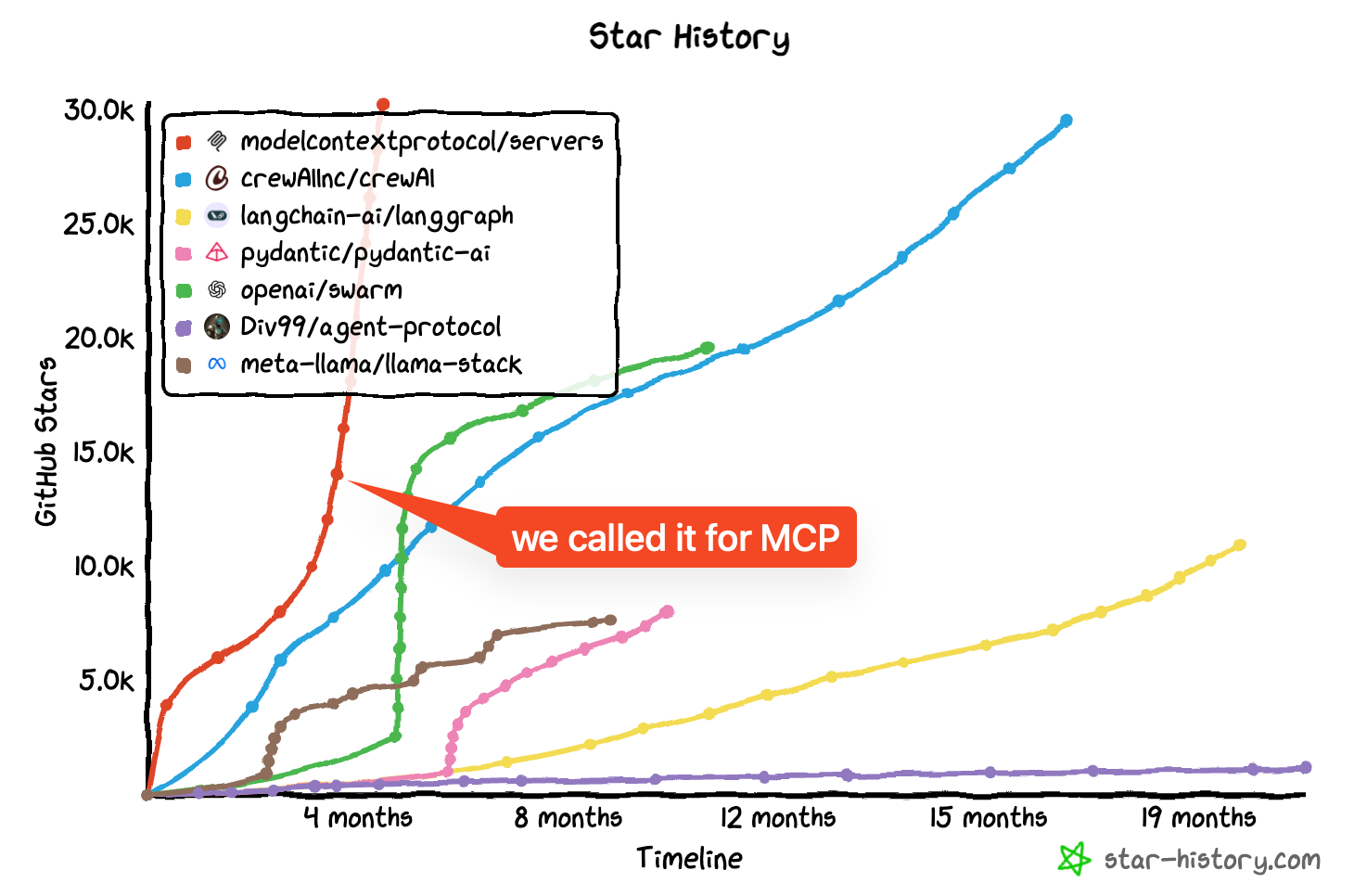
The Creators of Model Context Protocol
We are happy to announce that there will be a dedicated MCP track at the 2025 AI Engineer World's Fair, taking place Jun 3rd to 5th in San Francisco, where the MCP core team and major contributors and builders will be meeting. Join us and apply to speak or sponsor!
When we first wrote Why MCP Won, we had no idea how quickly it was about to win.
In the past 4 weeks, OpenAI and now Google have now announced the MCP support, effectively confirming our prediction that MCP was the presumptive winner of the agent standard wars. MCP has now overtaken OpenAPI, the incumbent option and most direct alternative, in GitHub stars (3 months ahead of conservative trendline):
We have explored the state of MCP at AIE (now the first ever >100k views workshop):
And since then, we’ve added a 7th reason why MCP won - this team acts very quickly on feedback, with the 2025-03-26 spec update adding support for stateless/resumable/streamable HTTP transports, and comprehensive authz capabilities based on OAuth 2.1.
This bodes very well for the future of the community and project.
For protocol and history nerds, we also asked David and Justin to tell the origin story of MCP, which we leave to the reader to enjoy (you can also skim the transcripts, or, the changelogs of a certain favored IDE). It’s incredible the impact that individual engineers solving their own problems can have on an entire industry.
Full video episode
Like and subscribe on YouTube!
Show Links
* David
* Justin
* MCP
Timestamps
* 00:00 Introduction and Guest Welcome
* 00:37 What is MCP?
* 02:00 The Origin Story of MCP
* 05:18 Development Challenges and Solutions
* 08:06 Technical Details and Inspirations
* 29:45 MCP vs Open API
* 32:48 Building MCP Servers
* 40:39 Exploring Model Independence in LLMs
* 41:36 Building Richer Systems with MCP
* 43:13 Understanding Agents in MCP
* 45:45 Nesting and Tool Confusion in MCP
* 49:11 Client Control and Tool Invocation
* 52:08 Authorization and Trust in MCP Servers
* 01:01:34 Future Roadmap and Stateless Servers
* 01:10:07 Open Source Governance and Community Involvement
* 01:18:12 Wishlist and Closing Remarks
Transcript
Alessio [00:00:02]: Hey, everyone. Welcome back to Latent Space. This is Alessio, partner and CTO at Decibel, and I'm joined by my co-host Swyx, founder of Small AI.
swyx [00:00:10]: Hey, morning. And today we have a remote recording, I guess, with David and Justin from Anthropic over in London. Welcome. Hey, good You guys have created a storm of hype because of MCP, and I'm really glad to have you on. Thanks for making the time. What is MCP? Let's start with a crisp what definition from the horse's mouth, and then we'll go into the origin story. But let's start off right off the bat. What is MCP?
Justin/David [00:00:43]: Yeah, sure. So Model Context Protocol, or MCP for short, is basically something we've designed to help AI applications extend themselves or integrate with an ecosystem of plugins, basically. The terminology is a bit different. We use this client-server terminology, and we can talk about why that is and where that came from. But at the end of the day, it really is that. It's like extending and enhancing the functionality of AI application.
swyx [00:01:05]: David, would you add anything?
Justin/David [00:01:07]: Yeah, I think that's actually a good description. I think there's like a lot of different ways for how people are trying to explain it. But at the core, I think what Justin said is like extending AI applications is really what this is about. And I think the interesting bit here that I want to highlight, it's AI applications and not models themselves that this is focused on. That's a common misconception that we can talk about a bit later. But yeah. Another version that we've used and gotten to like is like MCP is kind of like the USB-C port of AI applications and that it's meant to be this universal connector to a whole ecosystem of things.
swyx [00:01:44]: Yeah. Specifically, an interesting feature is, like you said, the client and server. And it's a sort of two-way, right? Like in the same way that said a USB-C is two-way, which could be super interesting. Yeah, let's go into a little bit of the origin story. There's many people who've tried to make statistics. There's many people who've tried to build open source. I think there's an overall, also, my sense is that Anthropic is going hard after developers in the way that other labs are not. And so I'm also curious if there was any external influence or was it just you two guys just in a room somewhere riffing?
Justin/David [00:02:18]: It is actually mostly like us two guys in a room riffing. So this is not part of a big strategy. You know, if you roll back time a little bit and go into like July 2024. I was like, started. I started at Anthropic like three months earlier or two months earlier. And I was mostly working on internal developer tooling, which is what I've been doing for like years and years before. And as part of that, I think there was an effort of like, how do I empower more like employees at Anthropic to use, you know, to integrate really deeply with the models we have? Because we've seen these, like, how good it is, how amazing it will become even in the future. And of course, you know, just dogfoot your own model as much as you can. And as part of that. From my development tooling background, I quickly got frustrated by the idea that, you know, on one hand side, I have Cloud Desktop, which is this amazing tool with artifacts, which I really enjoyed. But it was very limited to exactly that feature set. And it was there was no way to extend it. And on the other hand side, I like work in IDEs, which could greatly like act on like the file system and a bunch of other things. But then they don't have artifacts or something like that. And so what I constantly did was just copy. Things back and forth on between Cloud Desktop and the IDE, and that quickly got me, honestly, just very frustrated. And part of that frustration wasn't like, how do I go and fix this? What, what do we need? And back to like t
You May Also Like

Theo - t3․gg
Theo - t3․gg

All-In with Chamath, Jason, Sacks & Friedberg
All-In Podcast, LLC

Artificial Intelligence Masterclass
AI Masterclass

The Daily AI Show
The Daily AI Show Crew - Brian, Beth, Jyunmi, Andy and Karl

CriptoMonedas TV
CriptoMonedas TV

Jack Hopkins
Jack Hopkins
MacMagazine no Ar
MacMagazine.com.br
AI Unraveled: Latest AI News & Trends, ChatGPT, Gemini, DeepSeek, Gen AI, LLMs, Agents, Ethics, Bias
Etienne Noumen

AI News Daily
brief.news

Security Weekly Podcast Network (Audio)
Security Weekly Productions
Theo - t3․gg
Theo - t3․gg
All-In with Chamath, Jason, Sacks & Friedberg
All-In Podcast, LLC
Artificial Intelligence Masterclass
AI Masterclass
The Daily AI Show
The Daily AI Show Crew - Brian, Beth, Jyunmi, Andy and Karl
CriptoMonedas TV
CriptoMonedas TV
Jack Hopkins
Jack Hopkins
MacMagazine no Ar
MacMagazine.com.br
AI Unraveled: Latest AI News & Trends, ChatGPT, Gemini, DeepSeek, Gen AI, LLMs, Agents, Ethics, Bias
Etienne Noumen
AI News Daily
brief.news
Security Weekly Podcast Network (Audio)
Security Weekly Productions
Community discussion