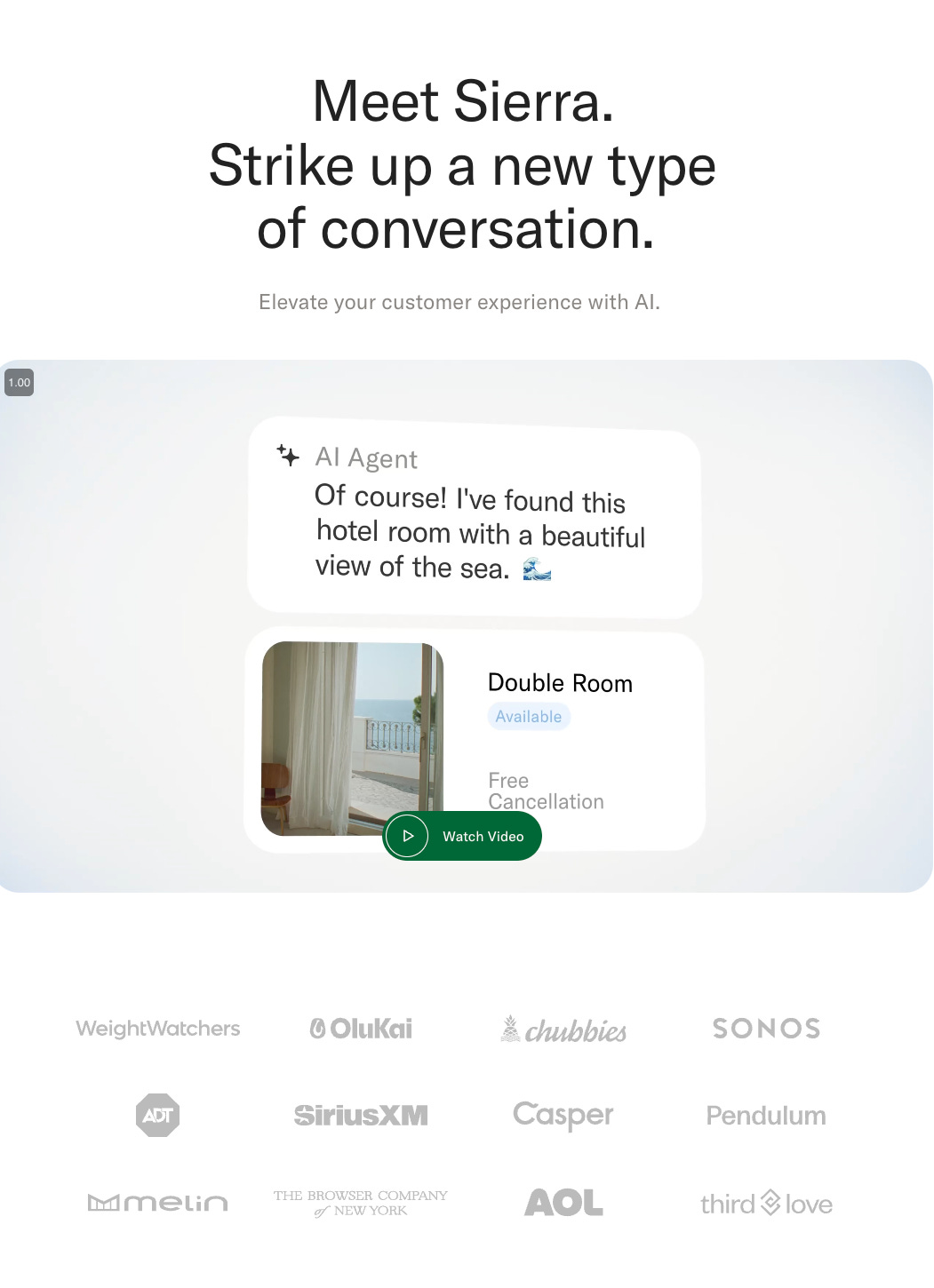
The AI Architect — Bret Taylor
If you’re in SF, join us tomorrow for a fun meetup at CodeGen Night!
If you’re in NYC, join us for AI Engineer Summit! The Agent Engineering track is now sold out, but 25 tickets remain for AI Leadership and 5 tickets for the workshops. You can see the full schedule of speakers and workshops at https://ai.engineer!
It’s exceedingly hard to introduce someone like Bret Taylor. We could recite his Wikipedia page, or his extensive work history through Silicon Valley’s greatest companies, but everyone else already does that.
As a podcast by AI engineers for AI engineers, we had the opportunity to do something a little different. We wanted to dig into what Bret sees from his vantage point at the top of our industry for the last 2 decades, and how that explains the rise of the AI Architect at Sierra, the leading conversational AI/CX platform.
“Across our customer base, we are seeing a new role emerge - the role of the AI architect. These leaders are responsible for helping define, manage and evolve their company's AI agent over time. They come from a variety of both technical and business backgrounds, and we think that every company will have one or many AI architects managing their AI agent and related experience.”
In our conversation, Bret Taylor confirms the Paul Buchheit legend that he rewrote Google Maps in a weekend, armed with only the help of a then-nascent Google Closure Compiler and no other modern tooling. But what we find remarkable is that he was the PM of Maps, not an engineer, though of course he still identifies as one. We find this theme recurring throughout Bret’s career and worldview. We think it is plain as day that AI leadership will have to be hands-on and technical, especially when the ground is shifting as quickly as it is today:
“There's a lot of power in combining product and engineering into as few people as possible… few great things have been created by committee.”
“If engineering is an order taking organization for product you can sometimes make meaningful things, but rarely will you create extremely well crafted breakthrough products. Those tend to be small teams who deeply understand the customer need that they're solving, who have a maniacal focus on outcomes.”
“And I think the reason why is if you look at like software as a service five years ago, maybe you can have a separation of product and engineering because most software as a service created five years ago. I wouldn't say there's like a lot of technological breakthroughs required for most business applications. And if you're making expense reporting software or whatever, it's useful… You kind of know how databases work, how to build auto scaling with your AWS cluster, whatever, you know, it's just, you're just applying best practices to yet another problem.
"When you have areas like the early days of mobile development or the early days of interactive web applications, which I think Google Maps and Gmail represent, or now AI agents, you're in this constant conversation with what the requirements of your customers and stakeholders are and all the different people interacting with it and the capabilities of the technology. And it's almost impossible to specify the requirements of a product when you're not sure of the limitations of the technology itself.”
This is the first time the difference between technical leadership for “normal” software and for “AI” software was articulated this clearly for us, and we’ll be thinking a lot about this going forward. We left a lot of nuggets in the conversation, so we hope you’ll just dive in with us (and thank Bret for joining the pod!)
Full YouTube
Timestamps
* 00:00:02 Introductions and Bret Taylor's background
* 00:01:23 Bret's experience at Stanford and the dot-com era
* 00:04:04 The story of rewriting Google Maps backend
* 00:11:06 Early days of interactive web applications at Google
* 00:15:26 Discussion on product management and engineering roles
* 00:21:00 AI and the future of software development
* 00:26:42 Bret's approach to identifying customer needs and building AI companies
* 00:32:09 The evolution of business models in the AI era
* 00:41:00 The future of programming languages and software development
* 00:49:38 Challenges in precisely communicating human intent to machines
* 00:56:44 Discussion on Artificial General Intelligence (AGI) and its impact
* 01:08:51 The future of agent-to-agent communication
* 01:14:03 Bret's involvement in the OpenAI leadership crisis
* 01:22:11 OpenAI's relationship with Microsoft
* 01:23:23 OpenAI's mission and priorities
* 01:27:40 Bret's guiding principles for career choices
* 01:29:12 Brief discussion on pasta-making
* 01:30:47 How Bret keeps up with AI developments
* 01:32:15 Exciting research directions in AI
* 01:35:19 Closing remarks and hiring at Sierra
Transcript
[00:02:05] Introduction and Guest Welcome
[00:02:05] Alessio: Hey everyone, welcome to the Latent Space Podcast. This is Alessio, partner and CTO at Decibel Partners, and I'm joined by my co host swyx, founder of smol.ai.
[00:02:17] swyx: Hey, and today we're super excited to have Bret Taylor join us. Welcome. Thanks for having me. It's a little unreal to have you in the studio.
[00:02:25] swyx: I've read about you so much over the years, like even before. Open AI effectively. I mean, I use Google Maps to get here. So like, thank you for everything that you've done. Like, like your story history, like, you know, I think people can find out what your greatest hits have been.
[00:02:40] Bret Taylor's Early Career and Education
[00:02:40] swyx: How do you usually like to introduce yourself when, you know, you talk about, you summarize your career, like, how do you look at yourself?
[00:02:47] Bret: Yeah, it's a great question. You know, we, before we went on the mics here, we're talking about the audience for this podcast being more engineering. And I do think depending on the audience, I'll introduce myself differently because I've had a lot of [00:03:00] corporate and board roles. I probably self identify as an engineer more than anything else though.
[00:03:04] Bret: So even when I was. Salesforce, I was coding on the weekends. So I think of myself as an engineer and then all the roles that I do in my career sort of start with that just because I do feel like engineering is sort of a mind
You May Also Like

CISO Insights: Voices in Cybersecurity
CISO Marketplace

a16z Show
Andreessen Horowitz

Jak Piggott
Jak Piggott
ChatGPT - Sol Good Shorts
Sol Good Network

Theo - t3․gg
Theo - t3․gg

Mark Tilbury
Mark Tilbury Fan

ITSPmagazine
ITSPmagazine, Sean Martin, Marco Ciappelli

ゆるコンピュータ科学ラジオ
pedantic

User Friendly - The Podcast
User Friendly Productions

Artificial Intelligence Masterclass
AI Masterclass
CISO Insights: Voices in Cybersecurity
CISO Marketplace
a16z Show
Andreessen Horowitz
Jak Piggott
Jak Piggott
ChatGPT - Sol Good Shorts
Sol Good Network
Theo - t3․gg
Theo - t3․gg
Mark Tilbury
Mark Tilbury Fan
ITSPmagazine
ITSPmagazine, Sean Martin, Marco Ciappelli
ゆるコンピュータ科学ラジオ
pedantic
User Friendly - The Podcast
User Friendly Productions
Artificial Intelligence Masterclass
AI Masterclass
Community discussion