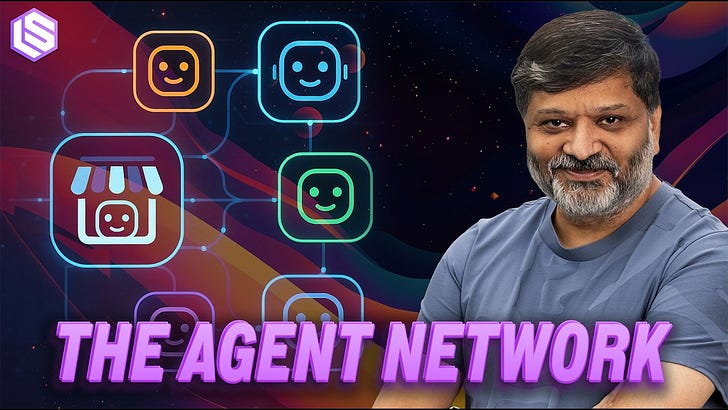
The Agent Network — Dharmesh Shah
If you’re in SF: Join us for the Claude Plays Pokemon hackathon this Sunday!
If you’re not: Fill out the 2025 State of AI Eng survey for $250 in Amazon cards!
For this episode: Thanks to Matija and Dan and Meng Shao for sharing on socials.
We are SO excited to share our conversation with Dharmesh Shah, co-founder of HubSpot and creator of Agent.ai.
A particularly compelling concept we discussed is the idea of "hybrid teams" - the next evolution in workplace organization where human workers collaborate with AI agents as team members. Just as we previously saw hybrid teams emerge in terms of full-time vs. contract workers, or in-office vs. remote workers, Dharmesh predicts that the next frontier will be teams composed of both human and AI members. This raises interesting questions about team dynamics, trust, and how to effectively delegate tasks between human and AI team members.
The discussion of business models in AI reveals an important distinction between Work as a Service (WaaS) and Results as a Service (RaaS), something Dharmesh has written extensively about. While RaaS has gained popularity, particularly in customer support applications where outcomes are easily measurable, Dharmesh argues that this model may be over-indexed. Not all AI applications have clearly definable outcomes or consistent economic value per transaction, making WaaS more appropriate in many cases. This insight is particularly relevant for businesses considering how to monetize AI capabilities.
The technical challenges of implementing effective agent systems are also explored, particularly around memory and authentication. Shah emphasizes the importance of cross-agent memory sharing and the need for more granular control over data access. He envisions a future where users can selectively share parts of their data with different agents, similar to how OAuth works but with much finer control. This points to significant opportunities in developing infrastructure for secure and efficient agent-to-agent communication and data sharing.
Other highlights from our conversation
* The Evolution of AI-Powered Agents – Exploring how AI agents have evolved from simple chatbots to sophisticated multi-agent systems, and the role of MCPs in enabling that.
* Hybrid Digital Teams and the Future of Work – How AI agents are becoming teammates rather than just tools, and what this means for business operations and knowledge work.
* Memory in AI Agents – The importance of persistent memory in AI systems and how shared memory across agents could enhance collaboration and efficiency.
* Business Models for AI Agents – Exploring the shift from software as a service (SaaS) to work as a service (WaaS) and results as a service (RaaS), and what this means for monetization.
* The Role of Standards Like MCP – Why MCP has been widely adopted and how it enables agent collaboration, tool use, and discovery.
* The Future of AI Code Generation and Software Engineering – How AI-assisted coding is changing the role of software engineers and what skills will matter most in the future.
* Domain Investing and Efficient Markets – Dharmesh’s approach to domain investing and how inefficiencies in digital asset markets create business opportunities.
* The Philosophy of Saying No – Lessons from "Sorry, Must Pass" and how prioritization leads to greater productivity and focus.
Full Video Episode
on youtube!
Timestamps
* 00:00 Introduction and Guest Welcome
* 02:29 Dharmesh Shah's Journey into AI
* 05:22 Defining AI Agents
* 06:45 The Evolution and Future of AI Agents
* 13:53 Graph Theory and Knowledge Representation
* 20:02 Engineering Practices and Overengineering
* 25:57 The Role of Junior Engineers in the AI Era
* 28:20 Multi-Agent Systems and MCP Standards
* 35:55 LinkedIn's Legal Battles and Data Scraping
* 37:32 The Future of AI and Hybrid Teams
* 39:19 Building Agent AI: A Professional Network for Agents
* 40:43 Challenges and Innovations in Agent AI
* 45:02 The Evolution of UI in AI Systems
* 01:00:25 Business Models: Work as a Service vs. Results as a Service
* 01:09:17 The Future Value of Engineers
* 01:09:51 Exploring the Role of Agents
* 01:10:28 The Importance of Memory in AI
* 01:11:02 Challenges and Opportunities in AI Memory
* 01:12:41 Selective Memory and Privacy Concerns
* 01:13:27 The Evolution of AI Tools and Platforms
* 01:18:23 Domain Names and AI Projects
* 01:32:08 Balancing Work and Personal Life
* 01:35:52 Final Thoughts and Reflections
Transcript
Alessio [00:00:04]: Hey everyone, welcome back to the Latent Space podcast. This is Alessio, partner and CTO at Decibel Partners, and I'm joined by my co-host Swyx, founder of Small AI.
swyx [00:00:12]: Hello, and today we're super excited to have Dharmesh Shah to join us. I guess your relevant title here is founder of Agent AI.
Dharmesh [00:00:20]: Yeah, that's true for this. Yeah, creator of Agent.ai and co-founder of HubSpot.
swyx [00:00:25]: Co-founder of HubSpot, which I followed for many years, I think 18 years now, gonna be 19 soon. And you caught, you know, people can catch up on your HubSpot story elsewhere. I should also thank Sean Puri, who I've chatted with back and forth, who's been, I guess, getting me in touch with your people. But also, I think like, just giving us a lot of context, because obviously, My First Million joined you guys, and they've been chatting with you guys a lot. So for the business side, we can talk about that, but I kind of wanted to engage your CTO, agent, engineer side of things. So how did you get agent religion?
Dharmesh [00:01:00]: Let's see. So I've been working, I'll take like a half step back, a decade or so ago, even though actually more than that. So even before HubSpot, the company I was contemplating that I had named for was called Ingenisoft. And the idea behind Ingenisoft was a natural language interface to business software. Now realize this is 20 years ago, so that was a hard thing to do. But the actual use case that I had in mind was, you know, we had data sitting in business systems like a CRM or something like that. And my kind of what I thought clever at the time. Oh, what if we used email as the kind of interface to get to business software? And the motivation for using email is that it automatically works when you're offline. So imagine I'm getting on a plane or I'm on a plane. There was no internet on planes back then. It's like, oh, I'm going through business cards from an event I went to. I can just type things into an email just to have them all
You May Also Like

Theo - t3․gg
Theo - t3․gg

Jak Piggott
Jak Piggott

Elon Musk Podcast
Stage Zero

The Honest Money Show
Anja Dragovic

The Everything Feed - All Packet Pushers Pods
Packet Pushers Team

The Fat Pipe - Most Popular Packet Pushers Pods
Packet Pushers

Kavanozdaki Yıldız
Apaçık Radyo

Jack Hopkins
Jack Hopkins

Mark Tilbury
Mark Tilbury Fan

Tech Brew Ride Home
Morning Brew
Theo - t3․gg
Theo - t3․gg
Jak Piggott
Jak Piggott
Elon Musk Podcast
Stage Zero
The Honest Money Show
Anja Dragovic
The Everything Feed - All Packet Pushers Pods
Packet Pushers Team
The Fat Pipe - Most Popular Packet Pushers Pods
Packet Pushers
Kavanozdaki Yıldız
Apaçık Radyo
Jack Hopkins
Jack Hopkins
Mark Tilbury
Mark Tilbury Fan
Tech Brew Ride Home
Morning Brew
Community discussion