SF Compute: Commoditizing Compute to solve the GPU Bubble forever
We are calling for the world’s best AI Engineer talks for AI Architects, /r/localLlama, Model Context Protocol (MCP), GraphRAG, AI in Action, Evals, Agent Reliability, Reasoning and RL, Retrieval/Search/RecSys , Security, Infrastructure, Generative Media, AI Design & Novel AI UX, AI Product Management, Autonomy, Robotics, and Embodied Agents, Computer-Using Agents (CUA), SWE Agents, Vibe Coding, Voice, Sales/Support Agents at AIEWF 2025! Fill out the 2025 State of AI Eng survey for $250 in Amazon cards and see you from Jun 3-5 in SF!
Coreweave’s now-successful IPO has led to a lot of questions about the GPU Neocloud market, which Dylan Patel has written extensively about on SemiAnalysis. Understanding markets requires an interesting mix of technical and financial expertise, so this will be a different kind of episode than our usual LS domain.
When we first published $2 H100s: How the GPU Rental Bubble Burst, we got 2 kinds of reactions on Hacker News:
* “Ah, now the AI bubble is imploding!”
* “Duh, this is how it works in every GPU cycle, are you new here?”
We don’t think either reaction is quite right. Specifically, it is not normal for the prices of one of the world’s most important resources right now to swing from $1 to $8 per hour based on drastically inelastic demand AND supply curves - from 3 year lock-in contracts to stupendously competitive over-ordering dynamics for NVIDIA allocations — especially with increasing baseline compute needed for even the simplest academic ML research and for new AI startups getting off the ground.
We’re fortunate today to have Evan Conrad, CEO of SFCompute, one of the most exciting GPU marketplace startups, talk us through his theory of the economics of GPU markets, and why he thinks CoreWeave and Modal are well positioned, but Digital Ocean and Together are not.
However, more broadly, the entire point of SFC is creating liquidity between GPU owners and consumers and making it broadly tradable, even programmable:
As we explore, these are the primitives that you can then use to create your own, high quality, custom GPU availability for your time and money budget, similar to how Amazon Spot Instances automated the selective buying of unused compute.
The ultimate end state of where all this is going is GPU that trade like other perishable, staple commodities of the world - oil, soybeans, milk. Because the contracts and markets are so well established, the price swings also are not nearly as drastic, and people can also start hedging and managing the risk of one of the biggest costs of their business, just like we have risk-managed commodities risks of all other sorts for centuries. As a former derivatives trader, you can bet that swyx doubleclicked on that…
Show Notes
Full Video Pod
Timestamps
* [00:00:05] Introductions
* [00:00:12] Introduction of guest Evan Conrad from SF Compute
* [00:00:12] CoreWeave Business Model Discussion
* [00:05:37] CoreWeave as a Real Estate Business
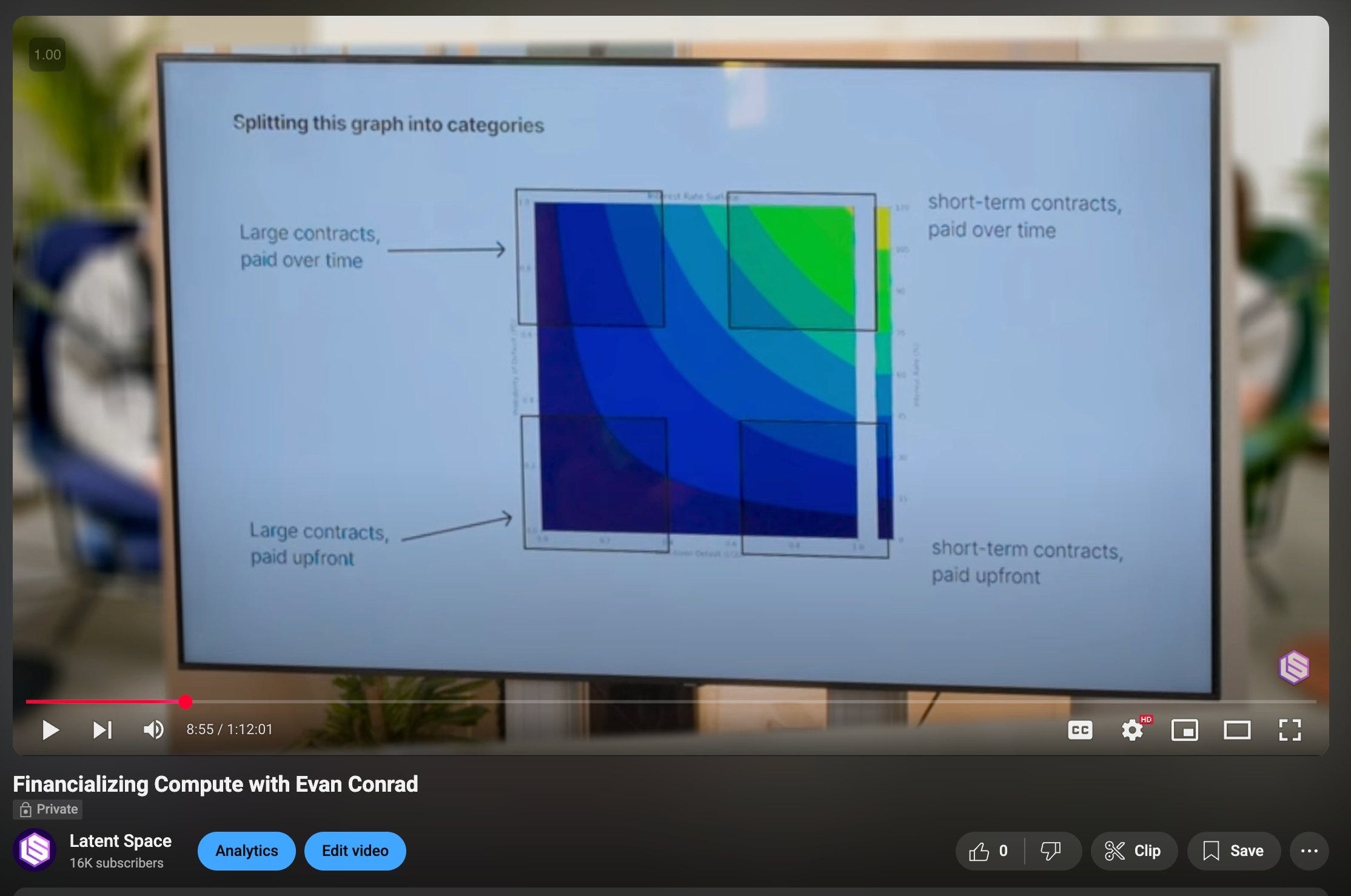
* [00:08:59] Interest Rate Risk and GPU Market Strategy Framework
* [00:16:33] Why Together and DigitalOcean will lose money on their clusters
* [00:20:37] SF Compute's AI Lab Origins
* [00:25:49] Utilization Rates and Benefits of SF Compute Market Model
* [00:30:00] H100 GPU Glut, Supply Chain Issues, and Future Demand Forecast
* [00:34:00] P2P GPU networks
* [00:36:50] Customer stories
* [00:38:23] VC-Provided GPU Clusters and Credit Risk Arbitrage
* [00:41:58] Market Pricing Dynamics and Preemptible GPU Pricing Model
* [00:48:00] Future Plans for Financialization?
* [00:52:59] Cluster auditing and quality control
* [00:58:00] Futures Contracts for GPUs
* [01:01:20] Branding and Aesthetic Choices Behind SF Compute
* [01:06:30] Lessons from Previous Startups
* [01:09:07] Hiring at SF Compute
Transcript
Alessio [00:00:05]: Hey everyone, welcome to the Latent Space podcast. This is Alessio, partner and CTO at Decibel, and I'm joined by my co-host Swyx, founder of Smol AI.
Swyx [00:00:12]: Hey, and today we're so excited to be finally in the studio with Evan Conrad from SF Compute. Welcome. I've been fortunate enough to be your friend before you were famous, and also we've hung out at various social things. So it's really cool to see that SF Compute is coming into its own thing, and it's a significant presence, at least in the San Francisco community, which of course, it's in the name, so you couldn't help but be.
Evan: Indeed, indeed. I think we have a long way to go, but yeah, thanks.
Swyx: Of course, yeah. One way I was thinking about kicking on this conversation is we will likely release this right after CoreWeave IPO. And I was watching, I was looking, doing some research on you. You did a talk at The Curve. I think I may have been viewer number 70. It was a great talk. More people should go see it, Evan Conrad at The Curve. But we have like three orders of magnitude more people. And I just wanted to, to highlight, like, what is your analysis of what CoreWeave did that went so right for them?
Evan: Sell locked-in long-term contracts and don't really do much short-term at all. I think like a lot of people had this assumption that GPUs would work a lot like CPUs and the like standard business model of any sort of CPU cloud is you buy commodity hardware, then you lay on services that are mostly software, and that gives you high margins and pretty much all your value comes from those services. Not really the underlying. Compute in any capacity and because it's commodity hardware and it's not actually that expensive, most of that can be sort of on-demand compute. And while you do want locked-in contracts for folks, it's mostly just a sort of de-risk situation. It helps you plan revenue because you don't know if people are going to scale up or down. But fundamentally, people are like buying hourly and that's how your business is structured and you make 50 percent margins or higher. This like doesn't really work in GPUs. And the reason why it doesn't work is because you end up with like super price sensitive customers. And that isn't because necessari
You May Also Like

Semiconductor Insiders
SemiWiki

No Tiene Nombre
elbruno

Artificial Intelligence Masterclass
AI Masterclass

The Vergecast
The Verge
EasyApple
EasyPodcast

Radio Miraya
Radio Miraya

Eye On A.I.
Craig S. Smith
Nodesignal - Deine Bitcoin-Frequenz
Die Nodesignal Crew

Jack Hopkins
Jack Hopkins

Mark Tilbury
Mark Tilbury Fan
Semiconductor Insiders
SemiWiki
No Tiene Nombre
elbruno
Artificial Intelligence Masterclass
AI Masterclass
The Vergecast
The Verge
EasyApple
EasyPodcast
Radio Miraya
Radio Miraya
Eye On A.I.
Craig S. Smith
Nodesignal - Deine Bitcoin-Frequenz
Die Nodesignal Crew
Jack Hopkins
Jack Hopkins
Mark Tilbury
Mark Tilbury Fan
Community discussion