NeurIPS 2023 Recap — Best Papers
We are running an end of year listener survey! Please let us know any feedback you have, what episodes resonated with you, and guest requests for 2024! Survey link here.
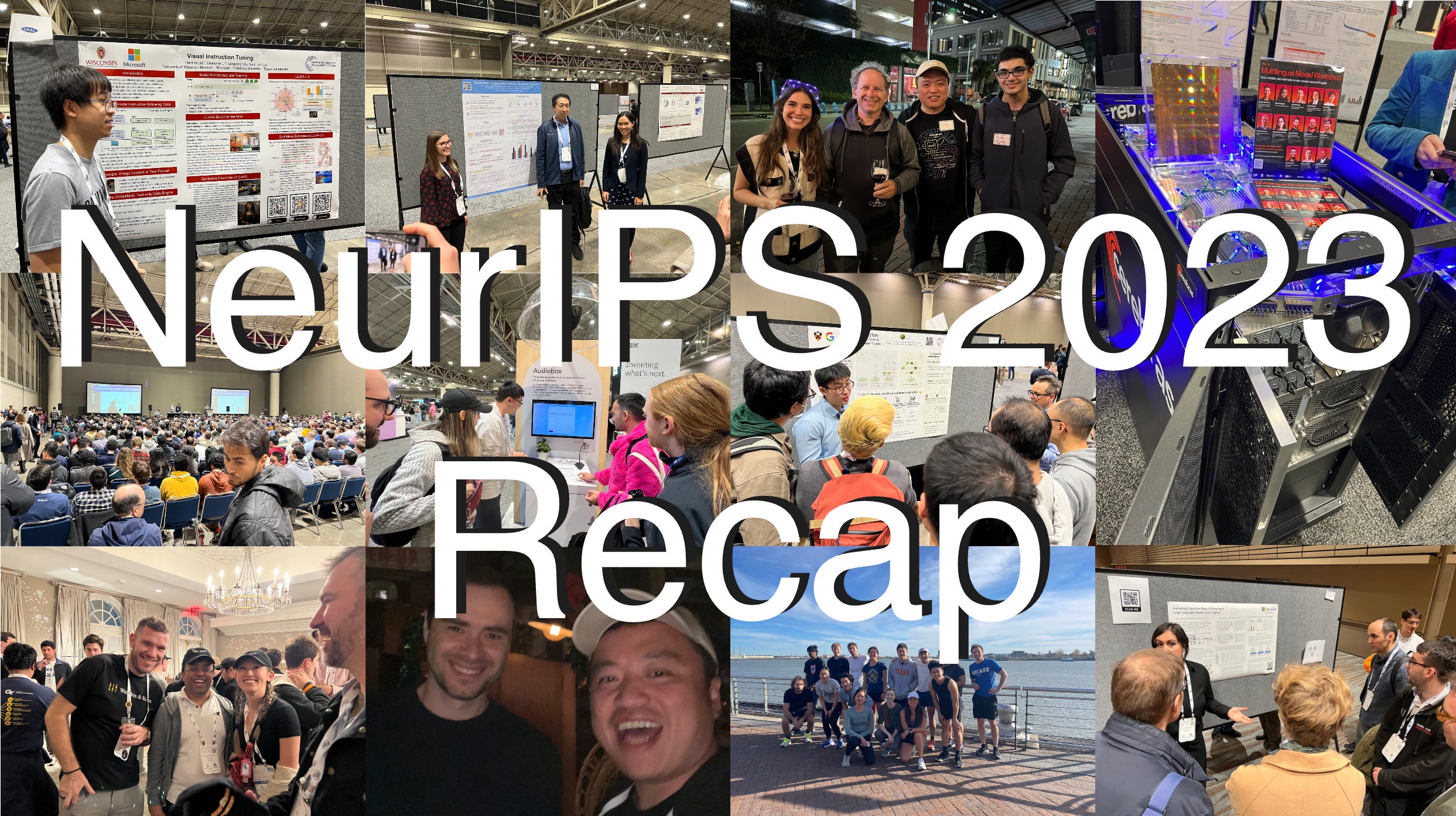
NeurIPS 2023 took place from Dec 10–16 in New Orleans. The Latent Space crew was onsite for as many of the talks and workshops as we could attend (and more importantly, hosted cocktails and parties after hours)!
Picking from the 3586 papers accepted to the conference (available online, full schedule here) is an impossible task, but we did our best to present an audio guide with brief commentary on each. We also recommend MLContests.com NeurIPS recap and Seb Ruder’s NeurIPS primer and Jerry Liu’s paper picks. We also found the VizHub guide useful for a t-SNE clustering of papers. Lots also happened in the arxiv publishing world outside NeurIPS, as highlighted by Karpathy, especially DeepMind’s Beyond Human Data: Scaling Self-Training for Problem-Solving with Language Models.
Jan 2024 update: we also strongly recommend Sebastian Raschka, PhD ‘s pick of the year’s 10 best papers, including Pythia.
We’ll start with the NeurIPS Best Paper Awards, and then go to a selection of non-awarded but highly influential papers, and then arbitrary personal picks to round out the selection. Where we were able to do a poster session interview, please scroll to the relevant show notes for images of their poster for discussion. We give Chris Ré the last word due to the Mamba and StripedHyena state space models drawing particular excitement but still being too early to assess impact.
Timestamps
* [0:01:19] Word2Vec (Jeff Dean, Greg Corrado)
* [0:15:28] Emergence Mirage (Rylan Schaeffer)
* [0:28:48] DPO (Rafael Rafailov)
* [0:41:36] DPO Poster Session (Archit Sharma)
* [0:52:03] Datablations (Niklas Muennighoff)
* [1:00:50] QLoRA (Tim Dettmers)
* [1:12:23] DataComp (Samir Gadre)
* [1:25:38] DataComp Poster Session (Samir Gadre, Alex Dimakis)
* [1:35:25] LLaVA (Haotian Liu)
* [1:47:21] LLaVA Poster Session (Haotian Liu)
* [1:59:19] Tree of Thought (Shunyu Yao)
* [2:11:27] Tree of Thought Poster Session (Shunyu Yao)
* [2:20:09] Toolformer (Jane Dwivedi-Yu)
* [2:32:26] Voyager (Guanzhi Wang)
* [2:45:14] CogEval (Ida Momennejad)
* [2:59:41] State Space Models (Chris Ré)
Papers covered
* Distributed Representations of Words and Phrases and their Compositionality (Word2Vec) Tomas Mikolov · Ilya Sutskever · Kai Chen · Greg Corrado · Jeff Dean. The recently introduced continuous Skip-gram model is an efficient method for learning high-quality distributed vector representations that capture a large number of precise syntactic and semantic word relationships. In this paper we present several improvements that make the Skip-gram model more expressive and enable it to learn higher quality vectors more rapidly. We show that by subsampling frequent words we obtain significant speedup, and also learn higher quality representations as measured by our tasks. We also introduce Negative Sampling, a simplified variant of Noise Contrastive Estimation (NCE) that learns more accurate vectors for frequent words compared to the hierarchical softmax. An inherent limitation of word representations is their indifference to word order and their inability to represent idiomatic phrases. For example, the meanings of Canada'' and "Air'' cannot be easily combined to obtain "Air Canada''. Motivated by this example, we present a simple and efficient method for finding phrases, and show that their vector representations can be accurately learned by the Skip-gram model.
* Some notable reflections from Tomas Mikolov - and debate over the Seq2Seq paper credit with Quoc Le
* Are Emergent Abilities of Large Language Models a Mirage? (Schaeffer et al.). Emergent abilities are abilities that are present in large-scale models but not in smaller models and are hard to predict. Rather than being a product of models’ scaling behavior, this paper argues that emergent abilities are mainly an artifact of the choice of metric used to evaluate them. Specifically, nonlinear and discontinuous metrics can lead to sharp and unpredictable changes in model performance. Indeed, the authors find that when accuracy is changed to a continuous metric for arithmetic tasks where emergent behavior was previously observed, performance improves smoothly instead. So while emergent abilities may still exist, they should be properly controlled and researchers should consider how the chosen metric interacts with the model.
* Direct Preference Optimization: Your Language Model is Secretly a Reward Model (Rafailov et al.)
* While large-scale unsupervised language models (LMs) learn broad world knowledge and some reasoning skills, achieving precise control of their behavior is difficult due to the completely unsupervised nature of their training. Existing methods for gaining such steerability collect human labels of the relative quality of model generations and fine-tune the unsupervised LM to align with these preferences, often with reinforcement learning from human feedback (RLHF). However, RLHF is a complex and often unstable procedure, first fitting a reward model that reflects the human preferences, and then fine-tuning the large unsupervised LM using reinforcement learning to maximize this estimated reward without drifting too far from the original model.
* In this paper, we leverage a mapping between rewar
You May Also Like

Daily Tech News Show
Tom Merritt

Artificial Intelligence Masterclass
AI Masterclass

Theo - t3․gg
Theo - t3․gg

Mark Tilbury
Mark Tilbury Fan

Programming Tech Brief By HackerNoon
HackerNoon

Bitcoin Magazine Podcast
BTC Media

Lenny's Podcast: Product | Career | Growth
Lenny Rachitsky

CISO Insights: Voices in Cybersecurity
CISO Marketplace

a16z Show
Andreessen Horowitz

Jak Piggott
Jak Piggott
Daily Tech News Show
Tom Merritt
Artificial Intelligence Masterclass
AI Masterclass
Theo - t3․gg
Theo - t3․gg
Mark Tilbury
Mark Tilbury Fan
Programming Tech Brief By HackerNoon
HackerNoon
Bitcoin Magazine Podcast
BTC Media
Lenny's Podcast: Product | Career | Growth
Lenny Rachitsky
CISO Insights: Voices in Cybersecurity
CISO Marketplace
a16z Show
Andreessen Horowitz
Jak Piggott
Jak Piggott
Community discussion